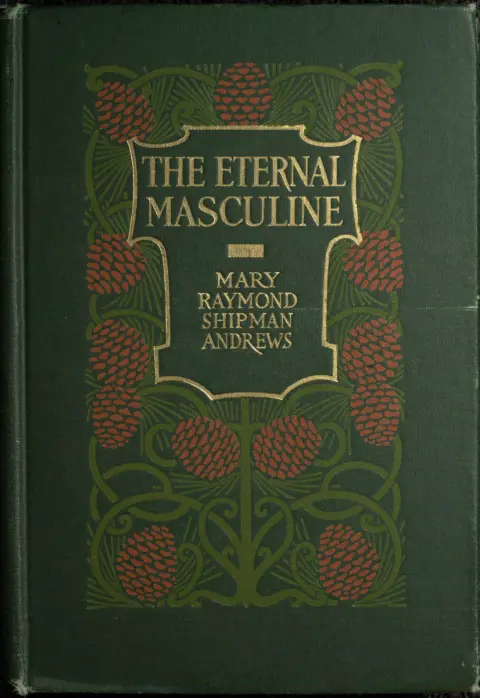
The eternal masculine
Mary Raymond Shipman Andrews
THE CLASSIC COLLECTION · 1911
"The Courage of the Commonplace" by Mary Raymond Shipman Andrews is a novel written during the early 20th century. It revolves around the social dynamics at Yale University during a pivotal event called "Tap Day," where junior class members are selected for prestigious senior societies. The narrative explores themes of ambition, self-worth, and the pressures young men face as they seek approval and recognition from their peers. The story primarily follows Johnny McLean, a junior at Yale who struggles with feelings of inadequacy and fear of failure, especially during the emotionally charged Tap Day. As he and his classmates await their fate, Johnny's concerns reflect a broader commentary on the nature of success and honor within elite circles. Johnny does not get tapped, leading him into a period of reflection, ultimately spurring him to embrace hard work and personal growth. After graduating, he becomes a superintendent at a mine where he demonstrates remarkable courage during a crisis, stepping up to guide his trapped coworkers to safety. Ultimately, he earns not only the admiration of his peers but also reignites a romantic connection with a girl he once respected, bringing redemption and fulfillment to his earlier disappointments. The novel powerfully illustrates the idea that the courage to face everyday challenges can lead to extraordinary accomplishments.
Introduction adapted from the source catalogue; source summaries may be automatically generated.
Free to read · English · 10,882 words · No account needed
MAKE TIME FOR A GOOD BOOK
On by default. Untick to stop anonymous reading totals. Each page counts after 10 seconds in view. How this works.
Anonymous counting is on unless you have switched it off.
"Men of the class of --," the president began, in his deep, characteristic intonations, "I know that there is only one name you want to hear me speak; only one thought in all the minds of your class."
A hoarse murmur which a second's growth would have made into a wild shout started in the throats of the massed men behind the class banner. The president held up his hand.
"Wait a minute. We want that cheer; we'll have it; but I've got a word first. A great speaker who talked to you boys in your college course said a thing that came to my mind to-day. 'The courage of the commonplace,' he said, 'is greater than the courage of the crisis.'"
Again that throaty, threatening growl, and again the president's hand went up--the boys were hard to hold.
"I see a man among you whose life has added a line to that saying, who has shown to the world that it is the courage of the commonplace which trains for the courage of the crisis. And that's all I've got to say, for the nation is saying the rest--except three times three for the glory of the class of --, the newest name on the honor roll of Yale, McLean of the Oriel mine."
It is probably a dizzying thing to be snatched into the seventh heaven. Johnny McLean standing, scarlet, stunned, his eyes glued on the iron fence between him and the president, knew nothing except a whirling of his brain and an earnest prayer that he might not make a fool of himself. With that, even as the thunder of voices began, he felt himself lifted, swung to men's shoulders, carried forward. And there he sat in his foolish Buster Brown costume, with his broken arm in its sling, with the white patch on his forehead, above his roaring classmates. There he sat perspiring and ashamed, and faced the head of the University, who, it must be said, appeared not to miss the humor of the situation, for he laughed consumedly. And still they cheered and still his name rang again and again. Johnny, hot and squirming under the merry presidential eye, wondered if they were going to cheer all night. And suddenly everything--class-mates, president, roaring voices--died away. There was just one thing on earth. In the doorway, in the group behind the president, a girl stood with her head against the wall and cried as if her heart would break. Cried frankly, openly, mopping away tears with a whole-hearted pocket-handkerchief, and cried more to mop away. As if there were no afternoon tea, no mob of Yale men in the streets, no world full of people who might, if they pleased, see those tears and understand. The girl. Herself. Crying. In a flash, by the light of the happiness that was overwhelming, he found this other happiness. He understood. The mad idea which had come back and back to him out there in the West, which he had put down firmly, the idea that she had cared too much and not too little on that Tap Day four years ago--that idea was true. She did care. She cared still. He knew it without a doubt. He sat on the men's shoulders in his ridiculous clothes, and the heavens opened. Then the tumult and the shouting died and they let the hero down, and to the rapid succession of strong emotions came as a relief another emotion--enthusiasm. They were cheering the president, on the point of bursting themselves into fragments to do it, it seemed. There were two hundred men behind the class banner, and each one was converting what was convertible of his being into noise. Johnny McLean turned to with a will and thundered into the volume of tone which sounded over and over the two short syllables of a name which to a Yale man's idea fits a cheer better than most. The president stood quiet, under the heaped-up honors of a brilliant career, smiling and steady under that delirious music of his own name rising, winged with men's hearts, to the skies. Then the band was playing again and they were marching off down the street together, this wonderful class that knew how to turn earth into heaven for a fellow who hadn't done much of a stunt anyhow, this grand, glorious, big-hearted lot of chaps who would have done much more in his place, every soul of them--so Johnny McLean's thoughts leaped in time with his steps as they marched away. And once or twice a terror seized him--for he was weak yet from his illness--that he was going to make "a fool of himself." He remembered how the girl had cried; he thought of the way the boys had loaded him with honor and affection; he heard the president's voice speaking those impossible words about him--about him--and he would have given a large sum of money at one or two junctures to bolt and get behind a locked door alone where he might cry as the girl had. But the unsentimental hilarity all around saved him and brought him through without a stain on his behavior. Only he could not bolt--he could not get a moment to himself for love or money. It was for love he wanted it. He must find her--he could not wait now. But he had to wait. He had to go into the country to dinner with them all and be lionized and made speeches at, and made fun of, and treated as the darling child and the pride and joy and--what was harder to bear--as the hero and the great man of the class. All the time growing madder with restlessness, for who could tell if she might not be leaving town! A remnant of the class ahead crossed them--and there was Brant, her brother. Diplomacy was not for Johnny McLean--he was much too anxious.
Your reading position is saved on this browser. Take it to another device with a library code. Reading pages adapt to text, rather than matching a printed edition.
Mary Raymond Shipman Andrews
Mary Raymond Shipman Andrews

Mary Raymond Shipman Andrews
Mary Raymond Shipman Andrews
BEHIND THE BOOK
This eBook is for the use of anyone anywhere in the United States and most other parts of the world at no cost and with almost no restrictions whatsoever. You may copy it, give it away or re-use it under the terms of the Project Gutenberg License included with this eBook or online at www.gutenberg.org. If you are not located in the United States, you will have to check the laws of the country where you are located before using this eBook. Read the source licence.
The original source file, including credits and licence, is retained by this library. Request an original-format copy at no charge. Please include the book title and Project Gutenberg identifier #5825.
KEEP YOUR CURIOSITY GOING
Coulson Kernahan

Maurice Baring
Frances Wright
Cécile Tormay

Frederic Jesup Stimson

W. H. P. (William Henry Pope) Jarvis