THE CLASSIC COLLECTION✦Quincy Adams Sawyer and Mason’s Corner Folks A Picture of New England Home LifeCLASSIC FREE BOOKS
Quincy Adams Sawyer and Mason’s Corner Folks A Picture of New England Home Life
Charles Felton Pidgin
THE CLASSIC COLLECTION · 1906
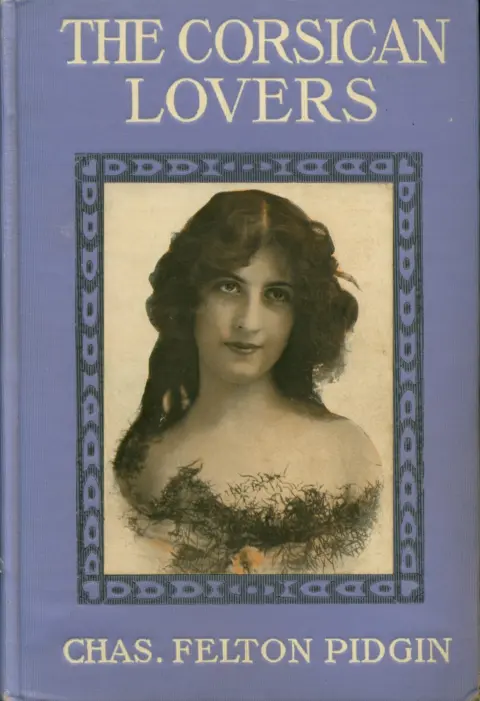
"The Corsican Lovers" by Charles Felton Pidgin is a historical novel written in the early 20th century. The story centers around the passionate and tumultuous lives of the Batistelli family, particularly focusing on Vivienne, a young woman grappling with the demands of a loveless marriage arranged by her brother Pascal, as she yearns for autonomy and true love amidst the shadow of her father’s vengeful legacy. At the start of the novel, we are introduced to Vivienne Batistelli, who fiercely opposes her brother Pascal's insistence that she marry Count Mont d'Oro's son, Napier. Vivienne is haunted by the memory of her father’s murder, and as she asserts her refusal to enter into a loveless union meant to appease family honor, her determination becomes palpable. The conflict escalates as Pascal reveals that their father's dying wish was for Vivienne to marry Napier, invoking a familial vendetta that looms over their lives. This opening sets the stage for not only personal dilemmas of love and duty but also a broader commentary on the intricacies of honor, revenge, and the expectations placed on women within their family and society.
Introduction adapted from the source catalogue; source summaries may be automatically generated.
Free to read · English · 104,285 words · No account needed
MAKE TIME FOR A GOOD BOOK
On by default. Untick to stop anonymous reading totals. Each page counts after 10 seconds in view. How this works.
Anonymous counting is on unless you have switched it off.
All of the Count’s attempts to make Bertha his companion were flat failures and he decided to adopt another course. A new opera was about to be given. The tickets were held at extravagant figures, but the Count secured a box.
“Oh, you are musical!” he exclaimed, one day as he entered the drawing-room and found Bertha seated at the piano.
“I play a little for my own amusement,” said she.
“Have you any objection to my listening?”
“Oh, not at all! I trust you will not find it irksome.”
He was extravagant in his praises of her performance, but Bertha had learned to take his remarks at their true value.
He did not ask Bertha to go to the opera with him, but invited his
mother instead.
“I have a box,” he said.
“Are you going to make up a party?”
“Oh, no, I will go with you.”
“Have you asked Bertha?”
“Certainly not,” he replied. “I have asked her to accompany me on several occasions, but she has always refused; I presume at your instigation. To speak plainly, I do not care whether she goes with us to the opera or not.”
He knew that this would pique his mother.
“Well, if Bertha cannot go, I shall not go,” said the Countess.
“If you choose to ask her to accompany you, I certainly shall not object, but, as I said before, I do not care whether she goes or not.”
He did not repeat this conversation to Bertha and the Countess herself was too politic to refer to it.
Every day, thereafter, the Count virtually haunted the drawing-room in the hope of finding Bertha at the piano. On one occasion he was successful.
“Will you not play for me?” he asked.
“You have heard my repertoire.”
“Do you not sing?”
“Very little; only the simplest of English ballads.”
He took a piece of music from the rack and placed it before her. “Can
you play that?”
“I can try.”
“If you will, I shall be your debtor.”
“I cannot sing it.”
“Excuse me,” he said, “but I did not ask you to.”
It was a tenor song. Bertha played the prelude, but was astonished when she struck the first note of the vocal score to hear the Count’s voice take up the melody. He had a pure, sweet voice, and sang with great power and expression.
“It is a beautiful song; do you not think so?” he asked.
“Very,” was her laconic reply.
“Now, will you not sing for me one of those English ballads?”
Bertha had enjoyed the Count’s song, and she felt it would be discourteous to refuse under the circumstances.
Your reading position is saved on this browser. Take it to another device with a library code. Reading pages adapt to text, rather than matching a printed edition.
BEHIND THE BOOK
This eBook is for the use of anyone anywhere in the United States and most other parts of the world at no cost and with almost no restrictions whatsoever. You may copy it, give it away or re-use it under the terms of the Project Gutenberg License included with this eBook or online at www.gutenberg.org. If you are not located in the United States, you will have to check the laws of the country where you are located before using this eBook. Read the source licence.
The original source file, including credits and licence, is retained by this library. Request an original-format copy at no charge. Please include the book title and Project Gutenberg identifier #67412.
KEEP YOUR CURIOSITY GOING
Cécile Tormay

Moritz Busch
Coulson Kernahan
John L. Ransom

Maurice Baring
Frances Wright