THE CLASSIC COLLECTION✦Quincy Adams Sawyer and Mason’s Corner Folks A Picture of New England Home LifeCLASSIC FREE BOOKS
Quincy Adams Sawyer and Mason’s Corner Folks A Picture of New England Home Life
Charles Felton Pidgin
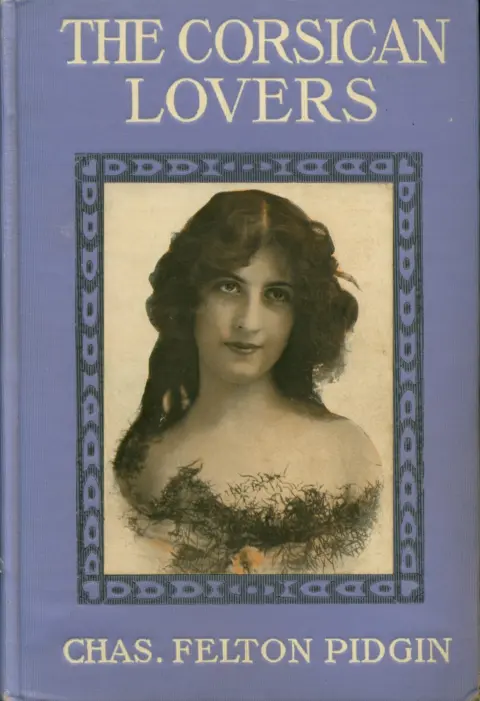
THE CLASSIC COLLECTION · 1906
"The Corsican Lovers" by Charles Felton Pidgin is a historical novel written in the early 20th century. The story centers around the passionate and tumultuous lives of the Batistelli family, particularly focusing on Vivienne, a young woman grappling with the demands of a loveless marriage arranged by her brother Pascal, as she yearns for autonomy and true love amidst the shadow of her father’s vengeful legacy. At the start of the novel, we are introduced to Vivienne Batistelli, who fiercely opposes her brother Pascal's insistence that she marry Count Mont d'Oro's son, Napier. Vivienne is haunted by the memory of her father’s murder, and as she asserts her refusal to enter into a loveless union meant to appease family honor, her determination becomes palpable. The conflict escalates as Pascal reveals that their father's dying wish was for Vivienne to marry Napier, invoking a familial vendetta that looms over their lives. This opening sets the stage for not only personal dilemmas of love and duty but also a broader commentary on the intricacies of honor, revenge, and the expectations placed on women within their family and society.
Introduction adapted from the source catalogue; source summaries may be automatically generated.
Free to read · English · 104,285 words · No account needed
MAKE TIME FOR A GOOD BOOK
On by default. Untick to stop anonymous reading totals. Each page counts after 10 seconds in view. How this works.
Anonymous counting is on unless you have switched it off.
“Well,” said Clarence, “as you stand about four inches taller than I do, and weigh about forty pounds more, I don’t think I shall resort to personal violence even if my feelings are injured.”
“Well,” said Jack, “I think we understand each other, so I will ask you the question in the bluntest possible way. Are you in love with Miss Renville, or are you likely to be, and is it probable that you will ever ask her to become your wife?”
“Well,” said Clarence, with a laugh, “that’s not one question, that’s three, but fortunately I can answer all with one little word--No. Now, Mr. De Vinne, will you allow me to ask you a question?”
“Why, certainly,” said Jack, whose face showed that Clarence’s reply to his question had greatly pleased him.
“Well,” began Clarence, “Mr. Jack De Vinne, I would like to ask you if you are in love with Miss Renville, or if not, are you likely to be, and is there any probability of your ever asking her to become your wife?”
“Fortunately,” said Jack, “I can answer you with a monosyllable--Yes.”
Clarence extended his hand. “Shake, old boy! Go ahead and win.”
“I have been talking to your father,” said Jack, “and although what he told me does not lessen my love for Miss Renville in any way, it must postpone our happiness. He says his ward is very poor.”
Involuntarily, Clarence gave a loud whistle.
Jack looked astonished. “What did you do that for?” he asked.
“Oh,” said Clarence, “when the governor talks to me about his generosity I always whistle.”
“Pardon me, Mr. Glynne,” said Jack, “but cannot you add a word or two to
the whistle?”
“Well,” said Clarence, “perhaps I can put in a word. A thought that usually runs through my mind when the governor is talking to me, is, don’t believe all he says. Take my advice, Mr. De Vinne, follow the course your heart dictates and I believe everything will come out right in the end. Now, I have been waiting nearly an hour for you for this little game of billiards and I must insist upon you taking your cue.”
It was late that night when Clarence parted from Jack at the door of the latter’s room. Young Mr. Glynne had smoked cigarettes incessantly while they had been playing billiards, and he felt the necessity of a walk in the open air before going to bed.
As he passed the door of the library, he was surprised to find it open, for he had supposed that his father had already retired.
“Is that you, Clarence?”
Your reading position is saved on this browser. Take it to another device with a library code. Reading pages adapt to text, rather than matching a printed edition.
BEHIND THE BOOK
This eBook is for the use of anyone anywhere in the United States and most other parts of the world at no cost and with almost no restrictions whatsoever. You may copy it, give it away or re-use it under the terms of the Project Gutenberg License included with this eBook or online at www.gutenberg.org. If you are not located in the United States, you will have to check the laws of the country where you are located before using this eBook. Read the source licence.
The original source file, including credits and licence, is retained by this library. Request an original-format copy at no charge. Please include the book title and Project Gutenberg identifier #67412.
KEEP YOUR CURIOSITY GOING
Cécile Tormay

Moritz Busch
Coulson Kernahan
John L. Ransom

Maurice Baring
Frances Wright