THE CLASSIC COLLECTION✦Quincy Adams Sawyer and Mason’s Corner Folks A Picture of New England Home LifeCLASSIC FREE BOOKS
Quincy Adams Sawyer and Mason’s Corner Folks A Picture of New England Home Life
Charles Felton Pidgin
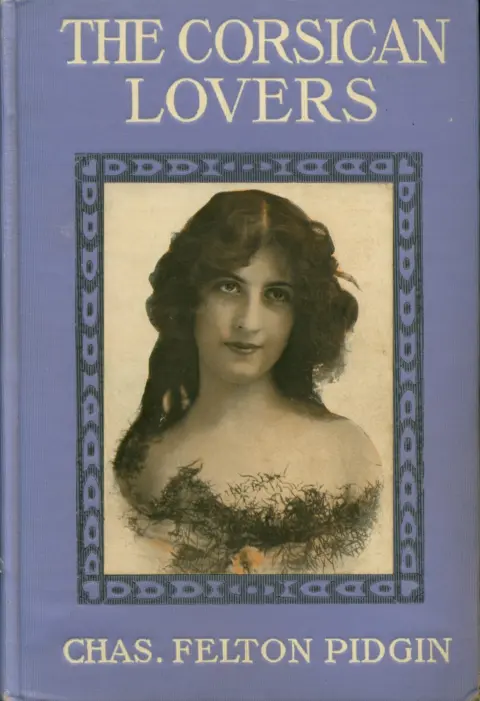
THE CLASSIC COLLECTION · 1906
"The Corsican Lovers" by Charles Felton Pidgin is a historical novel written in the early 20th century. The story centers around the passionate and tumultuous lives of the Batistelli family, particularly focusing on Vivienne, a young woman grappling with the demands of a loveless marriage arranged by her brother Pascal, as she yearns for autonomy and true love amidst the shadow of her father’s vengeful legacy. At the start of the novel, we are introduced to Vivienne Batistelli, who fiercely opposes her brother Pascal's insistence that she marry Count Mont d'Oro's son, Napier. Vivienne is haunted by the memory of her father’s murder, and as she asserts her refusal to enter into a loveless union meant to appease family honor, her determination becomes palpable. The conflict escalates as Pascal reveals that their father's dying wish was for Vivienne to marry Napier, invoking a familial vendetta that looms over their lives. This opening sets the stage for not only personal dilemmas of love and duty but also a broader commentary on the intricacies of honor, revenge, and the expectations placed on women within their family and society.
Introduction adapted from the source catalogue; source summaries may be automatically generated.
Free to read · English · 104,285 words · No account needed
MAKE TIME FOR A GOOD BOOK
On by default. Untick to stop anonymous reading totals. Each page counts after 10 seconds in view. How this works.
Anonymous counting is on unless you have switched it off.
“I wish to see your master, Pascal Batistelli,” said the messenger.
“He is busy in his library,” was Manassa’s reply. “Come again some other
time.”
“Lean down and I will tell you something.”
Manassa complied. A smile, fiendish in its nature, went over his face. He nodded his head a dozen times, chuckling as he did so.
“Come with me,” he said. “My master will be glad to see you.”
“Who are you?” asked Pascal Batistelli, as Cromillian’s messenger approached the table where he sat.
The man looked to see if Manassa had left the room. Assuring himself of
the fact, he asked:
“Will you keep my secret if I tell you who I am? It will pay you to do so and will injure you if you do not.”
“Under those circumstances, I will give you my word,” said Pascal.
“I am Paoli, Cromillian’s lieutenant.”
Pascal started to his feet, crying: “What are you here for? What business have I with you or your leader’s gang of thieves and cut-throats?”
“Not so fast, my good sir,” said Paoli. “We may injure some, but we benefit others, and I have come here to do you a great favour.”
“I do not understand you,” said Pascal, “but go on,” and he sank back
into his chair.
“You have heard, I suppose,” said Paoli, “that Vandemar Della Coscia, whose father murdered yours, was about to be foolish enough to come back to Corsica. What would you say if I told you that both Vandemar and his father were now on the island.”
“I should say that you lied!” cried Pascal.
“Let it go that way then,” Paoli coolly replied. “I know Vandemar is here, for I have seen him. No one who had known a Della Coscia could mistake him. I am sure, too, that the father is here; I don’t yet know where he is, but I shall find him. If I put you on their track, what do I get?”
“A hundred louis d’or for each,” cried Pascal Batistelli.
“Will you put it in writing?” asked Paoli.
“No,” said Pascal, “the word of a Batistelli is sufficient.”
It was about five o’clock in the afternoon when the old man again presented himself to Cromillian and handed him the letter which Vandemar had written, and which he had most carelessly and incautiously addressed to Manuel Della Coscia.
Cromillian looked at the superscription, and then said:
“I will see that this letter reaches the party to whom it is addressed.”
The old man bowed once more, and soon vanished among the trees.
Cromillian looked again at the superscription on the letter.
Your reading position is saved on this browser. Take it to another device with a library code. Reading pages adapt to text, rather than matching a printed edition.
BEHIND THE BOOK
This eBook is for the use of anyone anywhere in the United States and most other parts of the world at no cost and with almost no restrictions whatsoever. You may copy it, give it away or re-use it under the terms of the Project Gutenberg License included with this eBook or online at www.gutenberg.org. If you are not located in the United States, you will have to check the laws of the country where you are located before using this eBook. Read the source licence.
The original source file, including credits and licence, is retained by this library. Request an original-format copy at no charge. Please include the book title and Project Gutenberg identifier #67412.
KEEP YOUR CURIOSITY GOING
Cécile Tormay

Moritz Busch
Coulson Kernahan
John L. Ransom

Maurice Baring
Frances Wright