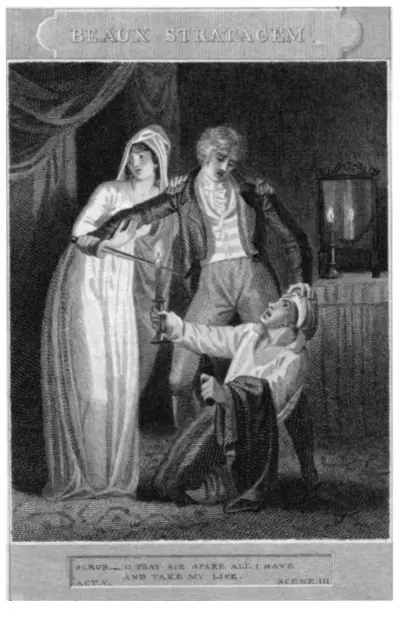
The Beaux-Stratagem: A comedy in five acts
George Farquhar
THE CLASSIC COLLECTION · 1701
"The Constant Couple; Or, A Trip to the Jubilee: A Comedy, in Five Acts" by George Farquhar is a play written in 1699. This Restoration comedy follows three rivals competing for the affections of Lady Lurewell, a wealthy heiress, triggering a cascade of comic misunderstandings. The play marked Farquhar's first major theatrical success and introduced the rakish Sir Harry Wildair, a character so popular he returned in a 1701 sequel. Staged at London's Drury Lane Theatre, the comedy has enjoyed numerous revivals over the centuries.
Introduction adapted from the source catalogue; source summaries may be automatically generated.
Free to read · English · 21,102 words · No account needed
MAKE TIME FOR A GOOD BOOK
On by default. Untick to stop anonymous reading totals. Each page counts after 10 seconds in view. How this works.
Anonymous counting is on unless you have switched it off.
Covent Garden.
Enter SIR H. WILDAIR and COLONEL STANDARD, meeting.
Colonel S. I thought, Sir Harry, to have met you ere this in a more convenient place; but since my wrongs were without ceremony, my revenge shall be so too.--Draw, sir.
Sir H. Draw, sir! What shall I draw?
Colonel S. Come, come, sir, I like your facetious humour well enough; it shows courage and unconcern. I know you brave, and therefore use you thus. Draw your sword.
Sir H. Nay, to oblige you, I will draw; but the devil take me if I fight.--Perhaps, colonel, this is the prettiest blade you have seen.
Colonel S. I doubt not but the arm is good; and therefore think both worth my resentment. Come, sir.
Sir H. But, pr'ythee, colonel, dost think that I am such a madman, as to send my soul to the devil and body to the worms--upon every fool's errand? [Aside.
Colonel S. I hope you're no coward, sir.
Sir H. Coward, sir! I have eight thousand pounds a year, sir.
Colonel S. You fought in the army, to my knowledge.
Sir H. Ay, for the same reason that I wore a red coat; because 'twas
fashionable.
Colonel S. Sir, you fought a French count in Paris.
Sir H. True, sir, he was a beau, like myself. Now you're a soldier, colonel, and fighting's your trade; and I think it downright madness to contend with any man in his profession.
Colonel S. Come, sir, no more dallying; I shall take very unseemly methods, if you don't show yourself a gentleman.
Sir H. A gentleman! Why, there again, now. A gentleman! I tell you once more, colonel, that I am a baronet, and have eight thousand pounds a year. I can dance, sing, ride, fence, understand the languages--Now I can't conceive how running you through the body should contribute one jot more to my gentility. But pray, colonel, I had forgot to ask you, what's the quarrel?
Colonel S. A woman, sir.
Sir H. Then I put up my sword. Take her.
Colonel S. Sir, my honour's concerned.
Sir H. Nay, if your honour be concerned with a woman, get it out of her hands as soon as you can.--An honourable lover is the greatest slave in nature: some will say, the greatest fool. Come, come, colonel, this is something about the Lady Lurewell, I warrant; I can give you satisfaction in that affair.
Colonel S. Do so then immediately.
Your reading position is saved on this browser. Take it to another device with a library code. Reading pages adapt to text, rather than matching a printed edition.
BEHIND THE BOOK
This eBook is for the use of anyone anywhere in the United States and most other parts of the world at no cost and with almost no restrictions whatsoever. You may copy it, give it away or re-use it under the terms of the Project Gutenberg License included with this eBook or online at www.gutenberg.org. If you are not located in the United States, you will have to check the laws of the country where you are located before using this eBook. Read the source licence.
The original source file, including credits and licence, is retained by this library. Request an original-format copy at no charge. Please include the book title and Project Gutenberg identifier #32419.
KEEP YOUR CURIOSITY GOING
Maurice Baring
W. B. (William Butler) Yeats
Edward Martyn

John Brougham & Charlotte Brontë
Marguerite Merington
Leonid Andreyev