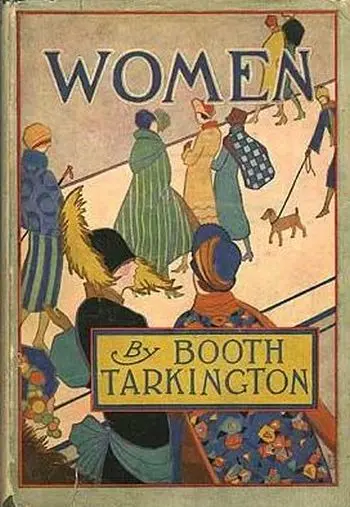
Women
Booth Tarkington
THE CLASSIC COLLECTION · 1905
"The Conquest of Canaan" by Booth Tarkington is a novel written in the early 20th century. The story appears to unfold in the fictional town of Canaan, Indiana, where a chorus of elderly men begins to debate various philosophical and social issues against the backdrop of a snow-covered landscape. Central to the narrative are the colorful characters who frequent the National House, a local watering hole, including the cynical Eskew Arp and the more reflective Roger Tabor, indicating an exploration of human nature, societal norms, and the existential musings of small-town life. The opening of the novel presents a picturesque, yet stark winter morning in Canaan, setting the stage for a lively exchange among the town's sages. The characters engage in a spirited debate on the implications of their environment and morality, with Arp's cynical views standing in contrast to Tabor’s more artistic and hopeful perspective. The arrival of Eugene Bantry, a young man returning from college, marks a shift in focus, poised to challenge the established social dynamics and potentially alter the lives of the characters. The dialogue is rich in comedic undertones and philosophical reflections, hinting at themes of social class, vanity, and the quest for personal identity, promising an engaging story that critiques both societal expectations and individual aspirations.
Introduction adapted from the source catalogue; source summaries may be automatically generated.
Free to read · English · 82,629 words · No account needed
MAKE TIME FOR A GOOD BOOK
On by default. Untick to stop anonymous reading totals. Each page counts after 10 seconds in view. How this works.
Anonymous counting is on unless you have switched it off.
Mamie, waiting just inside the door as Ariel and Eugene entered, gave the visitor a pale greeting, and, a moment later, hearing the wheels of the brougham crunch the gravel of the carriage-drive, hurried away, down the broad hall, and disappeared. Ariel dropped her parasol upon a marble-topped table near the door, and, removing her gloves, drifted into a room at the left, where a grand piano found shelter beneath crimson plush. After a moment of contemplation, she pushed back the coverlet, and, seating herself upon the plush-covered piano-stool (to match), let her fingers run up and down the key-board once and fall listlessly in her lap, as she gazed with deep interest at three life-sized colored photographs (in carved gilt frames) upon the wall she was facing: Judge Pike, Mamie, and Mrs. Pike with her rubies.
"Please don't stop playing, Miss Tabor," said a voice behind her. She had not observed that Eugene had followed her into the room.
"Very well, if you like," she answered, looking up to smile absently at him. And she began to play a rakish little air which, composed by some rattle-brain at a cafe table, had lately skipped out of the Moulin Rouge to disport itself over Paris. She played it slowly, in the minor, with elfish pathos; while he leaned upon the piano, his eyes fixed upon her fingers, which bore few rings, none, he observed with an unreasonable pleasure, upon the third finger of the left hand.
"It's one of those simpler Grieg things, isn't it?" he said, sighing gently. "I care for Grieg."
"Would you mind its being Chaminade?" she returned, dropping her eyes
to cloak the sin.
"Ah no; I recognize it now," replied Eugene. "He appeals to me even
more than Grieg."
At this she glanced quickly up at him, but more quickly down again, and hastened the time emphatically, swinging the little air into the major.
"Do you play the 'Pilgrim's Chorus'?"
She shook her head.
"Vous name pas Wagner?" inquired Eugene, leaning toward her.
"Oh yes," she answered, bending her head far over, so that her face was concealed from him, except the chin, which, he saw with a thrill of inexplicable emotion, was trembling slightly. There were some small white flowers upon her hat, and these shook too.
She stopped playing abruptly, rose from the stool and crossed the room to a large mahogany chair, upholstered in red velvet and of hybrid construction, possessing both rockers and legs. She had moved in a way which prevented him from seeing her face, but he was certain of her agitation, and strangely glad, while curious, tremulous half-thoughts, edged with prophecy, bubbled to the surface of his consciousness.
Your reading position is saved on this browser. Take it to another device with a library code. Reading pages adapt to text, rather than matching a printed edition.
Booth Tarkington
Booth Tarkington
Booth Tarkington

Booth Tarkington
BEHIND THE BOOK
This eBook is for the use of anyone anywhere in the United States and most other parts of the world at no cost and with almost no restrictions whatsoever. You may copy it, give it away or re-use it under the terms of the Project Gutenberg License included with this eBook or online at www.gutenberg.org. If you are not located in the United States, you will have to check the laws of the country where you are located before using this eBook. Read the source licence.
The original source file, including credits and licence, is retained by this library. Request an original-format copy at no charge. Please include the book title and Project Gutenberg identifier #483.
KEEP YOUR CURIOSITY GOING
Coulson Kernahan

Maurice Baring
Frances Wright
Cécile Tormay

Frederic Jesup Stimson

W. H. P. (William Henry Pope) Jarvis