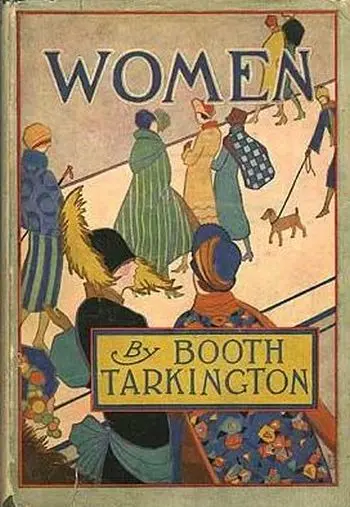
Women
Booth Tarkington
THE CLASSIC COLLECTION · 1905
"The Conquest of Canaan" by Booth Tarkington is a novel written in the early 20th century. The story appears to unfold in the fictional town of Canaan, Indiana, where a chorus of elderly men begins to debate various philosophical and social issues against the backdrop of a snow-covered landscape. Central to the narrative are the colorful characters who frequent the National House, a local watering hole, including the cynical Eskew Arp and the more reflective Roger Tabor, indicating an exploration of human nature, societal norms, and the existential musings of small-town life. The opening of the novel presents a picturesque, yet stark winter morning in Canaan, setting the stage for a lively exchange among the town's sages. The characters engage in a spirited debate on the implications of their environment and morality, with Arp's cynical views standing in contrast to Tabor’s more artistic and hopeful perspective. The arrival of Eugene Bantry, a young man returning from college, marks a shift in focus, poised to challenge the established social dynamics and potentially alter the lives of the characters. The dialogue is rich in comedic undertones and philosophical reflections, hinting at themes of social class, vanity, and the quest for personal identity, promising an engaging story that critiques both societal expectations and individual aspirations.
Introduction adapted from the source catalogue; source summaries may be automatically generated.
Free to read · English · 82,629 words · No account needed
MAKE TIME FOR A GOOD BOOK
On by default. Untick to stop anonymous reading totals. Each page counts after 10 seconds in view. How this works.
Anonymous counting is on unless you have switched it off.
"I think I begin to understand a little about the life you lead," she interrupted. "Then you don't complain of Canaan?"
"Of course not."
She threw him a quick, bright, happy look, then glanced again at the chair in which Mrs. Fear had sat. "Joe," she said, "last night I heard the people singing in the houses, the old Sunday-evening way. It 'took me back so'!"
"Yes, it would. And something else: there's one hymn they sing more than any other; it's Canaan's favorite. Do you know what it is?"
"Is it 'Rescue the Perishing'?"
"That's it. 'Rescue the Perishing'!" he cried, and repeating the words again, gave forth a peal of laughter so hearty that it brought tears to his eyes. "'RESCUE THE PERISHING'!"
At first she did not understand his laughter, but, after a moment, she did, and joined her own to it, though with a certain tremulousness.
"It IS funny, isn't it?" said Joe, wiping the moisture from his eyes. Then all trace of mirth left him. "Is it really YOU, sitting here and laughing with me, Ariel?"
"It seems to be," she answered, in a low voice. "I'm not at all sure."
"You didn't think, yesterday afternoon," he began, almost in a whisper,--"you didn't think that I had failed to come because I--" He grew very red, and shifted the sentence awkwardly: "I was afraid you might think that I was--that I didn't come because I might have been the same way again that I was when--when I met you at the station?"
"Oh no!" she answered, gently. "No. I knew better."
"And do you know," he faltered, "that that is all over? That it can
never happen again?"
"Yes, I know it," she returned, quickly.
"Then you know a little of what I owe you."
"No, no," she protested.
"Yes," he said. "You've made that change in me already. It wasn't
hard--it won't be--though it might have been if--if you hadn't come
soon."
"Tell me something," she demanded. "If these people had not sent for you yesterday, would you have come to Judge Pike's house to see me? You said you would try." She laughed a little, and looked away from him. "I want to know if you would have come."
There was a silence, and in spite of her averted glance she knew that he was looking at her steadily. Finally, "Don't you know?" he said.
She shook her head and blushed faintly.
"Don't you know?" he repeated.
Your reading position is saved on this browser. Take it to another device with a library code. Reading pages adapt to text, rather than matching a printed edition.
Booth Tarkington
Booth Tarkington
Booth Tarkington
Booth Tarkington
BEHIND THE BOOK
This eBook is for the use of anyone anywhere in the United States and most other parts of the world at no cost and with almost no restrictions whatsoever. You may copy it, give it away or re-use it under the terms of the Project Gutenberg License included with this eBook or online at www.gutenberg.org. If you are not located in the United States, you will have to check the laws of the country where you are located before using this eBook. Read the source licence.
The original source file, including credits and licence, is retained by this library. Request an original-format copy at no charge. Please include the book title and Project Gutenberg identifier #483.
KEEP YOUR CURIOSITY GOING
Coulson Kernahan

Maurice Baring
Frances Wright
Cécile Tormay

Frederic Jesup Stimson

W. H. P. (William Henry Pope) Jarvis