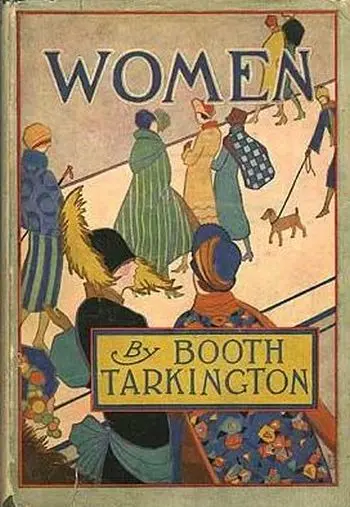
Women
Booth Tarkington
THE CLASSIC COLLECTION · 1905
"The Conquest of Canaan" by Booth Tarkington is a novel written in the early 20th century. The story appears to unfold in the fictional town of Canaan, Indiana, where a chorus of elderly men begins to debate various philosophical and social issues against the backdrop of a snow-covered landscape. Central to the narrative are the colorful characters who frequent the National House, a local watering hole, including the cynical Eskew Arp and the more reflective Roger Tabor, indicating an exploration of human nature, societal norms, and the existential musings of small-town life. The opening of the novel presents a picturesque, yet stark winter morning in Canaan, setting the stage for a lively exchange among the town's sages. The characters engage in a spirited debate on the implications of their environment and morality, with Arp's cynical views standing in contrast to Tabor’s more artistic and hopeful perspective. The arrival of Eugene Bantry, a young man returning from college, marks a shift in focus, poised to challenge the established social dynamics and potentially alter the lives of the characters. The dialogue is rich in comedic undertones and philosophical reflections, hinting at themes of social class, vanity, and the quest for personal identity, promising an engaging story that critiques both societal expectations and individual aspirations.
Introduction adapted from the source catalogue; source summaries may be automatically generated.
Free to read · English · 82,629 words · No account needed
MAKE TIME FOR A GOOD BOOK
On by default. Untick to stop anonymous reading totals. Each page counts after 10 seconds in view. How this works.
Anonymous counting is on unless you have switched it off.
This grave courtesy caused a strong, deep flush to spread itself under the rouge which unevenly covered the woman's cheeks, as she bowed elaborately in return. Then, furtively, during a protracted silence, she took stock of the new-comer, from the tip of her white suede shoes to the filmy lace and pink roses upon her wide white hat; and the sidelong gaze lingered marvellingly upon the quiet, delicate hands, slender and finely expressive, in their white gloves.
Her own hands, unlike the lady's, began to fidget confusedly, and, the silence continuing, she coughed several times, to effect the preface required by her sense of fitness, before she felt it proper to observe, with a polite titter:
"Mr. Louden seems to be a good while comin'."
"Have you been waiting very long?" asked the lady.
"Ever since six o'clock!"
"Yes," said the other. "That is very long."
"Yes, ma'am, it cert'nly is." The ice thus broken, she felt free to use her eyes more directly, and, after a long, frank stare, exclaimed:
"Why, you must be Miss Ariel Tabor, ain't you?"
"Yes." Ariel touched one of the roses upon Joe's desk with her
finger-tips. "I am Miss Tabor."
"Well, excuse me fer asking; I'm sure it ain't any business of mine," said the other, remembering the manners due one lady from another. "But I thought it must be. I expect," she added, with loud, inconsequent laughter, "there's not many in Canaan ain't heard you've come back." She paused, laughed again, nervously, and again, less loudly, to take off the edge of her abruptness: gradually tittering herself down to a pause, to fill which she put forth: "Right nice weather we be'n havin'."
"Yes," said Ariel.
"It was rainy, first of last week, though. I don't mind rain so much"--this with more laughter,--"I stay in the house when it rains. Some people don't know enough to, they say! You've heard that saying, ain't you, Miss Tabor?"
"Yes."
"Well, I tell YOU," she exclaimed, noisily, "there's plenty ladies and gen'lemen in this town that's like that!"
Her laughter did not cease; it became louder and shriller. It had been, until now, a mere lubrication of the conversation, helping to make her easier in Miss Tabor's presence, but as it increased in shrillness, she seemed to be losing control of herself, as if her laughter were getting away with her; she was not far from hysteria, when it stopped with a gasp, and she sat up straight in her chair, white and rigid.
Your reading position is saved on this browser. Take it to another device with a library code. Reading pages adapt to text, rather than matching a printed edition.
Booth Tarkington
Booth Tarkington
Booth Tarkington
Booth Tarkington
BEHIND THE BOOK
This eBook is for the use of anyone anywhere in the United States and most other parts of the world at no cost and with almost no restrictions whatsoever. You may copy it, give it away or re-use it under the terms of the Project Gutenberg License included with this eBook or online at www.gutenberg.org. If you are not located in the United States, you will have to check the laws of the country where you are located before using this eBook. Read the source licence.
The original source file, including credits and licence, is retained by this library. Request an original-format copy at no charge. Please include the book title and Project Gutenberg identifier #483.
KEEP YOUR CURIOSITY GOING
Coulson Kernahan

Maurice Baring
Frances Wright
Cécile Tormay

Frederic Jesup Stimson

W. H. P. (William Henry Pope) Jarvis