
Dark Hester
Anne Douglas Sedgwick
THE CLASSIC COLLECTION · 1899
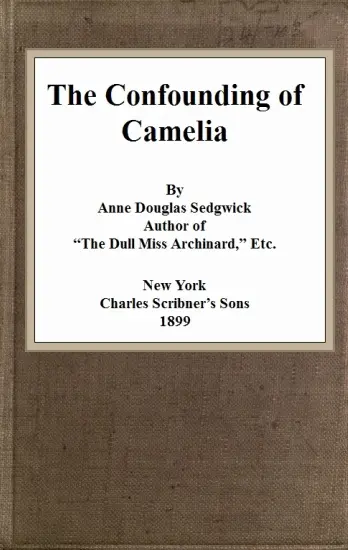
"The Confounding of Camelia" by Anne Douglas Sedgwick is a novel written in the late 19th century. The story revolves around the character Camelia Paton, who returns to her family estate in the country after a successful but disconcerting season in London. As she navigates the expectations and judgments of those around her, particularly concerning her unconventional nature and her family's legacy of quiet respectability, the narrative explores themes of identity, societal norms, and personal ambition. The opening of the novel introduces us to Camelia's background, including her lineage of “good, quiet people” and her father's rebellious spirit that sets her apart. The text paints a vivid picture of the contrast between her vibrant personality and the conservative views of her community in Clievesbury, establishing her as a figure both admired and scrutinized. We learn about her complex relationships, particularly with her mother, Lady Paton, and her childhood friend, Michael Perior, who seems critical yet protective of her. The dynamics in their interactions suggest an underlying tension and potential for deeper connections as Camelia seeks to assert her identity amidst the conformity she despises while also yearning for acceptance. The stage is set for a rich exploration of her character and the relationships in her life as she confronts societal expectations and her own desires.
Introduction adapted from the source catalogue; source summaries may be automatically generated.
Free to read · English · 74,100 words · No account needed
MAKE TIME FOR A GOOD BOOK
On by default. Untick to stop anonymous reading totals. Each page counts after 10 seconds in view. How this works.
Anonymous counting is on unless you have switched it off.
Perior hardly believed her, and yet he was much confused, especially as with a fresh access of sobs her face quivered in the pathetic grimace of loveliness distorted; before that the real issue of the situation seemed slipping away; her repudiation of the greater dishonesty effaced, for the moment, the smaller; he had nothing to say--she probably believed in herself; and those helpless sobs were so touching to him that, notwithstanding his unappeased anger against her, he could have gone to her and taken her in his arms to comfort her, at any cost--even at the cost of seeming to ask pardon. He did not do this, however, but said, "Don't cry, don't cry, Camelia; you mustn't cry. I'm glad you feel it in that way; I am glad you can cry over it." He did not go to her, but his very attitude of nervous hesitation told Camelia that he was worsted--at least worsted enough for the practical purposes of the moment.
She got out her handkerchief and dried her eyes, still feeling very sore-hearted, very much injured; but when the tears were gone she came up to him saying, while she looked at him with all the victorious pathos of wet lashes and trembling lips, "You are not kind to me, Alceste."
He moved away from her a little, but took her hands. "Because you are
naughty, Célimène."
"I will be good. I won't tell fibs."
"A very commendable resolution."
"You mock me. You won't believe a liar."
"Don't, please don't speak of it again, Camelia."
"Say you are sorry for having said it."
"Oh, you little rogue!" Taking her face between his hands he studied it with a sad curiosity. "I am sorry for having had to say it."
"Oh, prig, prig, prig." She smiled at him now from the narrow frame, her
own delicious smile.
"And bandersnatch if you will," said Perior, shaking her gently by the shoulders, and putting her away with a certain resignation.
"My good old bandersnatch! Dear old bandersnatch! After all, I need a bandersnatch, don't I, to keep me straight? Yes, I forgive you. I must put up with you, and you must put up with me, fibs and all--fibs, do you hear, not lies. Oh, ugly word!" She clasped her hands on his arm, poor Perior! "And you will stay to lunch?"
"No, I won't stay to lunch," said Perior, smiling despite himself.
"Why?"
"I am busy."
"You are a prig, you know," said Camelia, as if that summed up the
situation conclusively.
Your reading position is saved on this browser. Take it to another device with a library code. Reading pages adapt to text, rather than matching a printed edition.
Anne Douglas Sedgwick
Anne Douglas Sedgwick

Anne Douglas Sedgwick

Anne Douglas Sedgwick
BEHIND THE BOOK
This eBook is for the use of anyone anywhere in the United States and most other parts of the world at no cost and with almost no restrictions whatsoever. You may copy it, give it away or re-use it under the terms of the Project Gutenberg License included with this eBook or online at www.gutenberg.org. If you are not located in the United States, you will have to check the laws of the country where you are located before using this eBook. Read the source licence.
The original source file, including credits and licence, is retained by this library. Request an original-format copy at no charge. Please include the book title and Project Gutenberg identifier #41917.
KEEP YOUR CURIOSITY GOING
Coulson Kernahan

Maurice Baring
Frances Wright
Cécile Tormay

Frederic Jesup Stimson

W. H. P. (William Henry Pope) Jarvis