
Dark Hester
Anne Douglas Sedgwick
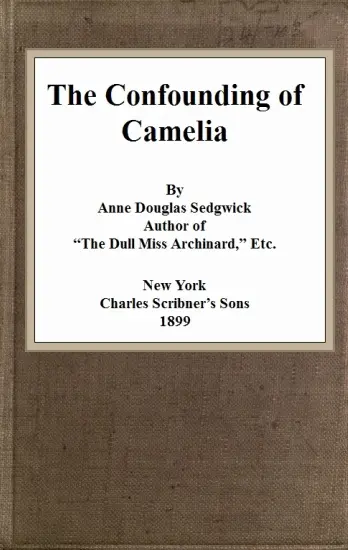
THE CLASSIC COLLECTION · 1899
"The Confounding of Camelia" by Anne Douglas Sedgwick is a novel written in the late 19th century. The story revolves around the character Camelia Paton, who returns to her family estate in the country after a successful but disconcerting season in London. As she navigates the expectations and judgments of those around her, particularly concerning her unconventional nature and her family's legacy of quiet respectability, the narrative explores themes of identity, societal norms, and personal ambition. The opening of the novel introduces us to Camelia's background, including her lineage of “good, quiet people” and her father's rebellious spirit that sets her apart. The text paints a vivid picture of the contrast between her vibrant personality and the conservative views of her community in Clievesbury, establishing her as a figure both admired and scrutinized. We learn about her complex relationships, particularly with her mother, Lady Paton, and her childhood friend, Michael Perior, who seems critical yet protective of her. The dynamics in their interactions suggest an underlying tension and potential for deeper connections as Camelia seeks to assert her identity amidst the conformity she despises while also yearning for acceptance. The stage is set for a rich exploration of her character and the relationships in her life as she confronts societal expectations and her own desires.
Introduction adapted from the source catalogue; source summaries may be automatically generated.
Free to read · English · 74,100 words · No account needed
MAKE TIME FOR A GOOD BOOK
On by default. Untick to stop anonymous reading totals. Each page counts after 10 seconds in view. How this works.
Anonymous counting is on unless you have switched it off.
Physically the composition was most certainly exhausting. Lady Henge's fine, flushed profile, bent with brooding intensity above the key-board, evinced a panting effort to cope with the mighty requirements of her creation.
"It sounds as if she were being tossed in her cabin, doesn't it?" Camelia's soft voice murmured under the safe cover of the tumult, her face keeping the expression of grave attention, "and horribly seasick. One hears the bottles breaking, and the basins clashing, and the boots being hurled from side to side. Anything but abstract. Intimately descriptive rather--don't you think?" A side glint of her eye evidently twinkled for sympathy; but Perior solemnly stared at the ceiling.
"The construction too," Camelia said more soberly, "she plunged us into the free fantasia--and perhaps at the end she may fish us out with the dominant phrase--but I haven't caught it yet; ah, this thudding finale announces the journey's end." And she jumped up as Lady Henge, with a fine, tense look of soul-experience, rose from the piano. The dazed and wilted listeners chimed out the polite chorus usual on such occasions. Camelia led Lady Henge to her chair. "Thank you--so much," she said. Lady Henge smiled dimly, her eyes fixed on vacancy.
"It was like a glorious wind blowing about one. It made me think of Wordsworth's sonnets--of the soul in nature," said Camelia. Perior still looked stolidly at the ceiling, and she felt his silence to be ominous.
"Such music," she added, "gives one courage for life." She was angry with Perior. Lady Henge pressed her hand.
"Thanks, my dear. Yes--you felt. One must hear, of course, a composition many times before entering into the sanctuary of the artist's meaning." Camelia's mouth retained its sympathetic gravity. Perior said nothing; and faint, relieved little groups of talk twittered like birds after a storm.
"And you, Mr. Perior," Lady Henge, fanning herself largely turned to this silent critic. "You, too, are a musician as I know, a musician at least in appreciation. What do you think of my 'Thalassa'? Frankly now--as one artist to another." Perior moved his eyes slowly from the ceiling, and dropped them to Camelia's face. He grew very red.
"Frankly now," Lady Henge reiterated with genial urgency.
"I think it is very bad," said Perior. The sentence fell with a thud,
like a stone.
Lady Henge flushed, and her fan fluttered to stillness; Camelia, her eyebrows lightly lifted, met Perior's square look.
"Bad," Lady Henge repeated, with a pathetic mingling of deprecating pride and pain, "really bad, Mr. Perior?"
"Very bad," said Perior.
The unmitigated sentence reduced her to feeble plaintiveness.
"But why? This is really savage, you know."
Your reading position is saved on this browser. Take it to another device with a library code. Reading pages adapt to text, rather than matching a printed edition.
Anne Douglas Sedgwick
Anne Douglas Sedgwick

Anne Douglas Sedgwick

Anne Douglas Sedgwick
BEHIND THE BOOK
This eBook is for the use of anyone anywhere in the United States and most other parts of the world at no cost and with almost no restrictions whatsoever. You may copy it, give it away or re-use it under the terms of the Project Gutenberg License included with this eBook or online at www.gutenberg.org. If you are not located in the United States, you will have to check the laws of the country where you are located before using this eBook. Read the source licence.
The original source file, including credits and licence, is retained by this library. Request an original-format copy at no charge. Please include the book title and Project Gutenberg identifier #41917.
KEEP YOUR CURIOSITY GOING
Coulson Kernahan

Maurice Baring
Frances Wright
Cécile Tormay

Frederic Jesup Stimson

W. H. P. (William Henry Pope) Jarvis