
Dark Hester
Anne Douglas Sedgwick
THE CLASSIC COLLECTION · 1899
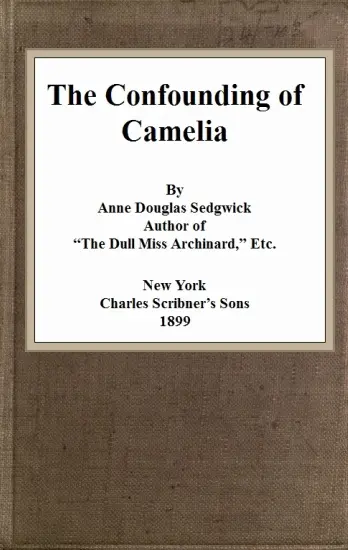
"The Confounding of Camelia" by Anne Douglas Sedgwick is a novel written in the late 19th century. The story revolves around the character Camelia Paton, who returns to her family estate in the country after a successful but disconcerting season in London. As she navigates the expectations and judgments of those around her, particularly concerning her unconventional nature and her family's legacy of quiet respectability, the narrative explores themes of identity, societal norms, and personal ambition. The opening of the novel introduces us to Camelia's background, including her lineage of “good, quiet people” and her father's rebellious spirit that sets her apart. The text paints a vivid picture of the contrast between her vibrant personality and the conservative views of her community in Clievesbury, establishing her as a figure both admired and scrutinized. We learn about her complex relationships, particularly with her mother, Lady Paton, and her childhood friend, Michael Perior, who seems critical yet protective of her. The dynamics in their interactions suggest an underlying tension and potential for deeper connections as Camelia seeks to assert her identity amidst the conformity she despises while also yearning for acceptance. The stage is set for a rich exploration of her character and the relationships in her life as she confronts societal expectations and her own desires.
Introduction adapted from the source catalogue; source summaries may be automatically generated.
Free to read · English · 74,100 words · No account needed
MAKE TIME FOR A GOOD BOOK
On by default. Untick to stop anonymous reading totals. Each page counts after 10 seconds in view. How this works.
Anonymous counting is on unless you have switched it off.
"I can't say that you have made me anxious to see them."
"Have you no taste for sociology?"
"You will stay and see us, however, will you not?" said Lady Paton, advancing now in happy security. "I want a long talk with you."
"Then I stay."
"His majesty stays!" Camelia murmured.
"How are the tenants getting on?" asked Lady Paton, taking from the table a soft mass of white wool, and beginning to knit. She was one of those women whose hands are always uselessly and prettily busy.
"Mary and I drove past the cottages yesterday--I wish you had come, dear--you would have liked to see them. So pretty they are, among their orchards, with such beautiful gardens full of flowers."
"Yes, don't they look well?" said Perior, much pleased. "I am trying to get the people to devote themselves to fruit and flower growing. It pays well."
"And do the cottages themselves pay?" Camelia inquired mischievously. "I hear that, asking the ridiculous rents you do, you need never expect to make the smallest profit--or even get back the capital expended."
"Thank Heaven the money-making epoch of my life is over," said Perior, folding his arms and looking at her rather defiantly.
"But what blasphemy against political economy! Cottages that don't pay! It's very immoral, Alceste. It is feminine. You are pauperizing your tenants."
"I don't at all disbelieve that a little infusion of femininity into political economy would be a very good thing. Besides, the cottages will pay in the end."
"The rents are lower than the lowest in the village. Lord Haversham was telling me about it yesterday."
"Oh, Haversham!" laughed Perior.
"He was very plaintive. Said that times were hard enough for landlords as it was, without your charitable visionaries and your socialistic theories."
"The two accusations don't fit; but of the two I prefer the latter."
"It is a mere egotistic diversion then?"
"Yes, a purely scientific experiment."
"And your tenants have bath-tubs, I hear. Do they use them with Pears'
soap every morning?"
"I flatter myself that they are fairly clean. That alone is an
interesting experiment. Dirt, I firmly believe to be the root of all
evil."
"Ah, we come down to the bed-rock of ethics at last, don't we? Well, how is the laboratory getting on? Have you found traces of original sin in protoplasm?"
"I think I have spotted perverse tendencies," Perior smiled.
"What a Calvinist you are!"
"Michael a Calvinist, my dear child!" Lady Paton looked up from her
knitting in amazement.
Your reading position is saved on this browser. Take it to another device with a library code. Reading pages adapt to text, rather than matching a printed edition.
Anne Douglas Sedgwick
Anne Douglas Sedgwick

Anne Douglas Sedgwick

Anne Douglas Sedgwick
BEHIND THE BOOK
This eBook is for the use of anyone anywhere in the United States and most other parts of the world at no cost and with almost no restrictions whatsoever. You may copy it, give it away or re-use it under the terms of the Project Gutenberg License included with this eBook or online at www.gutenberg.org. If you are not located in the United States, you will have to check the laws of the country where you are located before using this eBook. Read the source licence.
The original source file, including credits and licence, is retained by this library. Request an original-format copy at no charge. Please include the book title and Project Gutenberg identifier #41917.
KEEP YOUR CURIOSITY GOING
Coulson Kernahan

Maurice Baring
Frances Wright
Cécile Tormay

Frederic Jesup Stimson

W. H. P. (William Henry Pope) Jarvis