
Dark Hester
Anne Douglas Sedgwick
THE CLASSIC COLLECTION · 1899
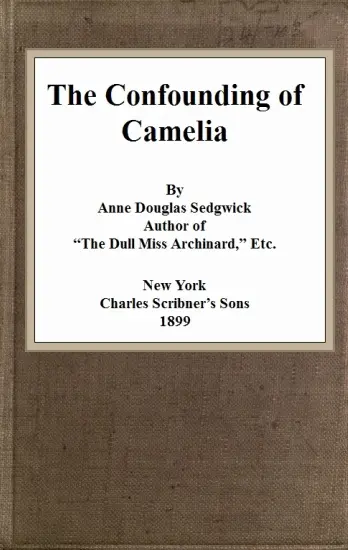
"The Confounding of Camelia" by Anne Douglas Sedgwick is a novel written in the late 19th century. The story revolves around the character Camelia Paton, who returns to her family estate in the country after a successful but disconcerting season in London. As she navigates the expectations and judgments of those around her, particularly concerning her unconventional nature and her family's legacy of quiet respectability, the narrative explores themes of identity, societal norms, and personal ambition. The opening of the novel introduces us to Camelia's background, including her lineage of “good, quiet people” and her father's rebellious spirit that sets her apart. The text paints a vivid picture of the contrast between her vibrant personality and the conservative views of her community in Clievesbury, establishing her as a figure both admired and scrutinized. We learn about her complex relationships, particularly with her mother, Lady Paton, and her childhood friend, Michael Perior, who seems critical yet protective of her. The dynamics in their interactions suggest an underlying tension and potential for deeper connections as Camelia seeks to assert her identity amidst the conformity she despises while also yearning for acceptance. The stage is set for a rich exploration of her character and the relationships in her life as she confronts societal expectations and her own desires.
Introduction adapted from the source catalogue; source summaries may be automatically generated.
Free to read · English · 74,100 words · No account needed
MAKE TIME FOR A GOOD BOOK
On by default. Untick to stop anonymous reading totals. Each page counts after 10 seconds in view. How this works.
Anonymous counting is on unless you have switched it off.
"No, not she. She asked me if I had never seen that Mary loved you, so, in reply, I said that I had only seen that I loved you."
"Did that excellent piece of truth-telling pain you?"
"No; it was a delicious mouthful. But, she said too, that the flattery of my love had pierced your indifference--or your priggishness, she called it"--and Camelia gave him a rather arch glance, "and I didn't really wonder, not really; but you were so much more indifferent than I was, weren't you?" and she paused in the path to look at him, not archly, but very seriously. Her candor was so charming, with its little touch of fear, that Perior's answer could not resist an emphasis.
"Dearest," he said, and Camelia's wonder was not unpleasant, and his daring went unrebuked, as he put his arm around her.
"That means you were not?"
"It means a great deal more. I was in love with you when I was nothing to you. I've always been in love with you--horribly in love with you. Indifference! Great heavens! that was what I prayed for, that was what I tried to feign, for I thought you such an abominable little siren. All the time that you were picking me up, and putting me down, and whisking past me, and torturing and teasing me, all the time I was adoring you, I couldn't help myself! adoring you with all your crimes upon you! thinking myself a fool for it, I grant."
"Putting you down? No, I never did that," Camelia demurred.
"Well, I thought so. And at all events you know that you were most comfortably indifferent until you found out that you couldn't get me for the asking."
"No, no!" cried Camelia. "From the first, if you had really let me think you loved me, told me so, nicely, and begged a little, I should have fallen straight into your arms, and perhaps never have found out how bad I was!"
"And that would have been a pity, eh? No," he added, with an argumentative gravity that touched and made her smile sadly. "You were never bad. It was always half my fault. I misjudged you, and you danced to my lugubrious piping."
"This is the very madness of devotion! Oh, dear Alceste, with you, perhaps, with you I have not dealt so badly; but, but----" She walked on again, turning away her head.
"Don't," said Perior gently.
"Ah, I must, I must remember."
For a long time they were silent during the rounding of the whole garden, where the high walls grew dark against the sky, and the flowers, in the faint light, were ghostly.
Your reading position is saved on this browser. Take it to another device with a library code. Reading pages adapt to text, rather than matching a printed edition.
Anne Douglas Sedgwick
Anne Douglas Sedgwick

Anne Douglas Sedgwick

Anne Douglas Sedgwick
BEHIND THE BOOK
This eBook is for the use of anyone anywhere in the United States and most other parts of the world at no cost and with almost no restrictions whatsoever. You may copy it, give it away or re-use it under the terms of the Project Gutenberg License included with this eBook or online at www.gutenberg.org. If you are not located in the United States, you will have to check the laws of the country where you are located before using this eBook. Read the source licence.
The original source file, including credits and licence, is retained by this library. Request an original-format copy at no charge. Please include the book title and Project Gutenberg identifier #41917.
KEEP YOUR CURIOSITY GOING
Coulson Kernahan

Maurice Baring
Frances Wright
Cécile Tormay

Frederic Jesup Stimson

W. H. P. (William Henry Pope) Jarvis