
Dark Hester
Anne Douglas Sedgwick
THE CLASSIC COLLECTION · 1899
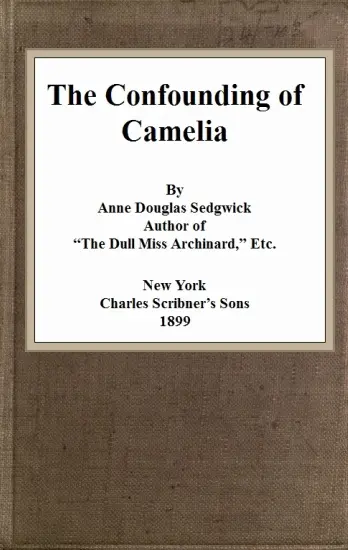
"The Confounding of Camelia" by Anne Douglas Sedgwick is a novel written in the late 19th century. The story revolves around the character Camelia Paton, who returns to her family estate in the country after a successful but disconcerting season in London. As she navigates the expectations and judgments of those around her, particularly concerning her unconventional nature and her family's legacy of quiet respectability, the narrative explores themes of identity, societal norms, and personal ambition. The opening of the novel introduces us to Camelia's background, including her lineage of “good, quiet people” and her father's rebellious spirit that sets her apart. The text paints a vivid picture of the contrast between her vibrant personality and the conservative views of her community in Clievesbury, establishing her as a figure both admired and scrutinized. We learn about her complex relationships, particularly with her mother, Lady Paton, and her childhood friend, Michael Perior, who seems critical yet protective of her. The dynamics in their interactions suggest an underlying tension and potential for deeper connections as Camelia seeks to assert her identity amidst the conformity she despises while also yearning for acceptance. The stage is set for a rich exploration of her character and the relationships in her life as she confronts societal expectations and her own desires.
Introduction adapted from the source catalogue; source summaries may be automatically generated.
Free to read · English · 74,100 words · No account needed
MAKE TIME FOR A GOOD BOOK
On by default. Untick to stop anonymous reading totals. Each page counts after 10 seconds in view. How this works.
Anonymous counting is on unless you have switched it off.
Camelia smiled at him, and he smiled at her, smiles that might have been children kissing and "making up"; frank, and bravely light.
"I thought you were in London," said Camelia. "No; come back, Siegfried, we are going no farther; for you were coming to us, I suppose, Alceste?" She could look at him quite directly. She was not ashamed, no, mercifully she was not ashamed, that was her jubilant thought. After the pang of the first moment she felt the strong conviction, borne in upon her by her own calmness, that her love for him could never shame her, nor her confession of it. The warm power of his friendship kept her from petty terrors. She felt, in a moment, that on her courage depended their future relationship. To ignore the past, to make him ignore it, would be to regain, to keep her friend.
"Yes, I was going to you--of course," said Perior, smiling, as they went towards the road together.
"I have been to Italy, you know, but I came back some time ago. I
thought I might be of use."
"Ah! I should have liked to have been of use! but I had been too badly bitten to dare put out a finger!"
"I wouldn't put out fingers, if I were you; it isn't safe--when, they are so pretty." The intimacy was almost caressing; she leaned against it thankfully. Proud to show him that of the crying child there was not a trace, she determined on a swift glance at the past that would put him quite at ease.
"And you are coming back? Since this dreary business of the worsted right is over you won't exile yourself any longer--and rob us? All your friends will be glad to have you again!"
"Will they indeed?" his eyes sought hers for a moment, seemed to see in them the past's triumphant mausoleum, presented for inspection quite magnificently.
"Thanks, Camelia." The boldness delighted him, delighted all of him except that grumbling prisoner who, in his dungeon, felt foolishly aggrieved. "Yes, I am coming back--since I am welcome," he said, adding while they went along the road, "As for the worsted right, the right usually is worsted, in the first place. One must try to keep one's faith in eventual winning."
"Tell me," said Camelia, feeling foundations quite secure, since each had helped the other, "Mr. Rodrigg's opposition, that last speech of his--the satanic eloquence of it!--you don't think--ah! say you don't think me altogether responsible?"
"Would it please you--a little--to think you were?" The old rallying
smile pained her.
"Ah, don't! That has been knocked out of me--really! Don't imply such a monstrous perversion of vanity."
Your reading position is saved on this browser. Take it to another device with a library code. Reading pages adapt to text, rather than matching a printed edition.
Anne Douglas Sedgwick
Anne Douglas Sedgwick

Anne Douglas Sedgwick

Anne Douglas Sedgwick
BEHIND THE BOOK
This eBook is for the use of anyone anywhere in the United States and most other parts of the world at no cost and with almost no restrictions whatsoever. You may copy it, give it away or re-use it under the terms of the Project Gutenberg License included with this eBook or online at www.gutenberg.org. If you are not located in the United States, you will have to check the laws of the country where you are located before using this eBook. Read the source licence.
The original source file, including credits and licence, is retained by this library. Request an original-format copy at no charge. Please include the book title and Project Gutenberg identifier #41917.
KEEP YOUR CURIOSITY GOING
Coulson Kernahan

Maurice Baring
Frances Wright
Cécile Tormay

Frederic Jesup Stimson

W. H. P. (William Henry Pope) Jarvis