
Last letters from the living dead man
David Patterson (Spirit) Hatch
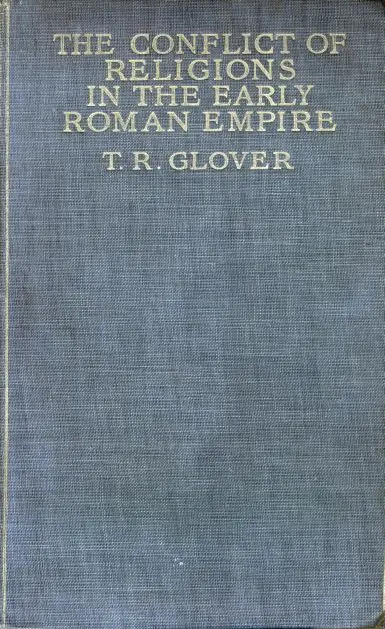
THE CLASSIC COLLECTION · 1909
"The Conflict of Religions in the Early Roman Empire" by T. R. Glover is a historical account written in the early 20th century. The book explores the complex interactions and struggles between various religious ideologies during the early Roman Empire, particularly highlighting the emergence of Christianity alongside established pagan traditions. Glover’s aim seems to be to shed light on how these conflicts shaped the cultural and spiritual landscape of the time. The opening of the text presents a vivid portrayal of the political and social condition of Rome following the assassination of Julius Caesar, setting the stage for the subsequent turmoil and eventual consolidation of power under Augustus. Glover reflects on the chaotic aftermath of Caesar's death and the societal decline that occurred as competing factions struggled for control, leading to widespread disorder. As he introduces the dynamics of Roman religion, Glover indicates a profound concern regarding the moral and spiritual decay of society, hinting at how Augustus sought to restore stability through a revival of traditional Roman religious practices, juxtaposed with the rise of new faiths and ideas, including the nascent Christian movement. This introduction effectively frames the subsequent discussions on the interplay of religious thought and state authority in ancient Rome.
Introduction adapted from the source catalogue; source summaries may be automatically generated.
Free to read · English · 142,040 words · No account needed
MAKE TIME FOR A GOOD BOOK
On by default. Untick to stop anonymous reading totals. Each page counts after 10 seconds in view. How this works.
Anonymous counting is on unless you have switched it off.
Clement, as already said, professed himself an eclectic in philosophy, and of such we need not expect the closest reasoning. Our plan will be to gather passages illustrative of his thoughts--we might almost say of his moods--and set side by side what he says from time to time of God. On such a subject it is perhaps impossible to hope for logic or consistency except at the cost of real aspects of the matter in hand. Something will be gained if we can realize the thoughts which most moved the man, even though their reconciliation is questionably possible. This doubt however does not seem to have occurred to himself, for he connects the dogmata of the philosophers and the teaching of the New Testament as if it were the most natural thing in the world.
To begin with the account of God which Clement gives in philosophical language. "The Lord calls himself 'one' (hen)--'that they all may be one ... as we are one; I in them, and thou in me, that they may be perfected into one.' Now God is 'one' (hen) and away beyond the 'one' (henos) and above the Monad itself."[105] Again, after quoting Solon and Empedocles and "John the Apostle" ("no man hath seen God at any time"), Clement enlarges on the difficulty of speaking of God:--"How can that be expressed, which is neither genus, nor differentia, nor species, neither indivisible, nor sum, nor accident, nor susceptive of accident? Nor could one properly call him a whole (holon); for whole (to holon) implies dimension, and he is Father of the Whole (ton holon). Nor could, one speak of his parts, for the one is indivisible and therefore limitless, not so conceived because there is no passing beyond it, but as being without dimension or limit, and therefore without form or name. And if we ever name him, calling him, though not properly, one, or the good, or mind, or absolute being, or father, or God, or demiurge, or lord, we do not so speak as putting forward his name; but, for want of his name, we use beautiful names, that the mind may not wander at large, but may rest on these. None of these names, taken singly, informs us of God; but, collectively and taken all together, they point to his almighty power. For predicates are spoken either of properties or of relation, and none of these can we assume about God. Nor is he the subject of the knowledge which amounts to demonstration; for this depends on premisses (protera) and things better known (gnorimotepa);[106] but nothing is anterior to the unbegotten. It remains then by divine grace and by the Logos alone that is from him to perceive the unknowable."[107] Again, "God has no natural relation (physiken schesin) to us, as the founders of heresies hold (not though he make us of what is not, or fashion us from matter, for that is not at all, and this is in every point different from God)--unless you venture to say that we are part of him and of one essence (homoousious) with God; and I do not understand how anyone who {291} knows God will endure to hear that said, when he casts his eye upon our life and the evils with which we are mixed up. For in this way (and it is a thing not fit to speak of) God would be sinning in his parts, that is, if the parts are parts of the whole and complete the whole--if they do not complete it, they would not be parts. However, God, by nature (physei) being rich in pity (eleos), of his goodness he cares for us who are not his members nor by nature his children (mete morion onton autou mete physei teknon). Indeed this is the chief proof of God's goodness, that though this is our position with regard to him, by nature utterly 'alienated' from him, he nevertheless cares for us. For the instinct of kindness to offspring is natural (physike) in animals, and so is friendship with the like-minded based on old acquaintance, but God's pity is rich towards us who in no respect have anything to do with him, I mean, in our being (ousia) or nature or the peculiar property of our being (dynamei te oikeia tes ousias hemon), but merely by our being the work of His will."[108] "The God of the Whole (ton helon), who is above every voice and every thought and every conception, could never be set forth in writing, for his property is to be unspeakable."[109]
Your reading position is saved on this browser. Take it to another device with a library code. Reading pages adapt to text, rather than matching a printed edition.
BEHIND THE BOOK
This eBook is for the use of anyone anywhere in the United States and most other parts of the world at no cost and with almost no restrictions whatsoever. You may copy it, give it away or re-use it under the terms of the Project Gutenberg License included with this eBook or online at www.gutenberg.org. If you are not located in the United States, you will have to check the laws of the country where you are located before using this eBook. Read the source licence.
The original source file, including credits and licence, is retained by this library. Request an original-format copy at no charge. Please include the book title and Project Gutenberg identifier #39092.
KEEP YOUR CURIOSITY GOING
David Patterson (Spirit) Hatch

David Patterson (Spirit) Hatch

David Patterson (Spirit) Hatch
Cécile Tormay

Moritz Busch
John L. Ransom