
Last letters from the living dead man
David Patterson (Spirit) Hatch
THE CLASSIC COLLECTION · 1909
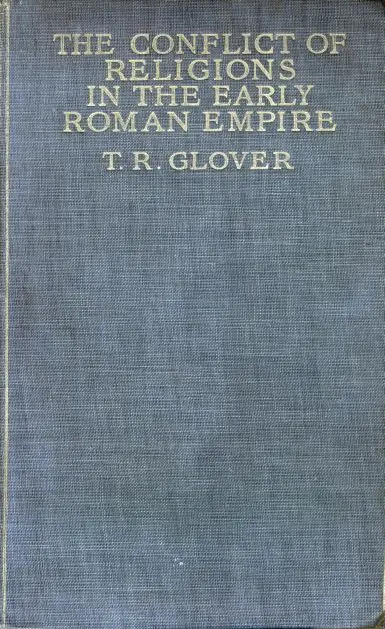
"The Conflict of Religions in the Early Roman Empire" by T. R. Glover is a historical account written in the early 20th century. The book explores the complex interactions and struggles between various religious ideologies during the early Roman Empire, particularly highlighting the emergence of Christianity alongside established pagan traditions. Glover’s aim seems to be to shed light on how these conflicts shaped the cultural and spiritual landscape of the time. The opening of the text presents a vivid portrayal of the political and social condition of Rome following the assassination of Julius Caesar, setting the stage for the subsequent turmoil and eventual consolidation of power under Augustus. Glover reflects on the chaotic aftermath of Caesar's death and the societal decline that occurred as competing factions struggled for control, leading to widespread disorder. As he introduces the dynamics of Roman religion, Glover indicates a profound concern regarding the moral and spiritual decay of society, hinting at how Augustus sought to restore stability through a revival of traditional Roman religious practices, juxtaposed with the rise of new faiths and ideas, including the nascent Christian movement. This introduction effectively frames the subsequent discussions on the interplay of religious thought and state authority in ancient Rome.
Introduction adapted from the source catalogue; source summaries may be automatically generated.
Free to read · English · 142,040 words · No account needed
MAKE TIME FOR A GOOD BOOK
On by default. Untick to stop anonymous reading totals. Each page counts after 10 seconds in view. How this works.
Anonymous counting is on unless you have switched it off.
There ends a column, and a line or two has been lost at the top of what seems to be the next, after which come the words "a kindly feeling for strangers also who may be staying here," and the incomplete statement which begins "knowing assuredly, that by knowledge of the matters relating to Nature and feelings, which I have set forth in the spaces below...." It is evident that Diogenes had something to say which he considered it a duty to make known. This proves to have been the Epicurean theory of life; and here he had carved up for all to read a simple exposition of the philosophy of his choice.
The uppermost row contains his account of his purpose and something upon old age--very fragmentary. There follow a letter of Epicurus to his mother, and another letter from some one unidentified to one Menneas, and then a series of apophthegms and sentences. Thus fragment 27 is a column of ten lines to this effect: "Nothing is so contributive to good spirits, as not to do many things, nor take in hand tiresome matters, nor force oneself in any way beyond one's own strength, for all these things perturb nature." Another column proclaims: "Acute {219} pains cannot be long; for either they quickly destroy life and are themselves destroyed with it, or they receive some abatement of their acuteness." These platitudes are, as we may guess, an afterthought.
The middle row, the first to be inscribed, deals with the Epicurean theory of atoms--not by apophthegm or aphorism, but with something of the fulness and technicality of a treatise. "Herakleitos of Ephesus, then, said fire was the element; Thales of Miletus water; Diogenes of Apollonia and Anaximenes air; Empedocles of Agrigentum both fire and air and water and earth; Anaxagoras of Clazomenae the homoeomeries of each thing in particular; those of the Stoa matter and God. But Democritus of Abdera said atomic natures--and he did well; but since he made some mistakes about them, these will be set right in our opinions. So now we will accuse the persons mentioned, not from any feeling of illwill against them, but wishing the truth to be saved (sothenai)." So he takes them in turn and argues at leisure. The large fragment 45 discusses astronomy in its four columns--in particular, the sun and its apparent distance and its nature. Fr. 48 (four columns) goes on to treat of civilization,--of the development of dress from leaves to skins and woven garments, without the intervention "of any other god or of Athena either." Need and time did all. Hermes did not invent language. In fr. 50, we read that Protagoras "said he did not know if there are gods. That is the same thing as saying he knew there are not." Fr. 51 deals with death--"thou hast even persuaded me to laugh at it. For I am not a whit afraid because of the Tityos-es and Tantalus-es, whom some people paint in Hades, nor do I dread decay, reflecting that the [something] of the body ... [three broken lines] ... nor anything else." At the end of the row another letter begins (fr. 56) "[Diogen]es to Anti[pater] greeting." He writes from Rhodes, he says, just before winter begins, to friends in Athens and elsewhere, whom he would like to see. Though away from his country, he knows he can do more for it in this way than by taking part in political life. He wishes to show that "that which is convenient to Nature, viz. Ataraxia is the same for all." He is now "at the sunset of life," and all but departing; so, since most men, as in a pestilence, are diseased with false opinion, which is very infectious, he wishes {220} "to help those that shall be after us; for they too are ours, even if they are not yet born"; and strangers too. "I wished to make use of this colonnade and to set forth in public the medicine of salvation" (ta tes soterias protheinai pharmaka, fr. 58). The idle fears that oppressed him, he has shaken off; as to pains--empty ones he has abolished utterly, and the rest are reduced to the smallest compass. He bewails the life of men, wasted as it is, and weeps for it; and he has "counted it a good man's part" to help men as far as he can. That is why he has thought of this inscription which may enable men to obtain "joy with good spirits" (te[s met' euthu]mias chara[s]), rather than of a theatre or a bath or anything else of the kind, such as rich men would often build for their fellow-citizens (fr. 59).
Your reading position is saved on this browser. Take it to another device with a library code. Reading pages adapt to text, rather than matching a printed edition.
BEHIND THE BOOK
This eBook is for the use of anyone anywhere in the United States and most other parts of the world at no cost and with almost no restrictions whatsoever. You may copy it, give it away or re-use it under the terms of the Project Gutenberg License included with this eBook or online at www.gutenberg.org. If you are not located in the United States, you will have to check the laws of the country where you are located before using this eBook. Read the source licence.
The original source file, including credits and licence, is retained by this library. Request an original-format copy at no charge. Please include the book title and Project Gutenberg identifier #39092.
KEEP YOUR CURIOSITY GOING
David Patterson (Spirit) Hatch

David Patterson (Spirit) Hatch

David Patterson (Spirit) Hatch
Cécile Tormay

Moritz Busch
John L. Ransom