
Last letters from the living dead man
David Patterson (Spirit) Hatch
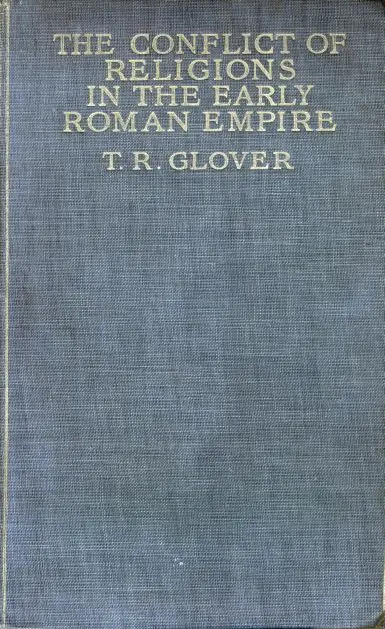
THE CLASSIC COLLECTION · 1909
"The Conflict of Religions in the Early Roman Empire" by T. R. Glover is a historical account written in the early 20th century. The book explores the complex interactions and struggles between various religious ideologies during the early Roman Empire, particularly highlighting the emergence of Christianity alongside established pagan traditions. Glover’s aim seems to be to shed light on how these conflicts shaped the cultural and spiritual landscape of the time. The opening of the text presents a vivid portrayal of the political and social condition of Rome following the assassination of Julius Caesar, setting the stage for the subsequent turmoil and eventual consolidation of power under Augustus. Glover reflects on the chaotic aftermath of Caesar's death and the societal decline that occurred as competing factions struggled for control, leading to widespread disorder. As he introduces the dynamics of Roman religion, Glover indicates a profound concern regarding the moral and spiritual decay of society, hinting at how Augustus sought to restore stability through a revival of traditional Roman religious practices, juxtaposed with the rise of new faiths and ideas, including the nascent Christian movement. This introduction effectively frames the subsequent discussions on the interplay of religious thought and state authority in ancient Rome.
Introduction adapted from the source catalogue; source summaries may be automatically generated.
Free to read · English · 142,040 words · No account needed
MAKE TIME FOR A GOOD BOOK
On by default. Untick to stop anonymous reading totals. Each page counts after 10 seconds in view. How this works.
Anonymous counting is on unless you have switched it off.
The most accessible illustration of this line of apology is to be found in the second chapter of Matthew. We may set out in parallel columns the events in the life of Jesus and the prophecies which they fulfil.
(a) The Virgin-Birth. Isaiah 7, 14: Behold a virgin shall conceive.
(b) Bethlehem. Micah 5,2: And thou, Bethlehem, etc.
(c) The Flight into Egypt. Hosea 11, 1: Out of Egypt have I called my son.
(d) The Murder of the children. Jerem. 31, 15: Rachel weeping.
(e) Nazareth. Judges 13, 5: A Nazarene.
{185} It is hardly unfair to say that the man who cited these passages in these connexions had no idea whatever of their original meaning, even where he quotes them correctly.
Here is a fuller scheme taken from the Apology which Justin addressed to the Emperor Antoninus Pius. (The numbers on the left refer to the chapter in the first Apology.)
32. Jesus Christ foretold by Gen. 49, 10 f: (the blessing Judah). of Moses.
Numbers 24, 17: There shall
dawn a star, etc.
Jesus Christ foretold by Isaiah 11, i: the rod of Jesse, Isaiah. etc.
33. Jesus Christ to be born Is. 7, 14: (the sign to of a virgin. Ahaz).
34. Jesus Christ to be born at Micah 5, 2: Thou, Bethlehem, Bethlehem. etc.
35. The triumphal entry into Zech. 9, 9: Thy king cometh Jerusalem. riding on an ass, etc.
The Crucifixion: the Cross. Is. 9,6: The government upon his shoulders.
Is. 65, 2: I have stretched out
my hands, etc.
The Crucifixion: the Is. 58, 2: They ask me for mockery. judgment, etc.
The Crucifixion: the nails Psalm 22, 16, 18: They and the casting of lots. pierced my feet and my hands; they cast lots upon my raiment.
38. The Crucifixion: the Is. 50, 6-8: I gave my back scourging. to the lashes and my cheeks to blows, etc.
The Crucifixion: the Ps. 22, 7: they wagged the mocking. head, saying, etc.
The Crucifixion: the Ps. 3, 5: I slept and slumbered resurrection. and I rose up (anesten) because the Lord laid hold of me.
39. The sending of the twelve Is. 2, 3 f.: Out of Sion shall Apostles. go forth the law.
40. The proclamation of the Ps. 19, 2-5: Day unto day, Gospel. etc.
Christ, Pilate, the Jews Psalms 1 and 2: cited in and Herod. extenso.
41. Christ to reign after the 1 Chron. 16, 23, 25-31: (a Crucifixion. psalm). Cf. Ps. 96, i, 2, 4-11, with ending: "The Lord hath reigned from the tree."
45. The Ascension. Ps. 110, 1-3: Sit thou at my right hand, etc.
47. The desolation of Jerusalem. Is. 64, 10-12: Sion has become desert, etc.
Is. 1, 7, and Jer. 50, 3:
Their land is desert.
48. The miracles of Christ. Is. 35, 5, 6: The lame shall leap ... the dead shall rise and walk, etc.
Christ's death. Is. 57, 1 f.: Behold, how the Just Man has perished, etc.
Your reading position is saved on this browser. Take it to another device with a library code. Reading pages adapt to text, rather than matching a printed edition.
BEHIND THE BOOK
This eBook is for the use of anyone anywhere in the United States and most other parts of the world at no cost and with almost no restrictions whatsoever. You may copy it, give it away or re-use it under the terms of the Project Gutenberg License included with this eBook or online at www.gutenberg.org. If you are not located in the United States, you will have to check the laws of the country where you are located before using this eBook. Read the source licence.
The original source file, including credits and licence, is retained by this library. Request an original-format copy at no charge. Please include the book title and Project Gutenberg identifier #39092.
KEEP YOUR CURIOSITY GOING
David Patterson (Spirit) Hatch

David Patterson (Spirit) Hatch

David Patterson (Spirit) Hatch
Cécile Tormay

Moritz Busch
John L. Ransom