
Last letters from the living dead man
David Patterson (Spirit) Hatch
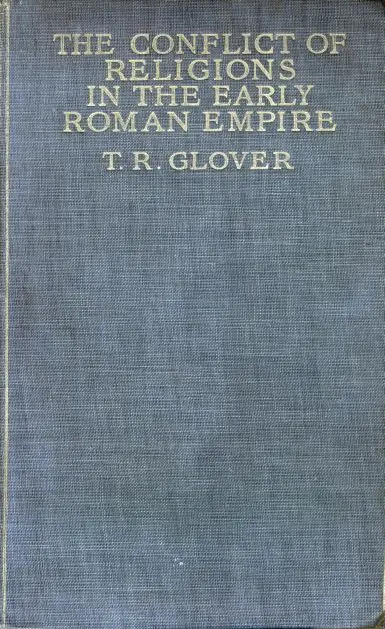
THE CLASSIC COLLECTION · 1909
"The Conflict of Religions in the Early Roman Empire" by T. R. Glover is a historical account written in the early 20th century. The book explores the complex interactions and struggles between various religious ideologies during the early Roman Empire, particularly highlighting the emergence of Christianity alongside established pagan traditions. Glover’s aim seems to be to shed light on how these conflicts shaped the cultural and spiritual landscape of the time. The opening of the text presents a vivid portrayal of the political and social condition of Rome following the assassination of Julius Caesar, setting the stage for the subsequent turmoil and eventual consolidation of power under Augustus. Glover reflects on the chaotic aftermath of Caesar's death and the societal decline that occurred as competing factions struggled for control, leading to widespread disorder. As he introduces the dynamics of Roman religion, Glover indicates a profound concern regarding the moral and spiritual decay of society, hinting at how Augustus sought to restore stability through a revival of traditional Roman religious practices, juxtaposed with the rise of new faiths and ideas, including the nascent Christian movement. This introduction effectively frames the subsequent discussions on the interplay of religious thought and state authority in ancient Rome.
Introduction adapted from the source catalogue; source summaries may be automatically generated.
Free to read · English · 142,040 words · No account needed
MAKE TIME FOR A GOOD BOOK
On by default. Untick to stop anonymous reading totals. Each page counts after 10 seconds in view. How this works.
Anonymous counting is on unless you have switched it off.
[89] Cf. the story of the appearance to Brutus of his evil genius--ho sos, o broute, daimon kakos, Brutus, 36. Basilides the Gnostic (the father of Isidore) is credited with describing Man as a sort of Wooden Horse with a whole army of different spirits in him (Clem. Alex. Strom, ii, 113). Plutarch makes a similar jibe at the Stoic account of arts, virtues, vices, etc., as corporeal or even animate and rational beings--making a man "a Paradise, or a cattle-pen, or a Wooden Horse," de commun. notit. adv. Stoicos, 45, 1084 B. There was a tendency in contemporary psychology to attribute all feelings, etc., to daemonic influence; cf. Clem. Alex. Strom. ii, 110, who suggests that all pathe are imprints (as of a seal) made on the soul by the spiritual powers against which we have to wrestle. Cf. Tert. de Anima, 41, the evil of soul in part due to evil spirit.
[90] Clement says (Strom. vi, 53) that Isidore the Gnostic "in the first book of the expositions of Parchor the Prophet" dealt with the daemon of Socrates and quoted Aristotle's authority for such tutelary spirits. For the book of Apuleius, see ch. vii.
[91] Porphyry, v. Plotini, 10. Cf. Origen, c. Cels. vii, 35, for Celsus' views on the visibility of daemons, e.g. in the cave of Trophonius.
[92] Life of Numa, 4--a most interesting chapter, when it is remembered what other works were being written contemporaneously.
[93] de genio Socr. 20, 588 D, 589 D.
[94] de gen. Socr. 24, 593 D.
[95] de def. orac. 38, 431 C, phantasias tou mellontos.
[96] Cf. Clem. Alex. Strom. vi, 46, on preaching of Christ in Hades, where souls, rid of the flesh, see more clearly.
[97] de dif. orac. 40, 432 C-E, thermoteti gar kai diachysei porous tinas anoigein phantastikous tou mellontos eikos estin.
For these poroi cf. Clem. Alex. Strom, vii, 36, with J. B. Mayor's
note.
[98] de def. orac. 46-48, 435 A-437 A (referring to Phaedo, 97 D). The curious mixture of metaphors, the double suggestion of krasis, the parallel from music, and the ambiguity of to enthousiastikon (characteristic of the confusion of spiritual and material then prevalent) make a curious sentence in English. On the relation of daemons to oracles, see also de facie in orbe lunae, 30, 944 D; also Tertullian, de Anima, 46, who gives a lucid account of daemons as the explanation of oracles, and Apol. 22--daemons inhabiting the atmosphere have early knowledge of the weather, and by their incredible speed can pass miraculously quickly from one end of the earth to the other, and so bring information--strange, he adds (c. 25), that Cybele took a week to inform her priest of the death of Marcus Aurelius--o somniculosa diplomata! ("sleepy post").
Your reading position is saved on this browser. Take it to another device with a library code. Reading pages adapt to text, rather than matching a printed edition.
BEHIND THE BOOK
This eBook is for the use of anyone anywhere in the United States and most other parts of the world at no cost and with almost no restrictions whatsoever. You may copy it, give it away or re-use it under the terms of the Project Gutenberg License included with this eBook or online at www.gutenberg.org. If you are not located in the United States, you will have to check the laws of the country where you are located before using this eBook. Read the source licence.
The original source file, including credits and licence, is retained by this library. Request an original-format copy at no charge. Please include the book title and Project Gutenberg identifier #39092.
KEEP YOUR CURIOSITY GOING
David Patterson (Spirit) Hatch

David Patterson (Spirit) Hatch

David Patterson (Spirit) Hatch
Cécile Tormay

Moritz Busch
John L. Ransom