
Last letters from the living dead man
David Patterson (Spirit) Hatch
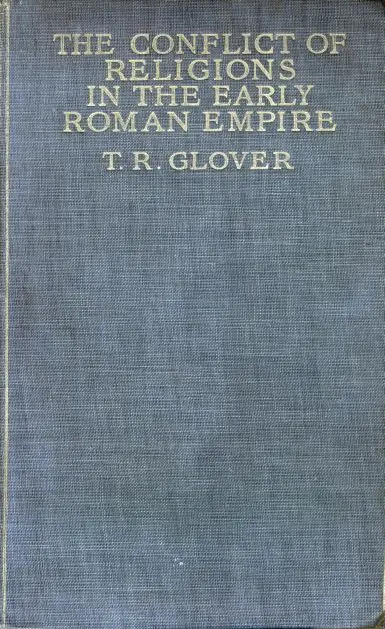
THE CLASSIC COLLECTION · 1909
"The Conflict of Religions in the Early Roman Empire" by T. R. Glover is a historical account written in the early 20th century. The book explores the complex interactions and struggles between various religious ideologies during the early Roman Empire, particularly highlighting the emergence of Christianity alongside established pagan traditions. Glover’s aim seems to be to shed light on how these conflicts shaped the cultural and spiritual landscape of the time. The opening of the text presents a vivid portrayal of the political and social condition of Rome following the assassination of Julius Caesar, setting the stage for the subsequent turmoil and eventual consolidation of power under Augustus. Glover reflects on the chaotic aftermath of Caesar's death and the societal decline that occurred as competing factions struggled for control, leading to widespread disorder. As he introduces the dynamics of Roman religion, Glover indicates a profound concern regarding the moral and spiritual decay of society, hinting at how Augustus sought to restore stability through a revival of traditional Roman religious practices, juxtaposed with the rise of new faiths and ideas, including the nascent Christian movement. This introduction effectively frames the subsequent discussions on the interplay of religious thought and state authority in ancient Rome.
Introduction adapted from the source catalogue; source summaries may be automatically generated.
Free to read · English · 142,040 words · No account needed
MAKE TIME FOR A GOOD BOOK
On by default. Untick to stop anonymous reading totals. Each page counts after 10 seconds in view. How this works.
Anonymous counting is on unless you have switched it off.
[56] Adv. Coloten (foe Epicurean), 31, 1125 D, E. For this argument from consensus, see Seneca, Ep. 117, 6, Multum dare solemus praesumptioni omnium hominum et apud nos veritatis argumentum est aliquid omnibus videri: tanquam deos esse inter alia hoc colligimus, quod omnibus insita de dis opinio est, nee ulla gens usquam est adeo extra leges moresque projecta ut non aliquos deos credat. This consensus rests (with the Stoics) on the common preconceptions of the mind, which are natural. For ridicule of the doctrine of consensus, see Lucian, Zeus Tragaedus, 42.
[57] Amatorius, 18, 763 C. Cf. view of Celsus ap. Orig. c. Cels.
vii, 41.
[58] Consol. ad Apoll. 34, 120 B.
[59] Quomodo Poetas, 1, 15 E, F, poetry a preliminary study to philosophy, prophilosopheteon tois poiemasin.
[60] de Pyth. orac. 29, 408 F. Cf. the pagan's speech in Minucius Felix, 7, 6, pleni et mixti deo vates futura praecerpunt ... etiam per guietem deos videmus....
[61] So Volkmann, Plutarch, ii, 290 n. Cf. a passage of Celsus,
Orig. c. Cels. viii, 45.
[62] de def. or. 14, 417 C, emphaseis and diaphaseis.
[63] Tertullian sums up the pagan line of argument and adds a telling criticism in his book adversus Nationes, ii, 1: adversus haec igitur nobis negotium est, adversus institutiones maiorum, auctoritates receptorum, leges dominantium, argumentationes prudentium, adversus vetustatem consuetudinem necessitatem, adversus exempla prodigia miracula, quae omnia adulterinam istam divinitatem corroboraverint.... Maior in huiusmodi penes vos auctoritas litterarum quam rerum est.
[64] de Iside, 67, 377 F-378 A
[65] Oakesmith, Religion of Plutarch, p. 88--a book which I have
found of great use.
[66] de E. 18-20. Cf. Clem. Alex. Protr. 84. The true To-day of God is eternity. Also Tert. ad Natt. ii, 6, on the axiom of no change in God.
[67] de E. 21.
[68] Cf. Plato, Timaeus, 55 D.
[69] Plutarch, de. def. orac. 29, 425 F-426 A. Celsus has the same view; (Origen, c. Cels. v, 25; vii, 68): the world's regions are severally allotted to epoptai under Providence; so that local usages may well be maintained in such form as pleases them; to alter these would be impious, while to worship the daemons is to honour God, who is not jealous of them. Cf. Plutarch, de fortuna Romanorum, 11, 324 B, ho Romaion megas daimon ... te polei synebesas kai synauxetheis, kthe--the tract is a poor and rhetorical one, and the phrase may be merely a synonym for "luck." See also Celsus (Orig. c. Cels. viii, 58) on the Egyptian attribution of the human body to thirty-six "daemons or gods of aether," so that by prayer to the right one disease in any part of the body may be cured; Celsus gives some of their names. The Christians assumed a somewhat similar scheme with a rather different development. Athenagoras, an apologist of the second century, gives the following account in his Presbeia, 24-27. A system of angels under Providence existed, some good and some bad, enjoying free-will as men also do; "the ruler of matter and of the forms in it" lusted after virgins and succumbed to flesh, and neglected the administration entrusted to him; others fell with him; they cannot regain heaven but meantime occupy the air; their children by mortal women were giants and the souls of these are the daemons; the ruler of matter directs all things against God; with matter are connected the soul's worse impulses. See also Clem. Alex. Strom. vi, 157, on angelic governance of individual nations and cities; and Lactantius, Instit. ii, 8, 14, whose account fairly resembles that of Athenagoras. Tertullian, however, suggests (Apol. 11) that the Creator had no need of ancillary gods to complete his work.
Your reading position is saved on this browser. Take it to another device with a library code. Reading pages adapt to text, rather than matching a printed edition.
BEHIND THE BOOK
This eBook is for the use of anyone anywhere in the United States and most other parts of the world at no cost and with almost no restrictions whatsoever. You may copy it, give it away or re-use it under the terms of the Project Gutenberg License included with this eBook or online at www.gutenberg.org. If you are not located in the United States, you will have to check the laws of the country where you are located before using this eBook. Read the source licence.
The original source file, including credits and licence, is retained by this library. Request an original-format copy at no charge. Please include the book title and Project Gutenberg identifier #39092.
KEEP YOUR CURIOSITY GOING
David Patterson (Spirit) Hatch

David Patterson (Spirit) Hatch

David Patterson (Spirit) Hatch
Cécile Tormay

Moritz Busch
John L. Ransom