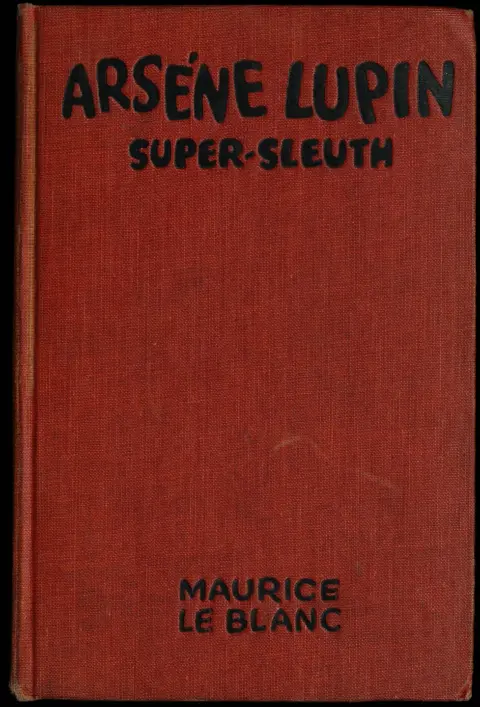
Arsène Lupin, super-sleuth
Maurice Leblanc
THE CLASSIC COLLECTION · 1912
"The Confessions of Arsène Lupin" by Maurice Leblanc is a collection of adventure stories written in the early 20th century. The narrative revolves around Arsène Lupin, a suave gentleman thief who combines charm and cunning to outsmart the law and other adversaries. This work showcases his escapades, detailing his participation in various crimes, his interactions with law enforcement, and his clever methods of infiltration and theft, all while maintaining his morality in some cases. The opening portion introduces the reader to Lupin's character through an engaging interplay between him and a narrative voice seeking to learn more about his exploits. Lupin is depicted lounging in a study, playfully dismissing inquiries about his legendary exploits, yet eventually indulging in providing snippets of insight by giving clues in a cryptic manner concerning a significant case involving a missing baroness and a hefty reward for her discovery. As the first chapter unfolds, Lupin demonstrates his talent for deduction and disguising his true intentions while he seems casually embroiled in a deeper mystery tied to the murder of a man linked to the baroness's disappearance, hinting at the thrilling adventures that await as his story progresses.
Introduction adapted from the source catalogue; source summaries may be automatically generated.
Free to read · English · 66,598 words · No account needed
MAKE TIME FOR A GOOD BOOK
On by default. Untick to stop anonymous reading totals. Each page counts after 10 seconds in view. How this works.
Anonymous counting is on unless you have switched it off.
"I received your telegram and here I am," said a gentleman with a grey moustache, who entered my study, dressed in a dark-brown frock-coat and a wide-brimmed hat, with a red ribbon in his buttonhole. "What's the matter?"
Had I not been expecting Arsene Lupin, I should certainly never have recognized him in the person of this old half-pay officer:
"What's the matter?" I echoed. "Oh, nothing much: a rather curious coincidence, that's all. And, as I know that you would just as soon clear up a mystery as plan one...."
"Well?"
"You seem in a great hurry!"
"I am ... unless the mystery in question is worth putting myself out for. So let us get to the point."
"Very well. Just begin by casting your eye on this little picture, which I picked up, a week or two ago, in a grimy old shop on the other side of the river. I bought it for the sake of its Empire frame, with the palm-leaf ornaments on the mouldings ... for the painting is execrable."
"Execrable, as you say," said Lupin, after he had examined it, "but the subject itself is rather nice. That corner of an old courtyard, with its rotunda of Greek columns, its sun-dial and its fish-pond and that ruined well with the Renascence roof and those stone steps and stone benches: all very picturesque."
"And genuine," I added. "The picture, good or bad, has never been taken out of its Empire frame. Besides, it is dated.... There, in the left-hand bottom corner: those red figures, 15. 4. 2, which obviously stand for 15 April, 1802."
"I dare say ... I dare say.... But you were speaking of a coincidence and, so far, I fail to see...."
I went to a corner of my study, took a telescope, fixed it on its stand and pointed it, through the open window, at the open window of a little room facing my flat, on the other side of the street. And I asked Lupin to look through it.
He stooped forward. The slanting rays of the morning sun lit up the room opposite, revealing a set of mahogany furniture, all very simple, a large bed and a child's bed hung with cretonne curtains.
"Ah!" cried Lupin, suddenly. "The same picture!"
"Exactly the same!" I said. "And the date: do you see the date, in red?
15. 4. 2."
"Yes, I see.... And who lives in that room?"
"A lady ... or, rather, a workwoman, for she has to work for her living ... needlework, hardly enough to keep herself and her child."
"What is her name?"
"Louise d'Ernemont.... From what I hear, she is the great-granddaughter of a farmer-general who was guillotined during the Terror."
Your reading position is saved on this browser. Take it to another device with a library code. Reading pages adapt to text, rather than matching a printed edition.
Maurice Leblanc
Maurice Leblanc
Maurice Leblanc
Maurice Leblanc
BEHIND THE BOOK
This eBook is for the use of anyone anywhere in the United States and most other parts of the world at no cost and with almost no restrictions whatsoever. You may copy it, give it away or re-use it under the terms of the Project Gutenberg License included with this eBook or online at www.gutenberg.org. If you are not located in the United States, you will have to check the laws of the country where you are located before using this eBook. Read the source licence.
The original source file, including credits and licence, is retained by this library. Request an original-format copy at no charge. Please include the book title and Project Gutenberg identifier #28093.
KEEP YOUR CURIOSITY GOING
Coulson Kernahan

Maurice Baring
Frances Wright
Cécile Tormay

Frederic Jesup Stimson

W. H. P. (William Henry Pope) Jarvis