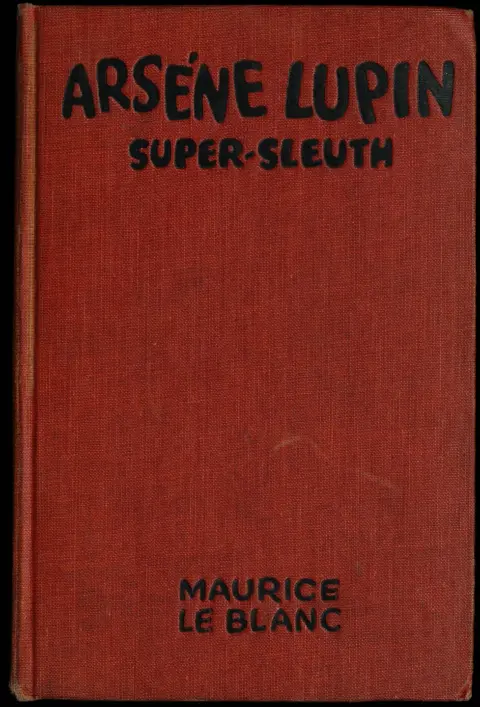
Arsène Lupin, super-sleuth
Maurice Leblanc
THE CLASSIC COLLECTION · 1912
"The Confessions of Arsène Lupin" by Maurice Leblanc is a collection of adventure stories written in the early 20th century. The narrative revolves around Arsène Lupin, a suave gentleman thief who combines charm and cunning to outsmart the law and other adversaries. This work showcases his escapades, detailing his participation in various crimes, his interactions with law enforcement, and his clever methods of infiltration and theft, all while maintaining his morality in some cases. The opening portion introduces the reader to Lupin's character through an engaging interplay between him and a narrative voice seeking to learn more about his exploits. Lupin is depicted lounging in a study, playfully dismissing inquiries about his legendary exploits, yet eventually indulging in providing snippets of insight by giving clues in a cryptic manner concerning a significant case involving a missing baroness and a hefty reward for her discovery. As the first chapter unfolds, Lupin demonstrates his talent for deduction and disguising his true intentions while he seems casually embroiled in a deeper mystery tied to the murder of a man linked to the baroness's disappearance, hinting at the thrilling adventures that await as his story progresses.
Introduction adapted from the source catalogue; source summaries may be automatically generated.
Free to read · English · 66,598 words · No account needed
MAKE TIME FOR A GOOD BOOK
On by default. Untick to stop anonymous reading totals. Each page counts after 10 seconds in view. How this works.
Anonymous counting is on unless you have switched it off.
"You're getting warm, chief, you're getting warm! It is certain that the tapestries, as they cannot have been stolen by any one making his way surreptitiously into the house, were stolen by somebody who remained in the house; and it is equally certain that, by taking the list of the people invited and inquiring into the antecedents of each of them, one might...."
"Well?"
"Well, chief, there's a 'but,' namely, that the three detectives had this list in their hands when the guests arrived and that they still had it when the guests left. Now sixty-three came in and sixty-three went away. So you see...."
"Then do you suppose a servant?..."
"No."
"The detectives?"
"No."
"But, still ... but, still," said the chief, impatiently, "if the robbery was committed from the inside...."
"That is beyond dispute," declared the inspector, whose excitement seemed to be nearing fever-point. "There is no question about it. All my investigations led to the same certainty. And my conviction gradually became so positive that I ended, one day, by drawing up this startling axiom: in theory and in fact, the robbery can only have been committed with the assistance of an accomplice staying in the house. Whereas there was no accomplice!"
"That's absurd," said Dudouis.
"Quite absurd," said Ganimard. "But, at the very moment when I uttered that absurd sentence, the truth flashed upon me."
"Eh?"
"Oh, a very dim, very incomplete, but still sufficient truth! With that clue to guide me, I was bound to find the way. Do you follow me, chief?"
M. Dudouis sat silent. The same phenomenon that had taken place in Ganimard was evidently taking place in him. He muttered:
"If it's not one of the guests, nor the servants, nor the private detectives, then there's no one left...."
"Yes, chief, there's one left...."
M. Dudouis started as though he had received a shock; and, in a voice that betrayed his excitement:
"But, look here, that's preposterous."
"Why?"
"Come, think for yourself!"
"Go on, chief: say what's in your mind."
"Nonsense! What do you mean?"
"Go on, chief."
"It's impossible! How can Sparmiento have been Lupin's accomplice?"
Ganimard gave a little chuckle.
"Exactly, Arsene Lupin's accomplice!... That explains everything. During the night, while the three detectives were downstairs watching, or sleeping rather, for Colonel Sparmiento had given them champagne to drink and perhaps doctored it beforehand, the said colonel took down the hangings and passed them out through the window of his bedroom. The room is on the second floor and looks out on another street, which was not watched, because the lower windows are walled up."
Your reading position is saved on this browser. Take it to another device with a library code. Reading pages adapt to text, rather than matching a printed edition.
Maurice Leblanc
Maurice Leblanc
Maurice Leblanc
Maurice Leblanc
BEHIND THE BOOK
This eBook is for the use of anyone anywhere in the United States and most other parts of the world at no cost and with almost no restrictions whatsoever. You may copy it, give it away or re-use it under the terms of the Project Gutenberg License included with this eBook or online at www.gutenberg.org. If you are not located in the United States, you will have to check the laws of the country where you are located before using this eBook. Read the source licence.
The original source file, including credits and licence, is retained by this library. Request an original-format copy at no charge. Please include the book title and Project Gutenberg identifier #28093.
KEEP YOUR CURIOSITY GOING
Coulson Kernahan

Maurice Baring
Frances Wright
Cécile Tormay

Frederic Jesup Stimson

W. H. P. (William Henry Pope) Jarvis