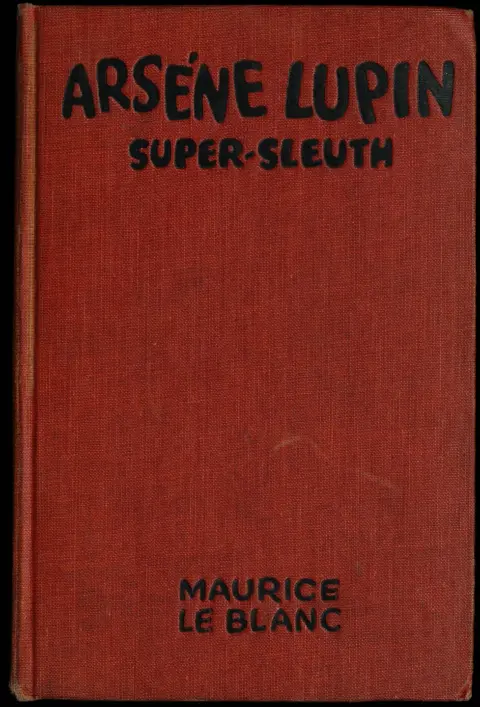
Arsène Lupin, super-sleuth
Maurice Leblanc
THE CLASSIC COLLECTION · 1912
"The Confessions of Arsène Lupin" by Maurice Leblanc is a collection of adventure stories written in the early 20th century. The narrative revolves around Arsène Lupin, a suave gentleman thief who combines charm and cunning to outsmart the law and other adversaries. This work showcases his escapades, detailing his participation in various crimes, his interactions with law enforcement, and his clever methods of infiltration and theft, all while maintaining his morality in some cases. The opening portion introduces the reader to Lupin's character through an engaging interplay between him and a narrative voice seeking to learn more about his exploits. Lupin is depicted lounging in a study, playfully dismissing inquiries about his legendary exploits, yet eventually indulging in providing snippets of insight by giving clues in a cryptic manner concerning a significant case involving a missing baroness and a hefty reward for her discovery. As the first chapter unfolds, Lupin demonstrates his talent for deduction and disguising his true intentions while he seems casually embroiled in a deeper mystery tied to the murder of a man linked to the baroness's disappearance, hinting at the thrilling adventures that await as his story progresses.
Introduction adapted from the source catalogue; source summaries may be automatically generated.
Free to read · English · 66,598 words · No account needed
MAKE TIME FOR A GOOD BOOK
On by default. Untick to stop anonymous reading totals. Each page counts after 10 seconds in view. How this works.
Anonymous counting is on unless you have switched it off.
"And yet, no, it can't be ... Explain yourself.... I don't understand.... I don't want to understand...."
There was a pause, during which the newcomer shut the window and closed the door leading to the next room. Then he came up to the old duke, touched him gently on the shoulder, to wake him from his torpor, and without further preface, as though to cut short any explanation that was not absolutely necessary, spoke as follows:
"Four years ago, that is to say, in the eleventh year of my voluntary exile, when I settled in the extreme south of Algeria, I made the acquaintance, in the course of a hunting-expedition arranged by a big Arab chief, of a man whose geniality, whose charm of manner, whose consummate prowess, whose indomitable pluck, whose combined humour and depth of mind fascinated me in the highest degree. The Comte d'Andresy spent six weeks as my guest. After he left, we kept up a correspondence at regular intervals. I also often saw his name in the papers, in the society and sporting columns. He was to come back and I was preparing to receive him, three months ago, when, one evening as I was out riding, my two Arab attendants flung themselves upon me, bound me, blindfolded me and took me, travelling day and night, for a week, along deserted roads, to a bay on the coast, where five men awaited them. I was at once carried on board a small steam-yacht, which weighed anchor without delay. There was nothing to tell me who the men were nor what their object was in kidnapping me. They had locked me into a narrow cabin, secured by a massive door and lighted by a port-hole protected by two iron cross-bars. Every morning, a hand was inserted through a hatch between the next cabin and my own and placed on my bunk two or three pounds of bread, a good helping of food and a flagon of wine and removed the remains of yesterday's meals, which I put there for the purpose. From time to time, at night, the yacht stopped and I heard the sound of the boat rowing to some harbour and then returning, doubtless with provisions. Then we set out once more, without hurrying, as though on a cruise of people of our class, who travel for pleasure and are not pressed for time. Sometimes, standing on a chair, I would see the coastline, through my port-hole, too indistinctly, however, to locate it. And this lasted for weeks. One morning, in the ninth week, I perceived that the hatch had been left unfastened and I pushed it open. The cabin was empty at the time. With an effort, I was able to take a nail-file from a dressing-table. Two weeks after that, by dint of patient perseverance, I had succeeded in filing through the bars of my port-hole and I could have escaped that way, only, though I am a good swimmer, I soon grow tired. I had therefore to choose a moment when the yacht was not too far from the land. It was not until yesterday that, perched on my chair, I caught sight of the coast; and, in the evening, at sunset, I recognized, to my astonishment, the outlines of the Chateau de Sarzeau, with its pointed turrets and its square keep. I wondered if this was the goal of my mysterious voyage. All night long, we cruised in the offing. The same all day yesterday. At last, this morning, we put in at a distance which I considered favourable, all the more so as we were steaming through rocks under cover of which I could swim unobserved. But, just as I was about to make my escape, I noticed that the shutter of the hatch, which they thought they had closed, had once more opened of itself and was flapping against the partition. I again pushed it ajar from curiosity. Within arm's length was a little cupboard which I managed to open and in which my hand, groping at random, laid hold of a bundle of papers. This consisted of letters, letters containing instructions addressed to the pirates who held me prisoner. An hour later, when I wriggled through the port-hole and slipped into the sea, I knew all: the reasons for my abduction, the means employed, the object in view and the infamous scheme plotted during the last three months against the Duc de Sarzeau-Vendome and his daughter. Unfortunately, it was too late. I was obliged, in order not to be seen from the yacht, to crouch in the cleft of a rock and did not reach land until mid-day. By the time that I had been to a fisherman's cabin, exchanged my clothes for his and come on here, it was three o'clock. On my arrival. I learnt that Angelique's marriage was celebrated this morning."
Your reading position is saved on this browser. Take it to another device with a library code. Reading pages adapt to text, rather than matching a printed edition.
Maurice Leblanc

Maurice Leblanc

Maurice Leblanc
Maurice Leblanc
BEHIND THE BOOK
This eBook is for the use of anyone anywhere in the United States and most other parts of the world at no cost and with almost no restrictions whatsoever. You may copy it, give it away or re-use it under the terms of the Project Gutenberg License included with this eBook or online at www.gutenberg.org. If you are not located in the United States, you will have to check the laws of the country where you are located before using this eBook. Read the source licence.
The original source file, including credits and licence, is retained by this library. Request an original-format copy at no charge. Please include the book title and Project Gutenberg identifier #28093.
KEEP YOUR CURIOSITY GOING
Coulson Kernahan

Maurice Baring
Frances Wright
Cécile Tormay

Frederic Jesup Stimson

W. H. P. (William Henry Pope) Jarvis