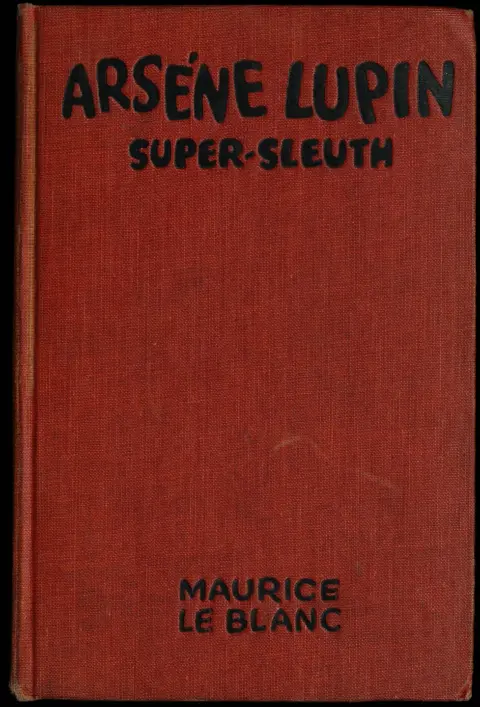
Arsène Lupin, super-sleuth
Maurice Leblanc
THE CLASSIC COLLECTION · 1912
"The Confessions of Arsène Lupin" by Maurice Leblanc is a collection of adventure stories written in the early 20th century. The narrative revolves around Arsène Lupin, a suave gentleman thief who combines charm and cunning to outsmart the law and other adversaries. This work showcases his escapades, detailing his participation in various crimes, his interactions with law enforcement, and his clever methods of infiltration and theft, all while maintaining his morality in some cases. The opening portion introduces the reader to Lupin's character through an engaging interplay between him and a narrative voice seeking to learn more about his exploits. Lupin is depicted lounging in a study, playfully dismissing inquiries about his legendary exploits, yet eventually indulging in providing snippets of insight by giving clues in a cryptic manner concerning a significant case involving a missing baroness and a hefty reward for her discovery. As the first chapter unfolds, Lupin demonstrates his talent for deduction and disguising his true intentions while he seems casually embroiled in a deeper mystery tied to the murder of a man linked to the baroness's disappearance, hinting at the thrilling adventures that await as his story progresses.
Introduction adapted from the source catalogue; source summaries may be automatically generated.
Free to read · English · 66,598 words · No account needed
MAKE TIME FOR A GOOD BOOK
On by default. Untick to stop anonymous reading totals. Each page counts after 10 seconds in view. How this works.
Anonymous counting is on unless you have switched it off.
"As the young bride, by virtue of an unrepealed decree of Charles X, bears the title and arms of the Bourbon-Condes, of whom she is the heiress-of-line, the eldest son of the Lupins de Sarzeau-Vendome will be styled Prince de Bourbon-Conde."
And, the day after, an advertisement.
"Exhibition of Mlle. de Sarzeau-Vendome's trousseau at Messrs.
----'s Great Linen Warehouse. Each article marked with initials L.
S. V."
Then an illustrated paper published a photographic scene: the duke, his daughter and his son-in-law sitting at a table playing three-handed auction-bridge.
And the date also was announced with a great flourish of trumpets: the
4th of May.
And particulars were given of the marriage-settlement. Lupin showed himself wonderfully disinterested. He was prepared to sign, the newspapers said, with his eyes closed, without knowing the figure of the dowry.
All these things drove the old duke crazy. His hatred of Lupin assumed morbid proportions. Much as it went against the grain, he called on the prefect of police, who advised him to be on his guard:
"We know the gentleman's ways; he is employing one of his favourite dodges. Forgive the expression, monsieur le duc, but he is 'nursing' you. Don't fall into the trap."
"What dodge? What trap?" asked the duke, anxiously.
"He is trying to make you lose your head and to lead you, by
intimidation, to do something which you would refuse to do in cold
blood."
"Still, M. Arsene Lupin can hardly hope that I will offer him my
daughter's hand!"
"No, but he hopes that you will commit, to put it mildly, a blunder."
"What blunder?"
"Exactly that blunder which he wants you to commit."
"Then you think, monsieur le prefet ...?"
"I think the best thing you can do, monsieur le duc, is to go home, or, if all this excitement worries you, to run down to the country and stay there quietly, without upsetting yourself."
This conversation only increased the old duke's fears. Lupin appeared to him in the light of a terrible person, who employed diabolical methods and kept accomplices in every sphere of society. Prudence was the watchword.
And life, from that moment, became intolerable. The duke grew more crabbed and silent than ever and denied his door to all his old friends and even to Angelique's three suitors, her Cousins de Mussy, d'Emboise and de Caorches, who were none of them on speaking terms with the others, in consequence of their rivalry, and who were in the habit of calling, turn and turn about, every week.
Your reading position is saved on this browser. Take it to another device with a library code. Reading pages adapt to text, rather than matching a printed edition.
Maurice Leblanc
Maurice Leblanc

Maurice Leblanc
Maurice Leblanc
BEHIND THE BOOK
This eBook is for the use of anyone anywhere in the United States and most other parts of the world at no cost and with almost no restrictions whatsoever. You may copy it, give it away or re-use it under the terms of the Project Gutenberg License included with this eBook or online at www.gutenberg.org. If you are not located in the United States, you will have to check the laws of the country where you are located before using this eBook. Read the source licence.
The original source file, including credits and licence, is retained by this library. Request an original-format copy at no charge. Please include the book title and Project Gutenberg identifier #28093.
KEEP YOUR CURIOSITY GOING
Coulson Kernahan

Maurice Baring
Frances Wright
Cécile Tormay

Frederic Jesup Stimson

W. H. P. (William Henry Pope) Jarvis