Object: matrimony
Montague Glass
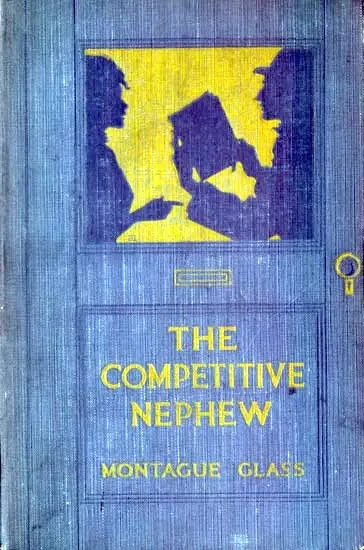
THE CLASSIC COLLECTION · 1915
"The Competitive Nephew" by Montague Glass is a humorous novel written in the early 20th century. The story revolves around the lives and interactions of various characters in the cloak and suit business, highlighting themes of nepotism, competition, and the complexities of human relationships. Central to the narrative are Aaron Pinsky, an asthmatic customer with a fondness for his ambitious nephew Fillup, and the business partners Sam Zaretsky and Max Fatkin, who navigate the challenges of the retail world while dealing with Aaron's interference and aspirations for his nephew. At the start of the novel, readers are introduced to Sam Zaretsky and Max Fatkin, who express their frustrations about competition and the challenges of hiring male employees who might eventually threaten their business. The conversation quickly turns to Aaron Pinsky, who boasts about his promising nephew Fillup, recently graduated from business college. After some comedic miscommunication and Aaron's insistence, Max and Sam reluctantly agree to bring Fillup into their business. As Aaron's character unfolds, with his asthmatic condition often taking center stage in humorous exchanges, the opening sets the stage for various intertwining narratives of ambition, loyalty, and the quirks of family dynamics within the context of the business world.
Introduction adapted from the source catalogue; source summaries may be automatically generated.
Free to read · English · 76,999 words · No account needed
MAKE TIME FOR A GOOD BOOK
On by default. Untick to stop anonymous reading totals. Each page counts after 10 seconds in view. How this works.
Anonymous counting is on unless you have switched it off.
Sam nodded and lay back wearily in the leather seat of the taxicab while it threaded its way through the traffic of lower Fifth Avenue. Only once did he appear to take an interest in his surroundings, and that was when the taxicab halted at the end of a long line of traffic opposite the debris of a new building.
"What's going on here?" he asked faintly.
"It's pretty nearly finished," the doctor replied. "Weldon, Jones & Company, of Minneapolis, are going to open a New York store."
Sam nodded again and once more closed his eyes. He grew more uncomfortable as the end of the journey approached, for he dreaded the reception that awaited him. Max had telephoned the news of his father's illness to his sister, Miss Babette Gembitz, Sam's only daughter, who upon her mother's death had assumed not only the duties but the manner and bearing of that tyrannical person; and Sam knew she would make a searching investigation of the cause of his ailment.
"Doctor, what do you think is the matter with me?" he asked, by way of
a feeler.
"At your age, it's impossible to say," the doctor replied; "but nothing
very serious."
"No?" Sam said. "Well, you don't think it's indigestion, do you?"
"Decidedly not," the doctor said.
"Well, then, you shouldn't forget and tell my daughter that," Sam declared as the cab stopped opposite his house, "otherwise she will swear I am eating something which disagrees with me."
He clambered feebly to the sidewalk, where stood Miss Babette Gembitz with Dr. Sigmund Eichendorfer.
"Wie gehts, Mr. Gembitz?" Doctor Eichendorfer cried cheerfully as he
took Sam's arm.
"Unpaesslich, Doctor," Sam replied. "I guess I'm a pretty sick man."
He glanced at his daughter for some trace of tears, but she met his
gaze unmoved.
"You've been making a hog of yourself again, popper!" she said
severely.
"Oser!" Sam protested. "Crackers and milk I am eating for my lunch. The doctor could tell you the same."
Ten minutes afterward Sam was tucked up in his bed, while in an adjoining room the young physician communicated his diagnosis to Doctor Eichendorfer.
"Arteriosclerosis, I should say," he murmured, and Doctor Eichendorfer
sniffed audibly.
"You mean Bright's Disease--ain't it?" he said. "That feller's arteries is as sound as plumbing."
Doctor Eichendorfer had received his medical training in Vienna and he considered it to be a solemn duty never to agree with the diagnosis of a native M.D.
"I thought of Bright's Disease," the young physician replied, speaking a little less than the naked truth; for in diagnosing Sam's ailment he had thought of nearly every disease he could remember.
Your reading position is saved on this browser. Take it to another device with a library code. Reading pages adapt to text, rather than matching a printed edition.
Montague Glass
Montague Glass

Montague Glass
Montague Glass
BEHIND THE BOOK
This eBook is for the use of anyone anywhere in the United States and most other parts of the world at no cost and with almost no restrictions whatsoever. You may copy it, give it away or re-use it under the terms of the Project Gutenberg License included with this eBook or online at www.gutenberg.org. If you are not located in the United States, you will have to check the laws of the country where you are located before using this eBook. Read the source licence.
The original source file, including credits and licence, is retained by this library. Request an original-format copy at no charge. Please include the book title and Project Gutenberg identifier #32960.
KEEP YOUR CURIOSITY GOING
Coulson Kernahan

Maurice Baring
Frances Wright
Cécile Tormay

Frederic Jesup Stimson

W. H. P. (William Henry Pope) Jarvis