Object: matrimony
Montague Glass
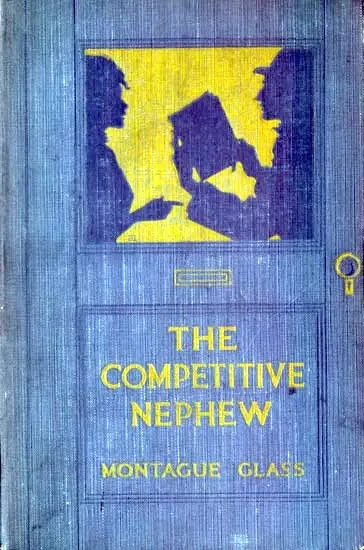
THE CLASSIC COLLECTION · 1915
"The Competitive Nephew" by Montague Glass is a humorous novel written in the early 20th century. The story revolves around the lives and interactions of various characters in the cloak and suit business, highlighting themes of nepotism, competition, and the complexities of human relationships. Central to the narrative are Aaron Pinsky, an asthmatic customer with a fondness for his ambitious nephew Fillup, and the business partners Sam Zaretsky and Max Fatkin, who navigate the challenges of the retail world while dealing with Aaron's interference and aspirations for his nephew. At the start of the novel, readers are introduced to Sam Zaretsky and Max Fatkin, who express their frustrations about competition and the challenges of hiring male employees who might eventually threaten their business. The conversation quickly turns to Aaron Pinsky, who boasts about his promising nephew Fillup, recently graduated from business college. After some comedic miscommunication and Aaron's insistence, Max and Sam reluctantly agree to bring Fillup into their business. As Aaron's character unfolds, with his asthmatic condition often taking center stage in humorous exchanges, the opening sets the stage for various intertwining narratives of ambition, loyalty, and the quirks of family dynamics within the context of the business world.
Introduction adapted from the source catalogue; source summaries may be automatically generated.
Free to read · English · 76,999 words · No account needed
MAKE TIME FOR A GOOD BOOK
On by default. Untick to stop anonymous reading totals. Each page counts after 10 seconds in view. How this works.
Anonymous counting is on unless you have switched it off.
"Sure, I know," Gembitz concluded; "and one thing I am only sorry, Schrimm: your father was a decent, respectable man, Schrimm, but he ought to got to die three years sooner. That's all."
No sooner had Mr. Gembitz left Hammersmith's restaurant than the gefuellte Rinderbrust commenced to assert itself; and by the time he arrived at his place of business he was experiencing all the preliminary symptoms of a severe bilious attack. Nevertheless, he pulled himself together and as he sat down at his desk he called loudly for Sidney.
"He ain't in," Max said.
"Oh, he ain't, ain't he?" Mr. Gembitz retorted. "Well, where is he?"
"He went out with a feller from the New Idea Store, Bridgetown," Max answered, drawing on his imagination in the defence of his brother.
"New Idea Store!" Gembitz repeated. "What's the feller's name?"
Max shrugged.
"I forgot his name," he answered.
"Well, I ain't forgot his name," Gembitz continued. "His name is Kelly; and every afternoon Schrimm tells me Sidney is playing this here Kelly pool."
For a brief interval Max stared at his father; then he broke into an
unrestrained laugh.
"Nu!" Gembitz cried. "What's the joke?"
"Why," Max explained, "you're all twisted. Kelly ain't a feller at all. Kelly pool's a game, like you would say straight pinochle and auction pinochle--there's straight pool and Kelly pool."
Gembitz drummed on his desk with his fingers.
"Do you mean to told me there ain't no such person, which he is buying goods for a concern, called Kelly?" he demanded.
Max nodded.
"Then that loafer just fools away his time every afternoon," Gembitz said in choking tones; "and, after all I done for him, he----"
"What's the matter, popper?" Max cried, for Gembitz's lips had suddenly grown purple, and, even as Max reached forward to aid him, he lurched from his chair on to the floor.
Half an hour later Samuel Gembitz was undergoing the entirely novel experience of riding uptown in a taxicab, accompanied by a young physician who had been procured from the medical department of an insurance company across the street.
"Say, lookyhere," Sam protested as they assisted him into the cab, "this ain't necessary at all!"
"No, I know it isn't," the doctor agreed, in his best imitation of an old practitioner's jocular manner. He was, in fact, a very young practitioner and was genuinely alarmed at Samuel's condition, which he attributed to arteriosclerosis and not to gefuellte Rinderbrust. "But, just the same," he concluded, "it is just as well to keep as quiet as possible for the present."
Your reading position is saved on this browser. Take it to another device with a library code. Reading pages adapt to text, rather than matching a printed edition.
Montague Glass
Montague Glass

Montague Glass
Montague Glass
BEHIND THE BOOK
This eBook is for the use of anyone anywhere in the United States and most other parts of the world at no cost and with almost no restrictions whatsoever. You may copy it, give it away or re-use it under the terms of the Project Gutenberg License included with this eBook or online at www.gutenberg.org. If you are not located in the United States, you will have to check the laws of the country where you are located before using this eBook. Read the source licence.
The original source file, including credits and licence, is retained by this library. Request an original-format copy at no charge. Please include the book title and Project Gutenberg identifier #32960.
KEEP YOUR CURIOSITY GOING
Coulson Kernahan

Maurice Baring
Frances Wright
Cécile Tormay

Frederic Jesup Stimson

W. H. P. (William Henry Pope) Jarvis