Object: matrimony
Montague Glass
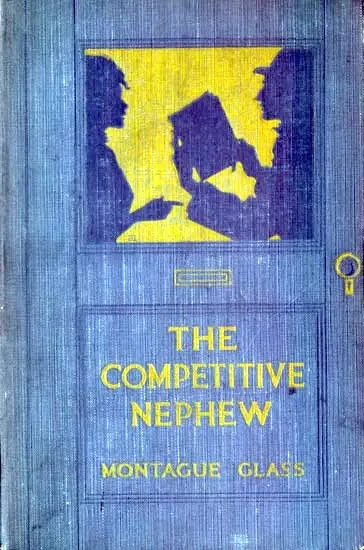
THE CLASSIC COLLECTION · 1915
"The Competitive Nephew" by Montague Glass is a humorous novel written in the early 20th century. The story revolves around the lives and interactions of various characters in the cloak and suit business, highlighting themes of nepotism, competition, and the complexities of human relationships. Central to the narrative are Aaron Pinsky, an asthmatic customer with a fondness for his ambitious nephew Fillup, and the business partners Sam Zaretsky and Max Fatkin, who navigate the challenges of the retail world while dealing with Aaron's interference and aspirations for his nephew. At the start of the novel, readers are introduced to Sam Zaretsky and Max Fatkin, who express their frustrations about competition and the challenges of hiring male employees who might eventually threaten their business. The conversation quickly turns to Aaron Pinsky, who boasts about his promising nephew Fillup, recently graduated from business college. After some comedic miscommunication and Aaron's insistence, Max and Sam reluctantly agree to bring Fillup into their business. As Aaron's character unfolds, with his asthmatic condition often taking center stage in humorous exchanges, the opening sets the stage for various intertwining narratives of ambition, loyalty, and the quirks of family dynamics within the context of the business world.
Introduction adapted from the source catalogue; source summaries may be automatically generated.
Free to read · English · 76,999 words · No account needed
MAKE TIME FOR A GOOD BOOK
On by default. Untick to stop anonymous reading totals. Each page counts after 10 seconds in view. How this works.
Anonymous counting is on unless you have switched it off.
But the waiters were too quick for him, and Daiches struck the car tracks and bounded east on Grand Street, toward his place of business, before Wolfson had an opportunity to question him.
Wolfson returned to his table without further appetite for his food. Hastily and with trembling fingers he took from his wallet a tissue-paper package wrapped after the fashion of a seidlitz powder. This he opened and exposed five glittering gems, but it seemed now to Wolfson that they possessed almost a spurious brilliancy. He glanced around nervously and at a table in the rear of the room he espied Sigmund Pollak, the pawnbroker, who could appraise a gem at a minute's notice by virtue of his long experience with impecunious customers.
At a frenzied gesture from Wolfson, Pollak leisurely crossed the room.
"Hullo, Wolfson," he said, "what's the trouble now?"
"Nothing," Wolfson replied, "only I want it you should do me a favour and look at these here diamonds."
Pollak examined them carefully.
"How much did you give for 'em?" he asked.
"I didn't give nothing for 'em," Wolfson replied. "I found 'em in a safe what I bought it from a feller by the name Philip Borrochson, in the jewellery business."
"Well," Pollak replied slowly, "you ain't made nothing by 'em and Borrochson ain't lost nothing by 'em, because they ain't worth nothing. They're just paste. In fact, there's a lot of that stuff around nowadays. A feller by the name Daiches showed me one of 'em about half an hour ago yet, and wants to sell it to me. I offered him a quarter for it."
Pollak returned the paste gems to Wolfson, who tossed them into his
trousers-pocket with a nonchalance engendered of many years' poker
playing.
"Have a little something to drink, Pollak?" he said.
"Thanks, I shouldn't mind if I did," Pollak replied. "By the way, ain't that your friend Borrochson what is coming in now?"
Wolfson again turned around in his chair, and this time, despite his poker training, he was shaken out of all self-possession.
"Who's this here tall, white-face feller what comes in with him?" he
hissed.
"Him?" Pollak answered. "Why, that's a great friend from Borrochson's, a feller by the name Rubin what is one of the actors by the Yiddisher theayter."
Wolfson faced about again and essayed to tackle his schnitzel.
"Say, Pollak," he croaked, "d'ye want to buy a good safe cheap?"
End of Project Gutenberg's The Competitive Nephew, by Montague Glass
Your reading position is saved on this browser. Take it to another device with a library code. Reading pages adapt to text, rather than matching a printed edition.
Montague Glass
Montague Glass

Montague Glass
Montague Glass
BEHIND THE BOOK
This eBook is for the use of anyone anywhere in the United States and most other parts of the world at no cost and with almost no restrictions whatsoever. You may copy it, give it away or re-use it under the terms of the Project Gutenberg License included with this eBook or online at www.gutenberg.org. If you are not located in the United States, you will have to check the laws of the country where you are located before using this eBook. Read the source licence.
The original source file, including credits and licence, is retained by this library. Request an original-format copy at no charge. Please include the book title and Project Gutenberg identifier #32960.
KEEP YOUR CURIOSITY GOING
Coulson Kernahan

Maurice Baring
Frances Wright
Cécile Tormay

Frederic Jesup Stimson

W. H. P. (William Henry Pope) Jarvis