THE CLASSIC COLLECTION✦Mrs. DallowayCLASSIC FREE BOOKS
Mrs. Dalloway
Virginia Woolf
THE CLASSIC COLLECTION · 1925
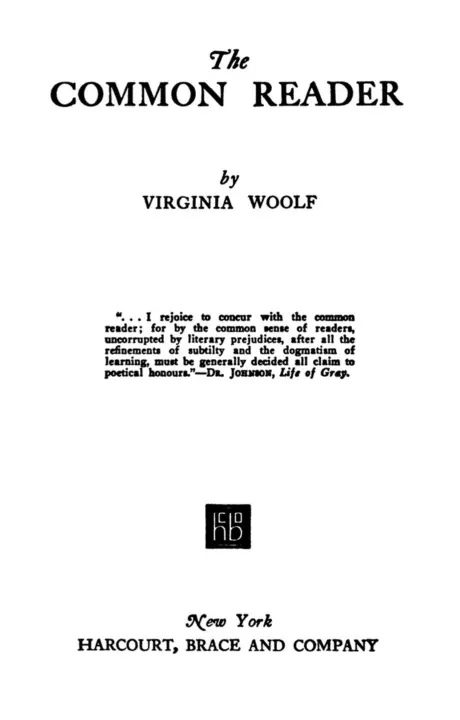
"The Common Reader" by Virginia Woolf is a collection of essays written in the early 20th century. The book is a thoughtful examination of literature through the lens of the ordinary reader, emphasizing the value of reading for pleasure and the unique perspective that non-experts bring to literary criticism. Woolf's exploration includes both historical and contemporary figures in literature, focusing on the experiences, thoughts, and opinions of the common reader in relation to the complexities of literary appreciation. The opening of "The Common Reader" begins with a quote from Dr. Johnson that sets the tone for Woolf’s reflection on the role of the common reader, who, unencumbered by academic prejudice, has a genuine intuition towards what constitutes good poetry and literature. Woolf contrasts the common reader with critics and scholars, suggesting that the former possess a unique insight born from personal engagement with texts. She introduces this theme by discussing the history of the Paston family and their correspondence, which encapsulates the everyday aspirations, concerns, and lives of individuals from a particular era, highlighting how these narratives shape the larger tapestry of literary history.
Introduction adapted from the source catalogue; source summaries may be automatically generated.
Free to read · English · 82,456 words · No account needed
MAKE TIME FOR A GOOD BOOK
On by default. Untick to stop anonymous reading totals. Each page counts after 10 seconds in view. How this works.
Anonymous counting is on unless you have switched it off.
The happy family life had its effect upon Margaret’s character. As a child, she would walk for hours alone, musing and contemplating and reasoning with herself of “everything her senses did present”. She took no pleasure in activity of any kind. Toys did not amuse her, and she could neither learn foreign languages nor dress as other people did. Her great pleasure was to invent dresses for herself, which nobody else was to copy, “for”, she remarks, “I always took delight in a singularity, even in accoutrements of habits”.
Such a training, at once so cloistered and so free, should have bred a lettered old maid, glad of her seclusion, and the writer perhaps of some volume of letters or translations from the classics, which we should still quote as proof of the cultivation of our ancestresses. But there was a wild streak in Margaret, a love of finery and extravagance and fame, which was for ever upsetting the orderly arrangements of nature. When she heard that the Queen, since the outbreak of the Civil War, had fewer maids-of-honour than usual, she had “a great desire” to become one of them. Her mother let her go against the judgement of the rest of the family, who, knowing that she had never left home and had scarcely been beyond their sight, justly thought that she might behave at Court to her disadvantage. “Which indeed I did,” Margaret confessed; “for I was so bashful when I was out of my mother’s, brothers’, and sisters’ sight that . . . I durst neither look up with my eyes, nor speak, nor be any way sociable, insomuch as I was thought a natural fool.” The courtiers laughed at her; and she retaliated in the obvious way. People were censorious; men were jealous of brains in a woman; women suspected intellect in their own sex; and what other lady, she might justly ask, pondered as she walked on the nature of matter and whether snails have teeth? But the laughter galled her, and she begged her mother to let her come home. This being refused, wisely as the event turned out, she stayed on for two years (1643–45), finally going with the Queen to Paris, and there, among the exiles who came to pay their respects to the Court, was the Marquis of Newcastle. To the general amazement, the princely nobleman, who had led the King’s forces to disaster with indomitable courage but little skill, fell in love with the shy, silent, strangely dressed maid-of-honour. It was not “amorous love, but honest, honourable love”, according to Margaret. She was no brilliant match; she had gained a reputation for prudery and eccentricity. What, then, could have made so great a nobleman fall at her feet? The onlookers were full of derision, disparagement, and slander. “I fear”, Margaret wrote to the Marquis, “others foresee we shall be unfortunate, though we see it not ourselves, or else there would not be such pains to untie the knot of our affections.” Again, “Saint Germains is a place of much slander, and thinks I send too often to you”. “Pray consider”, she warned him, “that I have enemies.” But the match was evidently perfect. The Duke, with his love of poetry and music and play-writing, his interest in philosophy, his belief “that nobody knew or could know the cause of anything”, his romantic and generous temperament, was naturally drawn to a woman who wrote poetry herself, was also a philosopher of the same way of thinking, and lavished upon him not only the admiration of a fellow-artist, but the gratitude of a sensitive creature who had been shielded and succoured by his extraordinary magnanimity. “He did approve”, she wrote, “of those bashful fears which many condemned, . . . and though I did dread marriage and shunned men’s company as much as I could, yet I . . . had not the power to refuse him.” She kept him company during the long years of exile; she entered with sympathy, if not with understanding, into the conduct and acquirements of those horses which he trained to such perfection that the Spaniards crossed themselves and cried “Miraculo!” as they witnessed their corvets, voltoes, and pirouettes; she believed that the horses even made a “trampling action” for joy when he came into the stables; she pleaded his cause in England during the Protectorate; and, when the Restoration made it possible for them to return to England, they lived together in the depths of the country in the greatest seclusion and perfect contentment, scribbling plays, poems, philosophies, greeting each other’s works with raptures of delight, and confabulating doubtless upon such marvels of the natural world as chance threw their way. They were laughed at by their contemporaries; Horace Walpole sneered at them. But there can be no doubt that they were perfectly happy.
Your reading position is saved on this browser. Take it to another device with a library code. Reading pages adapt to text, rather than matching a printed edition.
Virginia Woolf
Virginia Woolf
Virginia Woolf
Virginia Woolf
BEHIND THE BOOK
This eBook is for the use of anyone anywhere in the United States and most other parts of the world at no cost and with almost no restrictions whatsoever. You may copy it, give it away or re-use it under the terms of the Project Gutenberg License included with this eBook or online at www.gutenberg.org. If you are not located in the United States, you will have to check the laws of the country where you are located before using this eBook. Read the source licence.
The original source file, including credits and licence, is retained by this library. Request an original-format copy at no charge. Please include the book title and Project Gutenberg identifier #64457.
KEEP YOUR CURIOSITY GOING

David Patterson (Spirit) Hatch

David Patterson (Spirit) Hatch

David Patterson (Spirit) Hatch
Cécile Tormay

Moritz Busch
John L. Ransom