THE CLASSIC COLLECTION✦Mrs. DallowayCLASSIC FREE BOOKS
Mrs. Dalloway
Virginia Woolf
THE CLASSIC COLLECTION · 1925
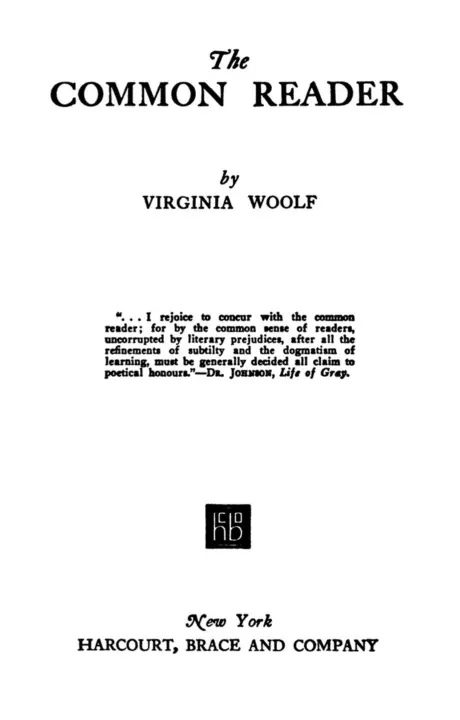
"The Common Reader" by Virginia Woolf is a collection of essays written in the early 20th century. The book is a thoughtful examination of literature through the lens of the ordinary reader, emphasizing the value of reading for pleasure and the unique perspective that non-experts bring to literary criticism. Woolf's exploration includes both historical and contemporary figures in literature, focusing on the experiences, thoughts, and opinions of the common reader in relation to the complexities of literary appreciation. The opening of "The Common Reader" begins with a quote from Dr. Johnson that sets the tone for Woolf’s reflection on the role of the common reader, who, unencumbered by academic prejudice, has a genuine intuition towards what constitutes good poetry and literature. Woolf contrasts the common reader with critics and scholars, suggesting that the former possess a unique insight born from personal engagement with texts. She introduces this theme by discussing the history of the Paston family and their correspondence, which encapsulates the everyday aspirations, concerns, and lives of individuals from a particular era, highlighting how these narratives shape the larger tapestry of literary history.
Introduction adapted from the source catalogue; source summaries may be automatically generated.
Free to read · English · 82,456 words · No account needed
MAKE TIME FOR A GOOD BOOK
On by default. Untick to stop anonymous reading totals. Each page counts after 10 seconds in view. How this works.
Anonymous counting is on unless you have switched it off.
The origin of Archbishop Thomson was obscure. His great-uncle “may reasonably be supposed” to have been “an ornament to the middle classes”. His aunt married a gentleman who was present at the murder of Gustavus III. of Sweden; and his father met his death at the age of eighty-seven by treading on a cat in the early hours of the morning. The physical vigour which this anecdote implies was combined in the Archbishop with powers of intellect which promised success in whatever profession he adopted. At Oxford it seemed likely that he would devote himself to philosophy or science. While reading for his degree he found time to write the Outlines of the Laws of Thought, which “immediately became a recognised text-book for Oxford classes”. But though poetry, philosophy, medicine, and the law held out their temptations he put such thoughts aside, or never entertained them, having made up his mind from the first to dedicate himself to Divine service. The measure of his success in the more exalted sphere is attested by the following facts: Ordained deacon in 1842 at the age of twenty-three, he became Dean and Bursar of Queen’s College, Oxford, in 1845; Provost in 1855, Bishop of Gloucester and Bristol in 1861, and Archbishop of York in 1862. Thus at the early age of forty-three he stood next in rank to the Archbishop of Canterbury himself; and it was commonly though erroneously expected that he would in the end attain to that dignity also.
It is a matter of temperament and belief whether you read this list with respect or with boredom; whether you look upon an archbishop’s hat as a crown or as an extinguisher. If, like the present reviewer, you are ready to hold the simple faith that the outer order corresponds to the inner—that a vicar is a good man, a canon a better man, and an archbishop the best man of all—you will find the study of the Archbishop’s life one of extreme fascination. He has turned aside from poetry and philosophy and law, and specialised in virtue. He has dedicated himself to the service of the Divine. His spiritual proficiency has been such that he has developed from deacon to dean, from dean to bishop, and from bishop to archbishop in the short space of twenty years. As there are only two archbishops in the whole of England the inference seems to be that he is the second best man in England; his hat is the proof of it. Even in a material sense his hat was one of the largest; it was larger than Mr. Gladstone’s; larger than Thackeray’s; larger than Dickens’; it was in fact, so his hatter told him and we are inclined to agree, an “eight full”. Yet he began much as other men begin. He struck an undergraduate in a fit of temper and was rusticated; he wrote a text-book of logic and rowed a very good oar. But after he was ordained his diary shows that the specialising process had begun. He thought a great deal about the state of his soul; about “the monstrous tumour of Simony”; about Church reform; and about the meaning of Christianity. “Self-renunciation,” he came to the conclusion, “is the foundation of Christian Religion and Christian Morals. . . . The highest wisdom is that which can enforce and cultivate this self-renunciation. Hence (against Cousin) I hold that religion is higher far than philosophy.” There is one mention of chemists and capillarity, but science and philosophy were, even at this early stage, in danger of being crowded out. Soon the diary takes a different tone. “He seems,” says his biographer, “to have had no time for committing his thoughts to paper”; he records his engagements only, and he dines out almost every night. Sir Henry Taylor, whom he met at one of these parties, described him as “simple, solid, good, capable, and pleasing”. Perhaps it was his solidity combined with his “eminently scientific” turn of mind, his blandness as well as his bulk, that impressed some of these great people with the confidence that in him the Church had found a very necessary champion. His “brawny logic” and massive frame seemed to fit him to grapple with a task that taxed the strongest—how, that is, to reconcile the scientific discoveries of the age with religion, and even prove them “some of its strongest witnesses for the truth”. If any one could do this Thomson could; his practical ability, unhampered by any mystical or dreaming tendency, had already proved itself in the conduct of the business affairs of his College. From Bishop he became almost instantly Archbishop; and in becoming Archbishop he became Primate of England, Governor of the Charterhouse and King’s College, London, patron of one hundred and twenty livings, with the Archdeaconries of York, Cleveland, and the East Riding in his gift, and the Canonries and Prebends in York Minster. Bishopthorpe itself was an enormous palace; he was immediately faced by the “knotty question” of whether to buy all the furniture—“much of it only poor stuff”—or to furnish the house anew, which would cost a fortune. Moreover there were seven cows in the park; but these, perhaps, were counterbalanced by nine children in the nursery. Then the Prince and Princess of Wales came to stay, and the Archbishop took upon himself the task of furnishing the Princess’s apartments. He went up to London and bought eight Moderator lamps, two Spanish figures holding candles, and reminded himself of the necessity of buying “soap for Princess”. But meanwhile far more serious matters claimed every ounce of his strength. Already he had been exhorted to “wield the sure lance of your brawny logic against the sophistries” of the authors of Essays and Reviews, and had responded in a work called Aids to Faith. Near at hand the town of Sheffield, with its large population of imperfectly educated working men, was a breeding ground of scepticism and discontent. The Archbishop made it his special charge. He was fond of watching the rolling of armour plate, and constantly addressed meetings of working men. “Now what are these Nihilisms, and Socialisms, and Communisms, and Fenianisms, and Secret Societies—what do they all mean?” he asked. “Selfishness,” he replied, and “assertion of one class against the rest is at the bottom of them all.” There was a law of nature, he said, by which wages went up and wages went down. “You must accept the declivity as well as the ascent. . . . If we could only get people to learn that, then things would go on a great deal better and smoother.” And the working men of Sheffield responded by giving him five hundred pieces of cutlery mounted in sterling silver. But presumably there were a certain number of knives among the spoons and the forks.
Your reading position is saved on this browser. Take it to another device with a library code. Reading pages adapt to text, rather than matching a printed edition.
Virginia Woolf
Virginia Woolf
Virginia Woolf
Virginia Woolf
BEHIND THE BOOK
This eBook is for the use of anyone anywhere in the United States and most other parts of the world at no cost and with almost no restrictions whatsoever. You may copy it, give it away or re-use it under the terms of the Project Gutenberg License included with this eBook or online at www.gutenberg.org. If you are not located in the United States, you will have to check the laws of the country where you are located before using this eBook. Read the source licence.
The original source file, including credits and licence, is retained by this library. Request an original-format copy at no charge. Please include the book title and Project Gutenberg identifier #64457.
KEEP YOUR CURIOSITY GOING

David Patterson (Spirit) Hatch

David Patterson (Spirit) Hatch

David Patterson (Spirit) Hatch
Cécile Tormay

Moritz Busch
John L. Ransom