THE CLASSIC COLLECTION✦Mrs. DallowayCLASSIC FREE BOOKS
Mrs. Dalloway
Virginia Woolf
THE CLASSIC COLLECTION · 1925
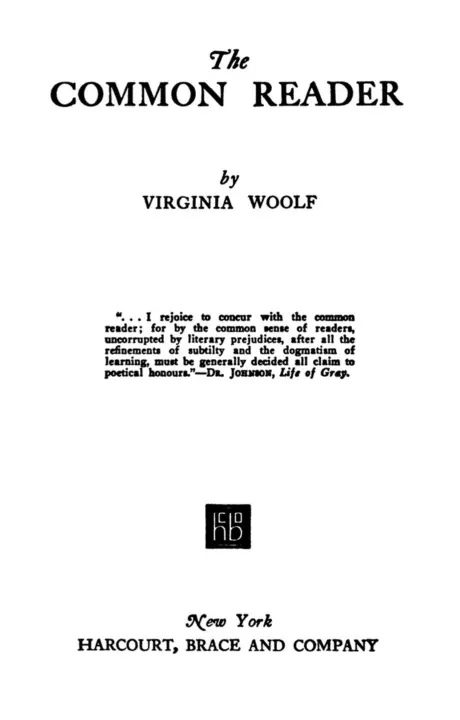
"The Common Reader" by Virginia Woolf is a collection of essays written in the early 20th century. The book is a thoughtful examination of literature through the lens of the ordinary reader, emphasizing the value of reading for pleasure and the unique perspective that non-experts bring to literary criticism. Woolf's exploration includes both historical and contemporary figures in literature, focusing on the experiences, thoughts, and opinions of the common reader in relation to the complexities of literary appreciation. The opening of "The Common Reader" begins with a quote from Dr. Johnson that sets the tone for Woolf’s reflection on the role of the common reader, who, unencumbered by academic prejudice, has a genuine intuition towards what constitutes good poetry and literature. Woolf contrasts the common reader with critics and scholars, suggesting that the former possess a unique insight born from personal engagement with texts. She introduces this theme by discussing the history of the Paston family and their correspondence, which encapsulates the everyday aspirations, concerns, and lives of individuals from a particular era, highlighting how these narratives shape the larger tapestry of literary history.
Introduction adapted from the source catalogue; source summaries may be automatically generated.
Free to read · English · 82,456 words · No account needed
MAKE TIME FOR A GOOD BOOK
On by default. Untick to stop anonymous reading totals. Each page counts after 10 seconds in view. How this works.
Anonymous counting is on unless you have switched it off.
But the Elizabethan prose writers, if they have the formlessness of youth have, too, its freshness and audacity. In the same essay Sidney shapes language, masterfully and easily, to his liking; freely and naturally reaches his hand for a metaphor. To bring this prose to perfection (and Dryden’s prose is very near perfection) only the discipline of the stage was necessary and the growth of self-consciousness. It is in the plays, and especially in the comic passages of the plays, that the finest Elizabethan prose is to be found. The stage was the nursery where prose learnt to find its feet. For on the stage people had to meet, to quip and crank, to suffer interruptions, to talk of ordinary things.
Cler. A box of her autumnal face, her pieced beauty! there’s no man can be admitted till she be ready now-a-days, till she has painted, and perfumed, and washed, and scoured, but the boy here; and him she wipes her oiled lips upon, like a sponge. I have made a song (I pray thee hear it) on the subject. [Page sings]
Still to be neat, still to be drest &c.
True. And I am clearly on the other side: I love a good dressing before any beauty o’ the world. O, a woman is then like a delicate garden; nor is there one kind of it; she may vary every hour; take often counsel of her glass, and choose the best. If she have good ears, show them; good hair, lay it out; good legs, wear short clothes; a good hand, discover it often: practise any art to mend breath, cleanse teeth, repair eyebrows; paint and profess it.
So the talk runs in Ben Jonson’s Silent Woman, knocked into shape by interruptions, sharpened by collisions, and never allowed to settle into stagnancy or swell into turbidity. But the publicity of the stage and the perpetual presence of a second person were hostile to that growing consciousness of one’s self, that brooding in solitude over the mysteries of the soul, which, as the years went by, sought expression and found a champion in the sublime genius of Sir Thomas Browne. His immense egotism has paved the way for all psychological novelists, autobiographers, confession-mongers, and dealers in the curious shades of our private life. He it was who first turned from the contacts of men with men to their lonely life within. “The world that I regard is myself; it is the microcosm of my own frame that I cast mine eye on; for the other I use it but like my globe, and turn it round sometimes for my recreation.” All was mystery and darkness as the first explorer walked the catacombs swinging his lanthorn. “I feel sometimes a hell within myself; Lucifer keeps his court in my breast; Legion is revived in me.” In these solitudes there were no guides and no companions. “I am in the dark to all the world, and my nearest friends behold me but in a cloud.” The strangest thoughts and imaginings have play with him as he goes about his work, outwardly the most sober of mankind and esteemed the greatest physician in Norwich. He has wished for death. He has doubted all things. What if we are asleep in this world and the conceits of life are as mere dreams? The tavern music, the Ave Mary bell, the broken pot that the workman has dug out of the field—at the sight and sound of them he stops dead, as if transfixed by the astonishing vista that opens before his imagination. “We carry with us the wonders we seek without us; there is all Africa and her prodigies in us.” A halo of wonder encircles everything that he sees; he turns his light gradually upon the flowers and insects and grasses at his feet so as to disturb nothing in the mysterious processes of their existence. With the same awe, mixed with a sublime complacency, he records the discovery of his own qualities and attainments. He was charitable and brave and averse from nothing. He was full of feeling for others and merciless upon himself. “For my conversation, it is like the sun’s, with all men, and with a friendly aspect to good and bad.” He knows six languages, the laws, the customs and policies of several states, the names of all the constellations and most of the plants of his country, and yet, so sweeping is his imagination, so large the horizon in which he sees this little figure walking that “methinks I do not know so many as when I did but know a hundred, and had scarcely ever simpled further than Cheapside”.
Your reading position is saved on this browser. Take it to another device with a library code. Reading pages adapt to text, rather than matching a printed edition.
Virginia Woolf
Virginia Woolf
Virginia Woolf
Virginia Woolf
BEHIND THE BOOK
This eBook is for the use of anyone anywhere in the United States and most other parts of the world at no cost and with almost no restrictions whatsoever. You may copy it, give it away or re-use it under the terms of the Project Gutenberg License included with this eBook or online at www.gutenberg.org. If you are not located in the United States, you will have to check the laws of the country where you are located before using this eBook. Read the source licence.
The original source file, including credits and licence, is retained by this library. Request an original-format copy at no charge. Please include the book title and Project Gutenberg identifier #64457.
KEEP YOUR CURIOSITY GOING

David Patterson (Spirit) Hatch

David Patterson (Spirit) Hatch

David Patterson (Spirit) Hatch
Cécile Tormay

Moritz Busch
John L. Ransom