THE CLASSIC COLLECTION✦Mrs. DallowayCLASSIC FREE BOOKS
Mrs. Dalloway
Virginia Woolf
THE CLASSIC COLLECTION · 1925
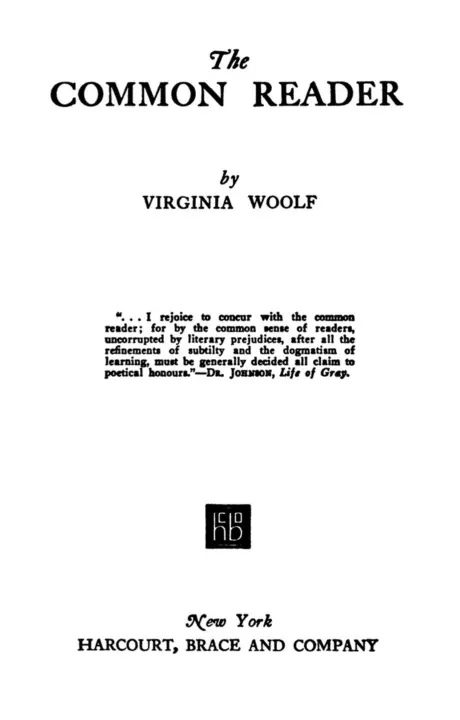
"The Common Reader" by Virginia Woolf is a collection of essays written in the early 20th century. The book is a thoughtful examination of literature through the lens of the ordinary reader, emphasizing the value of reading for pleasure and the unique perspective that non-experts bring to literary criticism. Woolf's exploration includes both historical and contemporary figures in literature, focusing on the experiences, thoughts, and opinions of the common reader in relation to the complexities of literary appreciation. The opening of "The Common Reader" begins with a quote from Dr. Johnson that sets the tone for Woolf’s reflection on the role of the common reader, who, unencumbered by academic prejudice, has a genuine intuition towards what constitutes good poetry and literature. Woolf contrasts the common reader with critics and scholars, suggesting that the former possess a unique insight born from personal engagement with texts. She introduces this theme by discussing the history of the Paston family and their correspondence, which encapsulates the everyday aspirations, concerns, and lives of individuals from a particular era, highlighting how these narratives shape the larger tapestry of literary history.
Introduction adapted from the source catalogue; source summaries may be automatically generated.
Free to read · English · 82,456 words · No account needed
MAKE TIME FOR A GOOD BOOK
On by default. Untick to stop anonymous reading totals. Each page counts after 10 seconds in view. How this works.
Anonymous counting is on unless you have switched it off.
The books which followed so soon after her union testify in the fullest manner to the great liberation which had come to her with personal happiness. In themselves they provide us with a plentiful feast. Yet at the threshold of her literary career one may find in some of the circumstances of her life influences that turned her mind to the past, to the country village, to the quiet and beauty and simplicity of childish memories and away from herself and the present. We understand how it was that her first book was Scenes of Clerical Life, and not Middlemarch. Her union with Lewes had surrounded her with affection, but in view of the circumstances and of the conventions it had also isolated her. “I wish it to be understood,” she wrote in 1857, “that I should never invite any one to come and see me who did not ask for the invitation.” She had been “cut off from what is called the world”, she said later, but she did not regret it. By becoming thus marked, first by circumstances and later, inevitably, by her fame, she lost the power to move on equal terms unnoted among her kind; and the loss for a novelist was serious. Still, basking in the light and sunshine of Scenes of Clerical Life, feeling the large mature mind spreading itself with a luxurious sense of freedom in the world of her “remotest past”, to speak of loss seems inappropriate. Everything to such a mind was gain. All experience filtered down through layer after layer of perception and reflection, enriching and nourishing. The utmost we can say, in qualifying her attitude towards fiction by what little we know of her life, is that she had taken to heart certain lessons not usually learnt early, if learnt at all, among which, perhaps, the most branded upon her was the melancholy virtue of tolerance; her sympathies are with the everyday lot, and play most happily in dwelling upon the homespun of ordinary joys and sorrows. She has none of that romantic intensity which is connected with a sense of one’s own individuality, unsated and unsubdued, cutting its shape sharply upon the background of the world. What were the loves and sorrows of a snuffy old clergyman, dreaming over his whisky, to the fiery egotism of Jane Eyre? The beauty of those first books, Scenes of Clerical Life, Adam Bede, The Mill on the Floss, is very great. It is impossible to estimate the merit of the Poysers, the Dodsons, the Gilfils, the Bartons, and the rest with all their surroundings and dependencies, because they have put on flesh and blood and we move among them, now bored, now sympathetic, but always with that unquestioning acceptance of all that they say and do, which we accord to the great originals only. The flood of memory and humour which she pours so spontaneously into one figure, one scene after another, until the whole fabric of ancient rural England is revived, has so much in common with a natural process that it leaves us with little consciousness that there is anything to criticise. We accept; we feel the delicious warmth and release of spirit which the great creative writers alone procure for us. As one comes back to the books after years of absence they pour out, even against our expectation, the same store of energy and heat, so that we want more than anything to idle in the warmth as in the sun beating down from the red orchard wall. If there is an element of unthinking abandonment in thus submitting to the humours of Midland farmers and their wives, that, too, is right in the circumstances. We scarcely wish to analyse what we feel to be so large and deeply human. And when we consider how distant in time the world of Shepperton and Hayslope is, and how remote the minds of farmer and agricultural labourers from those of most of George Eliot’s readers, we can only attribute the ease and pleasure with which we ramble from house to smithy, from cottage parlour to rectory garden, to the fact that George Eliot makes us share their lives, not in a spirit of condescension or of curiosity, but in a spirit of sympathy. She is no satirist. The movement of her mind was too slow and cumbersome to lend itself to comedy. But she gathers in her large grasp a great bunch of the main elements of human nature and groups them loosely together with a tolerant and wholesome understanding which, as one finds upon re-reading, has not only kept her figures fresh and free, but has given them an unexpected hold upon our laughter and tears. There is the famous Mrs. Poyser. It would have been easy to work her idiosyncrasies to death, and, as it is, perhaps, George Eliot gets her laugh in the same place a little too often. But memory, after the book is shut, brings out, as sometimes in real life, the details and subtleties which some more salient characteristic has prevented us from noticing at the time. We recollect that her health was not good. There were occasions upon which she said nothing at all. She was patience itself with a sick child. She doted upon Totty. Thus one can muse and speculate about the greater number of George Eliot’s characters and find, even in the least important, a roominess and margin where those qualities lurk which she has no call to bring from their obscurity.
Your reading position is saved on this browser. Take it to another device with a library code. Reading pages adapt to text, rather than matching a printed edition.
Virginia Woolf
Virginia Woolf
Virginia Woolf
Virginia Woolf
BEHIND THE BOOK
This eBook is for the use of anyone anywhere in the United States and most other parts of the world at no cost and with almost no restrictions whatsoever. You may copy it, give it away or re-use it under the terms of the Project Gutenberg License included with this eBook or online at www.gutenberg.org. If you are not located in the United States, you will have to check the laws of the country where you are located before using this eBook. Read the source licence.
The original source file, including credits and licence, is retained by this library. Request an original-format copy at no charge. Please include the book title and Project Gutenberg identifier #64457.
KEEP YOUR CURIOSITY GOING

David Patterson (Spirit) Hatch

David Patterson (Spirit) Hatch

David Patterson (Spirit) Hatch
Cécile Tormay

Moritz Busch
John L. Ransom