THE CLASSIC COLLECTION✦Mrs. DallowayCLASSIC FREE BOOKS
Mrs. Dalloway
Virginia Woolf
THE CLASSIC COLLECTION · 1925
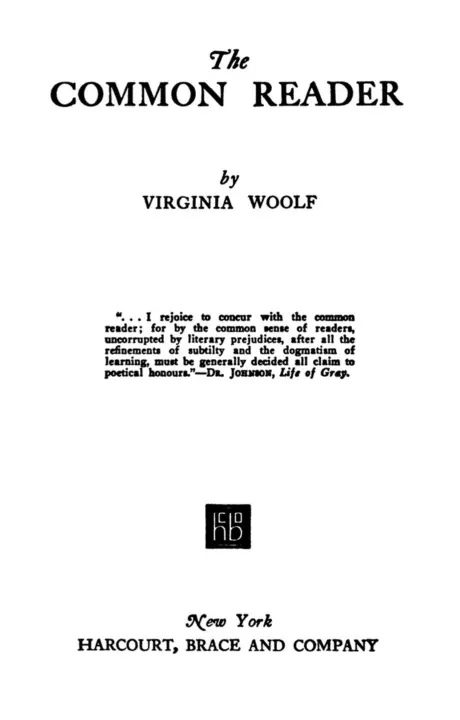
"The Common Reader" by Virginia Woolf is a collection of essays written in the early 20th century. The book is a thoughtful examination of literature through the lens of the ordinary reader, emphasizing the value of reading for pleasure and the unique perspective that non-experts bring to literary criticism. Woolf's exploration includes both historical and contemporary figures in literature, focusing on the experiences, thoughts, and opinions of the common reader in relation to the complexities of literary appreciation. The opening of "The Common Reader" begins with a quote from Dr. Johnson that sets the tone for Woolf’s reflection on the role of the common reader, who, unencumbered by academic prejudice, has a genuine intuition towards what constitutes good poetry and literature. Woolf contrasts the common reader with critics and scholars, suggesting that the former possess a unique insight born from personal engagement with texts. She introduces this theme by discussing the history of the Paston family and their correspondence, which encapsulates the everyday aspirations, concerns, and lives of individuals from a particular era, highlighting how these narratives shape the larger tapestry of literary history.
Introduction adapted from the source catalogue; source summaries may be automatically generated.
Free to read · English · 82,456 words · No account needed
MAKE TIME FOR A GOOD BOOK
On by default. Untick to stop anonymous reading totals. Each page counts after 10 seconds in view. How this works.
Anonymous counting is on unless you have switched it off.
Look within and life, it seems, is very far from being “like this”. Examine for a moment an ordinary mind on an ordinary day. The mind receives a myriad impressions—trivial, fantastic, evanescent, or engraved with the sharpness of steel. From all sides they come, an incessant shower of innumerable atoms; and as they fall, as they shape themselves into the life of Monday or Tuesday, the accent falls differently from of old; the moment of importance came not here but there; so that if a writer were a free man and not a slave, if he could write what he chose, not what he must, if he could base his work upon his own feeling and not upon convention, there would be no plot, no comedy, no tragedy, no love interest or catastrophe in the accepted style, and perhaps not a single button sewn on as the Bond Street tailors would have it. Life is not a series of gig lamps symmetrically arranged; but a luminous halo, a semi-transparent envelope surrounding us from the beginning of consciousness to the end. Is it not the task of the novelist to convey this varying, this unknown and uncircumscribed spirit, whatever aberration or complexity it may display, with as little mixture of the alien and external as possible? We are not pleading merely for courage and sincerity; we are suggesting that the proper stuff of fiction is a little other than custom would have us believe it.
It is, at any rate, in some such fashion as this that we seek to define the quality which distinguishes the work of several young writers, among whom Mr. James Joyce is the most notable, from that of their predecessors. They attempt to come closer to life, and to preserve more sincerely and exactly what interests and moves them, even if to do so they must discard most of the conventions which are commonly observed by the novelist. Let us record the atoms as they fall upon the mind in the order in which they fall, let us trace the pattern, however disconnected and incoherent in appearance, which each sight or incident scores upon the consciousness. Let us not take it for granted that life exists more fully in what is commonly thought big than in what is commonly thought small. Any one who has read The Portrait of the Artist as a Young Man or, what promises to be a far more interesting work, Ulysses,[10] now appearing in the Little Review, will have hazarded some theory of this nature as to Mr. Joyce’s intention. On our part, with such a fragment before us, it is hazarded rather than affirmed; but whatever the intention of the whole there can be no question but that it is of the utmost sincerity and that the result, difficult or unpleasant as we may judge it, is undeniably important. In contrast with those whom we have called materialists Mr. Joyce is spiritual; he is concerned at all costs to reveal the flickerings of that innermost flame which flashes its messages through the brain, and in order to preserve it he disregards with complete courage whatever seems to him adventitious, whether it be probability, or coherence or any other of these signposts which for generations have served to support the imagination of a reader when called upon to imagine what he can neither touch nor see. The scene in the cemetery, for instance, with its brilliancy, its sordidity, its incoherence, its sudden lightning flashes of significance, does undoubtedly come so close to the quick of the mind that, on a first reading at any rate, it is difficult not to acclaim a masterpiece. If we want life itself here, surely we have it. Indeed, we find ourselves fumbling rather awkwardly if we try to say what else we wish, and for what reason a work of such originality yet fails to compare, for we must take high examples, with Youth or The Mayor of Casterbridge. It fails because of the comparative poverty of the writer’s mind, we might say simply and have done with it. But it is possible to press a little further and wonder whether we may not refer our sense of being in a bright yet narrow room, confined and shut in, rather than enlarged and set free, to some limitation imposed by the method as well as by the mind. Is it the method that inhibits the creative power? Is it due to the method that we feel neither jovial nor magnanimous, but centred in a self which, in spite of its tremor of susceptibility, never embraces or creates what is outside itself and beyond? Does the emphasis laid, perhaps didactically, upon indecency, contribute to the effect of something angular and isolated? Or is it merely that in any effort of such originality it is much easier, for contemporaries especially, to feel what it lacks than to name what it gives? In any case it is a mistake to stand outside examining “methods”. Any method is right, every method is right, that expresses what we wish to express, if we are writers; that brings us closer to the novelist’s intention if we are readers. This method has the merit of bringing us closer to what we were prepared to call life itself; did not the reading of Ulysses suggest how much of life is excluded or ignored, and did it not come with a shock to open Tristram Shandy or even Pendennis and be by them convinced that there are not only other aspects of life, but more important ones into the bargain.
Your reading position is saved on this browser. Take it to another device with a library code. Reading pages adapt to text, rather than matching a printed edition.
Virginia Woolf
Virginia Woolf
Virginia Woolf
Virginia Woolf
BEHIND THE BOOK
This eBook is for the use of anyone anywhere in the United States and most other parts of the world at no cost and with almost no restrictions whatsoever. You may copy it, give it away or re-use it under the terms of the Project Gutenberg License included with this eBook or online at www.gutenberg.org. If you are not located in the United States, you will have to check the laws of the country where you are located before using this eBook. Read the source licence.
The original source file, including credits and licence, is retained by this library. Request an original-format copy at no charge. Please include the book title and Project Gutenberg identifier #64457.
KEEP YOUR CURIOSITY GOING

David Patterson (Spirit) Hatch

David Patterson (Spirit) Hatch

David Patterson (Spirit) Hatch
Cécile Tormay

Moritz Busch
John L. Ransom