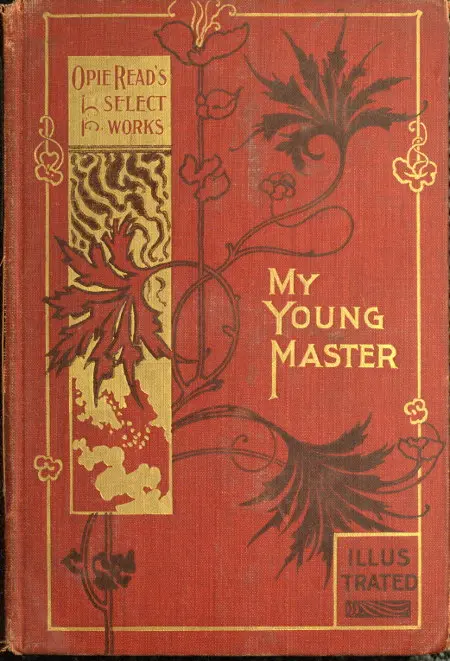
My Young Master: A Novel
Opie Percival Read
THE CLASSIC COLLECTION · 1893
"The Colossus: A Novel" by Opie Percival Read is a fictional narrative written in the late 19th century. The novel seems to explore themes of identity, belonging, and the complexities of human relationships through the experiences of the main character, Henry DeGolyer. As he navigates a life filled with hardship due to his tragic childhood, readers meet a variety of characters that impact his journey, setting the stage for his eventual transformation. At the start of the novel, readers are introduced to Henry DeGolyer, who reflects on his difficult childhood, marked by the death of his mother and a distant, alcoholic father. After being raised in a Foundlings' Home and by an old Italian woman, Henry struggles to become a journalist, facing both the highs and lows of a reporter's life. His journey takes a decisive turn when he is invited to Costa Rica by a young man named Henry Sawyer, which leads him to unexpected connections and revelations about his past. As he engages with new characters and situations, the groundwork is laid for exploring notions of heritage and personal responsibility amid the backdrop of a shifting family dynamic.
Introduction adapted from the source catalogue; source summaries may be automatically generated.
Free to read · English · 64,814 words · No account needed
MAKE TIME FOR A GOOD BOOK
On by default. Untick to stop anonymous reading totals. Each page counts after 10 seconds in view. How this works.
Anonymous counting is on unless you have switched it off.
"Hum!" Witherspoon grunted. He sat down in his leather-covered chair, crossed his legs, struck a match on the sole of his slipper, relighted his cigar, which he had suffered to go out, and for a time smoked in silence.
"Is there anything wrong about it?" Henry asked.
"I might ask you if there is anything right about it," Witherspoon replied. "'The poor ye have with you always,' was uttered by the Son of God. It was not only a prophecy, but a truth for all ages. There are grades in life, and who made them? Man. Ah, but who made man? God. Then who is responsible for the grades? Nature sets the example of inequality. One tree is higher than another." His cigar had gone out. He lighted it again and continued: "Writers who seek to benefit the poor of ten injure them--teach them a dissatisfaction which in its tarn brings a sort of reprisal on the part of capital."
"I don't agree with you," said Henry.
"Of course not."
"I have cause to know that you are wrong, sir."
"You think you have," the merchant replied.
"It is true," Henry admitted, "that we shall always have the poor with
us."
"I thought so," said Witherspoon.
"But it is not true that an attempt to aid them is harmful. Their condition has steadily improved since history "--
"You are a sentimentalist."
"I am more than that," said Henry. "I am a man."
"Hum! And are you more than that?"
"How could I be more?"
"Easily enough. You could be an anarchist."
"And is that a step higher?"
"Wolves think so."
"But I don't"
"I hope not."
They sat in silence. The young man was angry, but he controlled
himself.
"It is easy to scatter dangerous words in this town," said the merchant. "And, sir,"--he broke off, rousing himself,--"look at the inconsistency, the ridiculousness of your position. I employ more than a thousand people; my son says that I oppress them. I"--
"Hold on; I didn't say that. I don't know of any injustice that you inflict upon your employes; but I do know of such wrongs committed by other men. But you have shown me that the condition of those creatures is hopeless."
"What creatures?"
"Women who work for a living."
"And do you know the cause of their hopelessness?"
"Yes; poverty and oppression."
"Ah, but what is the cause of their poverty?"
"The greed of man."
"Oh, no; the appetite of man--whisky. Nine out of ten of those so-called wretched creatures can trace their wretchedness to drink."
"But it is not their fault."
"Oh!"
Your reading position is saved on this browser. Take it to another device with a library code. Reading pages adapt to text, rather than matching a printed edition.
Opie Percival Read
Opie Percival Read
Opie Percival Read
Opie Percival Read
BEHIND THE BOOK
This eBook is for the use of anyone anywhere in the United States and most other parts of the world at no cost and with almost no restrictions whatsoever. You may copy it, give it away or re-use it under the terms of the Project Gutenberg License included with this eBook or online at www.gutenberg.org. If you are not located in the United States, you will have to check the laws of the country where you are located before using this eBook. Read the source licence.
The original source file, including credits and licence, is retained by this library. Request an original-format copy at no charge. Please include the book title and Project Gutenberg identifier #15073.
KEEP YOUR CURIOSITY GOING
Coulson Kernahan

Maurice Baring
Frances Wright
Cécile Tormay

Frederic Jesup Stimson

W. H. P. (William Henry Pope) Jarvis