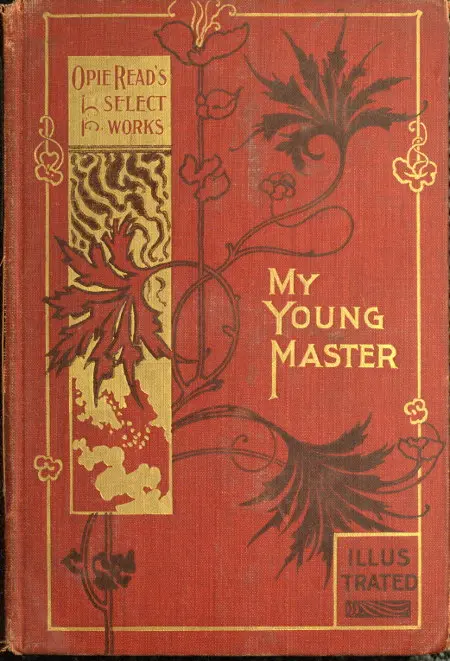
My Young Master: A Novel
Opie Percival Read
THE CLASSIC COLLECTION · 1893
"The Colossus: A Novel" by Opie Percival Read is a fictional narrative written in the late 19th century. The novel seems to explore themes of identity, belonging, and the complexities of human relationships through the experiences of the main character, Henry DeGolyer. As he navigates a life filled with hardship due to his tragic childhood, readers meet a variety of characters that impact his journey, setting the stage for his eventual transformation. At the start of the novel, readers are introduced to Henry DeGolyer, who reflects on his difficult childhood, marked by the death of his mother and a distant, alcoholic father. After being raised in a Foundlings' Home and by an old Italian woman, Henry struggles to become a journalist, facing both the highs and lows of a reporter's life. His journey takes a decisive turn when he is invited to Costa Rica by a young man named Henry Sawyer, which leads him to unexpected connections and revelations about his past. As he engages with new characters and situations, the groundwork is laid for exploring notions of heritage and personal responsibility amid the backdrop of a shifting family dynamic.
Introduction adapted from the source catalogue; source summaries may be automatically generated.
Free to read · English · 64,814 words · No account needed
MAKE TIME FOR A GOOD BOOK
On by default. Untick to stop anonymous reading totals. Each page counts after 10 seconds in view. How this works.
Anonymous counting is on unless you have switched it off.
"I began by selling newspapers."
Mrs. Witherspoon sighed, and the merchant asked: "And did Andrew urge
it?"
"Oh, no. In fact I was a reporter before he knew anything about it."
Witherspoon grunted. "I should have thought," said he, "that your uncle would have looked after you with more care. Did you receive a regular course of training?" Henry looked at him. "At school, I mean."
"Yes, in an elementary way. Afterward I studied in the public
library."
"A good school, but not cohesive," Witherspoon replied. "A thousand scraps of knowledge don't make an education."
"Father, you remember my uncle Harvey," said Mrs. Witherspoon.
"Hum, yes, I remember him."
"Well, his education did not prevent his having a thousand scraps of
knowledge."
"I should think not," Witherspoon replied. "No man's knowledge
interferes with his education."
"My uncle Harvey knew nearly everything," Mrs. Witherspoon went on. "He could make a clock; and he was one of the best school teachers in the country. I shouldn't think that education consists in committing a few rules to memory."
"No, Caroline, not in the committing of a thousand rules to memory, but without rule there is no complete education."
"I shouldn't think that there could be a complete education anyway,"
she rejoined, in a tone which Henry knew was meant in defense of
himself.
"Of course not," said the merchant, and turning from the subject as from something that could interest him but little, he again took up the newspaper project. "We'll investigate that matter to-morrow, and if you are still determined to go into it, the sooner the better. My own opinion is that you will soon get tired of it, in view of the better advantages that I urge upon you, for the worries of an experimental concern will serve to strengthen my proposal."
"I am resolved that in the end it shall cost you nothing," Henry
replied.
"Hum, we'll see about that. But whatever you do, do it earnestly, for a failure in one line does not argue success in another direction. In business it is well to beware of men who have failed. They bring bad luck. Without success there may be vanity, but there can be but little pride, little self-respect."
Henry moved uneasily in his chair. "But among those who have failed," he replied, "we often find the highest types of manhood."
"Nonsense," rejoined the merchant. "That is merely a poetic idea. What do you mean by the highest type of manhood? Men whose theories have all been proved to be wrong? Great men have an aim and accomplish it. America is a great country, and why? Because it is prosperous."
Your reading position is saved on this browser. Take it to another device with a library code. Reading pages adapt to text, rather than matching a printed edition.
Opie Percival Read
Opie Percival Read
Opie Percival Read
Opie Percival Read
BEHIND THE BOOK
This eBook is for the use of anyone anywhere in the United States and most other parts of the world at no cost and with almost no restrictions whatsoever. You may copy it, give it away or re-use it under the terms of the Project Gutenberg License included with this eBook or online at www.gutenberg.org. If you are not located in the United States, you will have to check the laws of the country where you are located before using this eBook. Read the source licence.
The original source file, including credits and licence, is retained by this library. Request an original-format copy at no charge. Please include the book title and Project Gutenberg identifier #15073.
KEEP YOUR CURIOSITY GOING
Coulson Kernahan

Maurice Baring
Frances Wright
Cécile Tormay

Frederic Jesup Stimson

W. H. P. (William Henry Pope) Jarvis