
The wild duck
Henrik Ibsen
THE CLASSIC COLLECTION · 1907
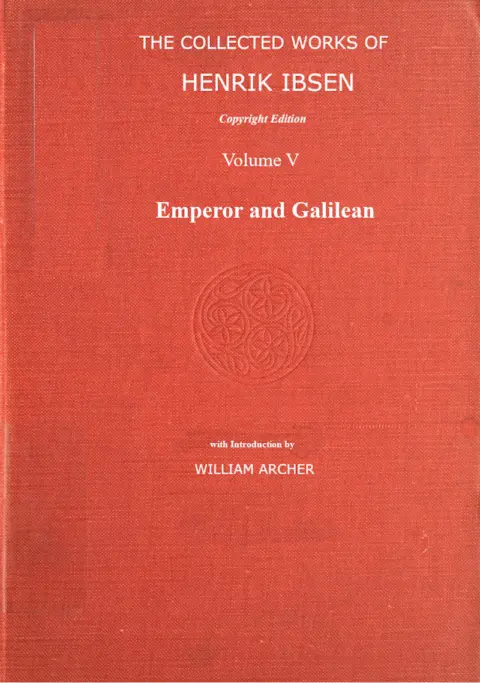
"The Collected Works of Henrik Ibsen, Vol. 05" by Henrik Ibsen is a collection of theatrical works written in the late 19th century. This volume includes the play "Emperor and Galilean," which is a historical drama centered around the life and struggles of Emperor Julian, known as "Julian the Apostate." As Ibsen explores Julian's internal conflicts, the play delves into themes of faith, power, and the battle between paganism and Christianity during a pivotal time in Roman history. At the start of "Emperor and Galilean," we are introduced to an intriguing blend of characters in the court of Emperor Constantius on Easter night. Amidst the chaos of rival factions and the looming threat of violence against non-Christians, young Julian grapples with his identity and the expectations of those around him. Tensions rise as he faces pressures from his family and the court while shaking off the influence of both Christian and pagan philosophies. In this early scene, the historical setting becomes palpable as Julian's internal struggle unfolds against the backdrop of religious and political turbulence, setting the stage for his eventual apostasy.
Introduction adapted from the source catalogue; source summaries may be automatically generated.
Free to read · English · 88,145 words · No account needed
MAKE TIME FOR A GOOD BOOK
On by default. Untick to stop anonymous reading totals. Each page counts after 10 seconds in view. How this works.
Anonymous counting is on unless you have switched it off.
Not many—and yet they actually swarm in front of the Imperial Chapel——
——on such a thrice-sacred night as this——
——blocking the way for true sons of the Church——
[In the crowd.] Are Donatists true sons of the Church?
What? A Donatist? Are you a Donatist?
What then? Are not you one?
I? I? May the lightning blast your tongue!
[Making the sign of the cross.] May plague and boils——!
A Donatist! You carrion! You rotten tree!
Right, right!
You brand for Satan’s furnace!
Right! Give it him; give it him, dear brother.
[Pushing the Goldsmith away.] Hold your tongue get you behind me. I know you now;—you are Potamon the Manichæan!
A Manichæan? A stinking heretic! Faugh, faugh!
[Holding up his paper lantern.] Heyday! Why, you are Phocion the Dyer, of Antioch! The Cainite!
Woe is me, I have held communion with falsehood!
Woe is me, I have helped a son of Satan!
[Boxing his ear.] Take that for your help!
[Returning the blow.] Oh, you abandoned hound!
Accursed, accursed be ye both!
[A general fight; laughter and derision among the onlookers.
[Calls to the soldiers.] The Emperor comes!
[The combatants are parted and carried with the stream of other worshippers into the church.
HYMN OF PRAISE.
[From the high altar.]
The Serpent is hurled
To the deepest abyss;—
The Lamb rules the world,—
All is peace, all is bliss!
The Court enters in stately procession from the left. Priests with censers go before; after them men-at-arms and torch-bearers, courtiers and bodyguards. In their midst the EMPEROR CONSTANTIUS, a man of thirty-four, of distinguished appearance, beardless, with brown curly hair; his eyes have a dark, distrustful expression; his gait and whole deportment betray uneasiness and debility. Beside him, on his left, walks the EMPRESS EUSEBIA, a pale, delicate woman, the same age as the Emperor. Behind the imperial pair follows PRINCE JULIAN, a not yet fully developed youth of nineteen. He has black hair and the beginnings of a beard, sparkling brown eyes with a rapid glance; his court-dress sits badly upon him; his manners are notably awkward and abrupt. The Emperor’s sister, the PRINCESS HELENA, a voluptuous beauty of twenty-five, follows, accompanied by maidens and older women. Courtiers and men-at-arms close the procession. The Emperor’s body-slave, MEMNON, a heavily-built, magnificently-dressed Ethiopian, is among them.
[Stops suddenly, turns round to PRINCE JULIAN, and asks sharply.]
Where is Gallus?
[Turning pale.] Gallus? What would you with Gallus?
There, I caught you!
Sire——!
Your reading position is saved on this browser. Take it to another device with a library code. Reading pages adapt to text, rather than matching a printed edition.
BEHIND THE BOOK
This eBook is for the use of anyone anywhere in the United States and most other parts of the world at no cost and with almost no restrictions whatsoever. You may copy it, give it away or re-use it under the terms of the Project Gutenberg License included with this eBook or online at www.gutenberg.org. If you are not located in the United States, you will have to check the laws of the country where you are located before using this eBook. Read the source licence.
The original source file, including credits and licence, is retained by this library. Request an original-format copy at no charge. Please include the book title and Project Gutenberg identifier #66240.
KEEP YOUR CURIOSITY GOING
Cécile Tormay

Moritz Busch
Coulson Kernahan
John L. Ransom

Maurice Baring
Frances Wright


