
The wild duck
Henrik Ibsen
THE CLASSIC COLLECTION · 1907
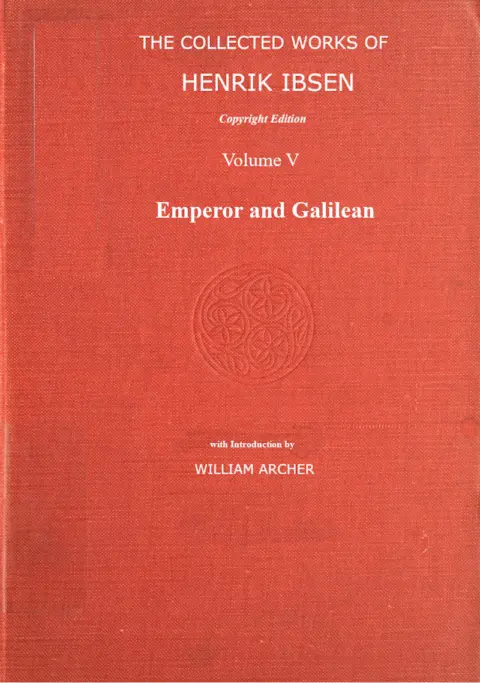
"The Collected Works of Henrik Ibsen, Vol. 05" by Henrik Ibsen is a collection of theatrical works written in the late 19th century. This volume includes the play "Emperor and Galilean," which is a historical drama centered around the life and struggles of Emperor Julian, known as "Julian the Apostate." As Ibsen explores Julian's internal conflicts, the play delves into themes of faith, power, and the battle between paganism and Christianity during a pivotal time in Roman history. At the start of "Emperor and Galilean," we are introduced to an intriguing blend of characters in the court of Emperor Constantius on Easter night. Amidst the chaos of rival factions and the looming threat of violence against non-Christians, young Julian grapples with his identity and the expectations of those around him. Tensions rise as he faces pressures from his family and the court while shaking off the influence of both Christian and pagan philosophies. In this early scene, the historical setting becomes palpable as Julian's internal struggle unfolds against the backdrop of religious and political turbulence, setting the stage for his eventual apostasy.
Introduction adapted from the source catalogue; source summaries may be automatically generated.
Free to read · English · 88,145 words · No account needed
MAKE TIME FOR A GOOD BOOK
On by default. Untick to stop anonymous reading totals. Each page counts after 10 seconds in view. How this works.
Anonymous counting is on unless you have switched it off.
The sacred grove around the temple of Apollo. The portico, supported by columns, and approached by a broad flight of steps, is seen among the trees in the background, on the left.
A number of people are rushing about in the grove with loud cries of terror. Far away is heard the music of the procession.
Mercy! The earth is quaking again!
Oh horror! Thunder beneath our feet——!
Was it indeed so? Was it the earth that shook?
Did you not feel it? That tree there swayed so that the branches
whistled through the air.
Hark, hark, hark!
’Tis the roll of chariots on the pavements.
’Tis the sound of drums. Hark to the music——, the Emperor is coming!
[The procession of Apollo advances from the right through the grove, and stations itself amid music of flutes and harps, in a semicircle in front of the temple.
[Turning towards the temple, with upstretched hands.] I accept the
omen!——
Never have I felt myself in such close communion with the immortal gods.
The Bow-Wielder is among us. The earth thunders beneath his tread, as when of old he stamped in wrath upon the Trojan shore.
But ’tis not on us he frowns. ’Tis on those unhappy wretches who hate him and his sunlit realm.
Yes,—as surely as good or evil fortune affords the true measure of the gods’ favour towards mortals,—so surely is the difference here made manifest between them and us.
Where are the Galileans now? Some under the executioner’s hands, others flying through the narrow streets, ashy pale with terror, their eyes starting from their heads—a shriek between their half-clenched teeth—their hair stiffening with dread, or torn out in despair.
And where are we? Here in Daphne’s pleasant grove, where the dryads’ balmy breath cools our brows,—here, before the glorious temple of the glorious god, lapped in the melodies of flute and lyre,—here, in light, in happiness, in safety, the god himself made manifest among us.
Where is the God of the Galileans? Where is the Jew, the carpenter’s crucified son? Let him manifest himself. Nay, not he!
’Tis fitting, then, that we should throng the sanctuary. There, with my own hands, I will perform the services which are so far from appearing to me mean and unbecoming, that I, on the contrary, esteem them above all others.
[He advances at the head of the procession, through the multitude, towards the temple.
[Calling out in the throng.] Stay, ungodly one!
A Galilean among us?
No further, blasphemer!
Your reading position is saved on this browser. Take it to another device with a library code. Reading pages adapt to text, rather than matching a printed edition.
BEHIND THE BOOK
This eBook is for the use of anyone anywhere in the United States and most other parts of the world at no cost and with almost no restrictions whatsoever. You may copy it, give it away or re-use it under the terms of the Project Gutenberg License included with this eBook or online at www.gutenberg.org. If you are not located in the United States, you will have to check the laws of the country where you are located before using this eBook. Read the source licence.
The original source file, including credits and licence, is retained by this library. Request an original-format copy at no charge. Please include the book title and Project Gutenberg identifier #66240.
KEEP YOUR CURIOSITY GOING
Cécile Tormay

Moritz Busch
Coulson Kernahan
John L. Ransom

Maurice Baring
Frances Wright


