
The wild duck
Henrik Ibsen
THE CLASSIC COLLECTION · 1907
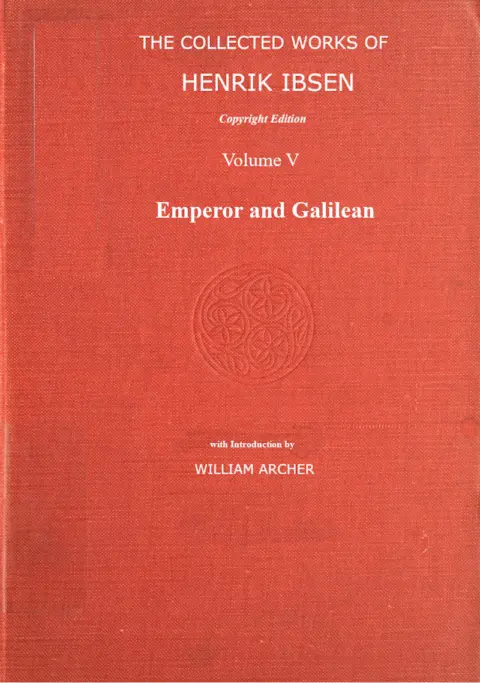
"The Collected Works of Henrik Ibsen, Vol. 05" by Henrik Ibsen is a collection of theatrical works written in the late 19th century. This volume includes the play "Emperor and Galilean," which is a historical drama centered around the life and struggles of Emperor Julian, known as "Julian the Apostate." As Ibsen explores Julian's internal conflicts, the play delves into themes of faith, power, and the battle between paganism and Christianity during a pivotal time in Roman history. At the start of "Emperor and Galilean," we are introduced to an intriguing blend of characters in the court of Emperor Constantius on Easter night. Amidst the chaos of rival factions and the looming threat of violence against non-Christians, young Julian grapples with his identity and the expectations of those around him. Tensions rise as he faces pressures from his family and the court while shaking off the influence of both Christian and pagan philosophies. In this early scene, the historical setting becomes palpable as Julian's internal struggle unfolds against the backdrop of religious and political turbulence, setting the stage for his eventual apostasy.
Introduction adapted from the source catalogue; source summaries may be automatically generated.
Free to read · English · 88,145 words · No account needed
MAKE TIME FOR A GOOD BOOK
On by default. Untick to stop anonymous reading totals. Each page counts after 10 seconds in view. How this works.
Anonymous counting is on unless you have switched it off.
Most gracious Emperor, forgive me, but—is that expedient?
Why not? I marvel at you, my Oribases!
Ah, sire, you may well marvel! Not expedient to——?
Should not a Julian dare what less god-like men have dared?
I, too, think that the more daring course would now be to disguise the counsels of the mystic powers. If it be the case that the divinities have deputed their sovereignty into earthly hands—as many signs justify us in concluding—it would indeed be most ungrateful to conceal the fact. In such hazardous circumstances as these, ’tis no trifling matter that the soldiers should pay their devotions in a quite different quarter from that in which they are due.
I tell you, Oribases, and all of you,—if, indeed, there be present any one else who would set limits to the Emperor’s power,—that this would be the very essence of impiety, and that I should therefore be forced to take strong measures against it.
Has not Plato long ago enunciated the truth that only a god can rule over men? What meant he by that saying? Answer me—what did he mean? Far be it from me to assert that Plato—incomparable sage though he was—had any individual, even the greatest, in his prophetic eye. But I think we have all seen what disorders result from the parcelling out, as it were, of the supreme power into several hands.
Enough of that. I have already commanded that the imperial busts shall be displayed about the camp.
Ah! what seek you in such haste, Eutherius?
The Chamberlain EUTHERIUS comes from the ships, accompanied by a man in girt-up garments.
Exalted Emperor,—this man of Antioch is sent by the governor, Alexander, and brings you a letter which, he says, is of great importance.
Ah, let me see! Light here!
[A torch is brought; the Emperor opens and reads the letter.
Can this be possible! More light! Yes, here it is written—and here—; what next?—Truly this exceeds all I could have conceived!
Bad news from the west, sire?
Nevita, tell me, how long will it take us to reach Ctesiphon?
It cannot be done in less than thirty days.
It must be done in less! Thirty days! A whole month! And while we are creeping forward here, I must let those madmen——
You know yourself, sire, that, on account of the ships, we must follow all the windings of the river. The current is rapid, and the bed, too, shallow and stony. I hold it impossible to proceed more quickly.
Your reading position is saved on this browser. Take it to another device with a library code. Reading pages adapt to text, rather than matching a printed edition.
BEHIND THE BOOK
This eBook is for the use of anyone anywhere in the United States and most other parts of the world at no cost and with almost no restrictions whatsoever. You may copy it, give it away or re-use it under the terms of the Project Gutenberg License included with this eBook or online at www.gutenberg.org. If you are not located in the United States, you will have to check the laws of the country where you are located before using this eBook. Read the source licence.
The original source file, including credits and licence, is retained by this library. Request an original-format copy at no charge. Please include the book title and Project Gutenberg identifier #66240.
KEEP YOUR CURIOSITY GOING
Cécile Tormay

Moritz Busch
Coulson Kernahan
John L. Ransom

Maurice Baring
Frances Wright


