THE CLASSIC COLLECTION✦On the StairsCLASSIC FREE BOOKS
On the Stairs
Henry Blake Fuller
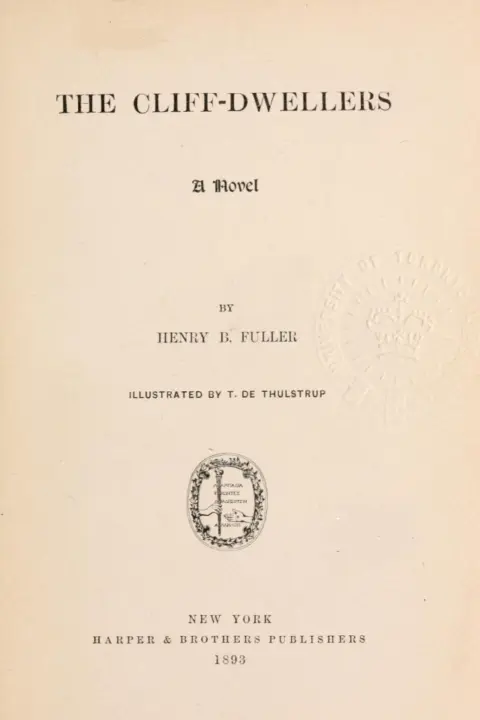
THE CLASSIC COLLECTION · 1893
"The Cliff-Dwellers: A Novel" by Henry Blake Fuller is a fictional work written in the late 19th century. Set against the backdrop of Chicago's rapidly evolving urban landscape, the novel explores themes of social interactions, aspirations, and the complexities of life in a bustling city. The story revolves around characters related to the Massachusetts Brass Company, including Walworth Floyd, who navigates his life amidst family expectations and societal pressures. The opening of the novel sets the stage by vividly describing the Clifton, a towering building housing a diverse group of people, including affluent businessmen and their families. The narrative introduces several key characters, including Walworth Floyd, who grapples with his position in life and the dynamics within his family, particularly regarding his choice of friends and his marriage. A significant focus is placed on the interactions between Walworth, his wife, and other young individuals in the community, foreshadowing deeper social themes and personal conflicts that will unfold throughout the story.
Introduction adapted from the source catalogue; source summaries may be automatically generated.
Free to read · English · 69,270 words · No account needed
MAKE TIME FOR A GOOD BOOK
On by default. Untick to stop anonymous reading totals. Each page counts after 10 seconds in view. How this works.
Anonymous counting is on unless you have switched it off.
"Didn't you say," demanded Atwater, "that you wanted to put up an architectural monument that would be a credit to the town? Would an eighteen-story flank of bare brick have been a pleasant object? Or, rather, is it?--for you see that sort of business all over the city. Heavens!" he went on, "we're doing some horrible things here, but we are not the ones who are altogether to blame."
"Who says you haven't done well with the Clifton?" demanded Ann Wilde. Host of the ladies had retired from these masculine topics, and were huddled in a gossipy little group at the foot of the stairs; Ann had remained behind, as an owner of real property. "That system of elevators is the most magnificent thing I ever saw."
Atwater groaned. "That's all a building is nowadays--one mass of pipes, pulleys, wires, tubes, shafts, chutes, and what not, running through an iron cage of from fourteen, to twenty stages. Then the artist comes along and is asked to apply the architecture by festooning on a lot of tile, brick, and terra-cotta. And over the whole thing hovers incessantly the demon of Nine-per-cent."
"A slap at me," said Ingles.
"It's enough to make you wonder whether Pericles ever lived. I doubt if he did," concluded Atwater.
"Are you the only sufferer?" asked his client. "How many of our
sub-contractors failed?"
"Two."
"How many times were we set on fire by salamanders?"
"Three."
"How many drunken night-watchmen were discharged?"
"Four or five."
"How much of the tin-work did you condemn?"
"Lots."
"How many of the contractors suffered a penalty for over-time?"
"Too many."
"How many times did carpenters wreck plaster-work?"
"Fifty."
"How many times did plasterers ruin woodwork?"
"A hundred."
"How many men were killed or injured?"
"Thirteen."
"Thirteen!" cried Ann Wilde; "how horrible!" "Then you don't encourage building," commented Bradley; "and Mr. Atwater wouldn't encourage young men to go into architecture."
"As engineers, not as architects," replied Atwater. "Or shall I say--as
constructionists?"
"Good word," murmured Ingles.
"Thanks. I've got fifteen draughtsmen up under the roof of the Clifton. When a new one comes, I say, 'My dear boy, go in for mining or dredging, or build bridges, or put up railway sheds, if you must; but don't go on believing that architecture nowadays has any great place for the artist. There won't be another Fair until long after you are dead and gone.'"
"I think I've had one of your young men with me lately," Bradley said. "He told us that he had been designing labels out at the Stock Yards, but had been in your office before that. Art may cover a wide range, you see," he said, laughing.
Your reading position is saved on this browser. Take it to another device with a library code. Reading pages adapt to text, rather than matching a printed edition.
Henry Blake Fuller
Henry Blake Fuller
Henry Blake Fuller
Henry Blake Fuller
BEHIND THE BOOK
This eBook is for the use of anyone anywhere in the United States and most other parts of the world at no cost and with almost no restrictions whatsoever. You may copy it, give it away or re-use it under the terms of the Project Gutenberg License included with this eBook or online at www.gutenberg.org. If you are not located in the United States, you will have to check the laws of the country where you are located before using this eBook. Read the source licence.
The original source file, including credits and licence, is retained by this library. Request an original-format copy at no charge. Please include the book title and Project Gutenberg identifier #57782.
KEEP YOUR CURIOSITY GOING
Coulson Kernahan

Maurice Baring
Frances Wright
Cécile Tormay

Frederic Jesup Stimson

W. H. P. (William Henry Pope) Jarvis