THE CLASSIC COLLECTION✦On the StairsCLASSIC FREE BOOKS
On the Stairs
Henry Blake Fuller
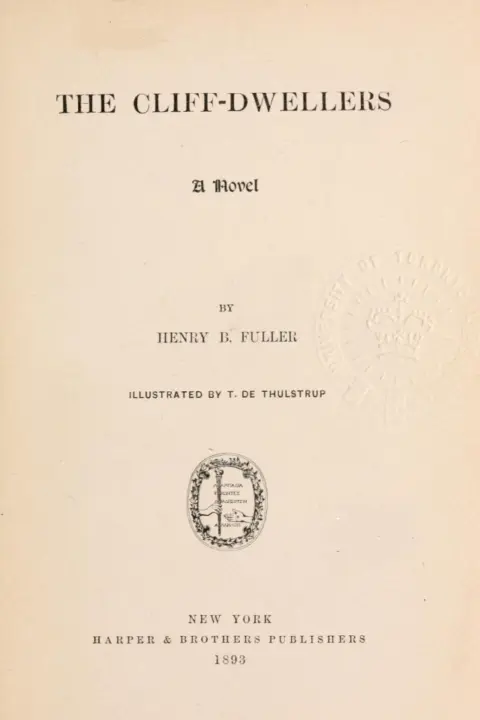
THE CLASSIC COLLECTION · 1893
"The Cliff-Dwellers: A Novel" by Henry Blake Fuller is a fictional work written in the late 19th century. Set against the backdrop of Chicago's rapidly evolving urban landscape, the novel explores themes of social interactions, aspirations, and the complexities of life in a bustling city. The story revolves around characters related to the Massachusetts Brass Company, including Walworth Floyd, who navigates his life amidst family expectations and societal pressures. The opening of the novel sets the stage by vividly describing the Clifton, a towering building housing a diverse group of people, including affluent businessmen and their families. The narrative introduces several key characters, including Walworth Floyd, who grapples with his position in life and the dynamics within his family, particularly regarding his choice of friends and his marriage. A significant focus is placed on the interactions between Walworth, his wife, and other young individuals in the community, foreshadowing deeper social themes and personal conflicts that will unfold throughout the story.
Introduction adapted from the source catalogue; source summaries may be automatically generated.
Free to read · English · 69,270 words · No account needed
MAKE TIME FOR A GOOD BOOK
On by default. Untick to stop anonymous reading totals. Each page counts after 10 seconds in view. How this works.
Anonymous counting is on unless you have switched it off.
"Would there be stairs?"
"Yes."
"And closets? Mamma says we never have enough closet-room."
"That's right, Claudia," said Ingles, commendingly; "score the
profession."
"Yes, closets, if you insist."
"And glass in the windows?"
"Yes. Dear me, they get more exacting with us every year!"
"And--and--" she rolled her eyes around the group, as if wondering whether any important detail had been overlooked--"gas-fixtures? Would there be one in every room, with four globes on it?"
"Perhaps."
"But don't charge the poor child a full commission on them," said
Ingles, grimly.
"Ah!" murmured Atwater, with a world of meaning. "And if I were to
promise to put a nice little red chimney on the roof--what would you
say?"
The child clasped her doll firmly and looked down at the carpet. "I shouldn't know whether to belave you," she said, shyly.
There was a burst of laughter. "You dear little tot!" cried Mrs. Fairchild, gathering her up, on no very definite grounds, for a kiss. Her father laughed loudest of all, but her mother contracted her eyebrows in distress.
"That dreadful Horah!" whimpered the poor woman. "She must go."
"Don't dismiss your bonne," laughed Atwater, thankful for the diversion; "she'll produce a beautiful accent in time."
"Well, after that," said her father, "I think our little McGintums had better retire. Say good-night, Claudia."
"Not yet," said Ingles. "Not before she has learned that she may have her doubts about a contractor, perhaps, but about an architect--never. Remember that great truth. Good-night, my child. Won't you kiss me?"
He lowered his face, but Claudia drew back. "I don't like whishky," she
said, solemnly.
"For Heaven's sake, my pet," cried Floyd, "are you trying to start a panic? There's Horah; go-go."
"Good-night, Claudia," called Atwater; "we won't forget your house. Upon my word, Ingles," he went on rapidly, and with a face still slightly flushed, "I believe I shall have to reconsider that determination of mine I spoke to you about the other day."
"What's that?" asked Walworth.
"To give up sky-scrapers and to do nothing but colonial houses for the nobility and gentry. Sky-scraping is bad enough, but the demands of the modern house-builder are worse. Ingles, you're not as evil as I said you were; I'm sorry I ever called you a Philistine."
"Why did you do that?" asked Fairchild, amused.
"Because," answered Ingles, "I took two weeks to consider whether I could afford to let the Clifton have four good street-fronts."
Your reading position is saved on this browser. Take it to another device with a library code. Reading pages adapt to text, rather than matching a printed edition.
Henry Blake Fuller
Henry Blake Fuller
Henry Blake Fuller
Henry Blake Fuller
BEHIND THE BOOK
This eBook is for the use of anyone anywhere in the United States and most other parts of the world at no cost and with almost no restrictions whatsoever. You may copy it, give it away or re-use it under the terms of the Project Gutenberg License included with this eBook or online at www.gutenberg.org. If you are not located in the United States, you will have to check the laws of the country where you are located before using this eBook. Read the source licence.
The original source file, including credits and licence, is retained by this library. Request an original-format copy at no charge. Please include the book title and Project Gutenberg identifier #57782.
KEEP YOUR CURIOSITY GOING
Coulson Kernahan

Maurice Baring
Frances Wright
Cécile Tormay

Frederic Jesup Stimson

W. H. P. (William Henry Pope) Jarvis