
The clammer
William John Hopkins
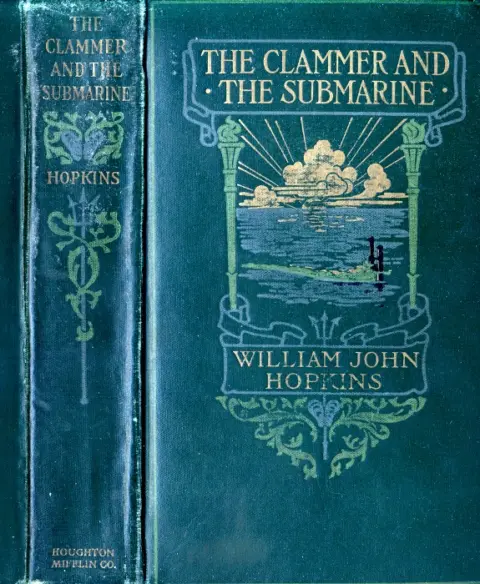
THE CLASSIC COLLECTION · 1917
"The Clammer and the Submarine" by William John Hopkins is a juvenile novel written in the early 20th century. The story is set against the backdrop of World War I and centers around the life of Adam, a clam digger, and his interactions with his family, particularly his wife Eve and their children. The narrative reflects Adam's thoughts on war, peace, and the idyllic life he wishes to maintain despite the tumultuous times. The opening of the novel introduces Adam as he sits under a great pine tree, contemplating the beauty of his surroundings while simultaneously grappling with his thoughts on the war. His musings reveal a man caught between his peaceful domestic life and the distant yet looming presence of conflict. The serene setting hints at his simple, rural lifestyle, which is contrasted by the encroaching realities of the war and how it impacts even the most civilian of lives. The arrival of his wife Eve and their daughter Tidda further grounds Adam in familial concerns, as he reflects on the duties of fatherhood and the uncertainty of the times, framing their everyday life amid the backdrop of global conflict.
Introduction adapted from the source catalogue; source summaries may be automatically generated.
Free to read · English · 44,325 words · No account needed
MAKE TIME FOR A GOOD BOOK
On by default. Untick to stop anonymous reading totals. Each page counts after 10 seconds in view. How this works.
Anonymous counting is on unless you have switched it off.
Elizabeth raised her eyes to me, and I saw two deep pools under a summer sun, and all manner of colors played over them, concealing the depths. Then for an instant the lights were quenched that concealed the depths, and her eyes became as two dark wells with yet a sort of light illumining the darkness, and there I saw content, but not satisfaction--if those two can be reconciled. It was for but an instant, and then the lights came back, and her eyes danced, and she laughed at me.
"Are you wondering," she asked, "what has happened to us, and what Bobby Leverett is doing here?"
"It is easy to guess," I answered, "that you and Pukkie have been overboard, although why you should go in swimming in all your clothes is another matter. But I must confess to some wonder about that matter standing fidgeting there." And I pointed an accusing finger at Bobby.
Bobby was ill at ease, and struggling between the constraint that was upon him and a wish to tell his tale.
"Well, you see, Adam," he began, "I--we were cruising--"
"Who," I asked, interrupting, "is 'we'?"
"Bobby," said Elizabeth quietly, "you'd better let me tell it first. Puk and I," she continued, addressing Eve and me, "were sailing along too calmly, and he wanted to put up the gafftopsail. So he got it out, and ran with it, and he caught his foot in some of the superfluous ropes and blocks, and went overboard--topsail and all. I was afraid he might be tangled in the sail, so I let all the halliards go on the run, and I went after him. I got him, and saved the sail, and there was a boat from the Rattlesnake, with Bobby. He helped us on board again, and insisted upon coming with us."
Bobby again opened his mouth to speak.
"One moment, Bobby," I said. "Tell me, Elizabeth, did the Rattlesnake
spring so suddenly?"
She smiled and glanced at Bobby. "Oh, we had seen her before. That was why Puk was wanting the topsail. He wanted to see if we could beat her."
"Oh," said I, and I looked at Bobby, who squirmed as a caterpillar on a
stick.
"We happened to be near," he said. He spoke calmly enough, but I saw that he was very uncomfortable. "I thought I ought to come, for Pukkie was very wet, and I wanted to be sure he was all right. Miss Radnor had rather a nasty time getting him clear of that sail."
"Bobby!" said Elizabeth warningly. And suddenly she smiled as if she was much amused at something, perhaps at Bobby.
Your reading position is saved on this browser. Take it to another device with a library code. Reading pages adapt to text, rather than matching a printed edition.
William John Hopkins
William John Hopkins
William John Hopkins

William John Hopkins
BEHIND THE BOOK
This eBook is for the use of anyone anywhere in the United States and most other parts of the world at no cost and with almost no restrictions whatsoever. You may copy it, give it away or re-use it under the terms of the Project Gutenberg License included with this eBook or online at www.gutenberg.org. If you are not located in the United States, you will have to check the laws of the country where you are located before using this eBook. Read the source licence.
The original source file, including credits and licence, is retained by this library. Request an original-format copy at no charge. Please include the book title and Project Gutenberg identifier #39456.
KEEP YOUR CURIOSITY GOING
Cécile Tormay

Moritz Busch
Coulson Kernahan
John L. Ransom

Maurice Baring
Frances Wright