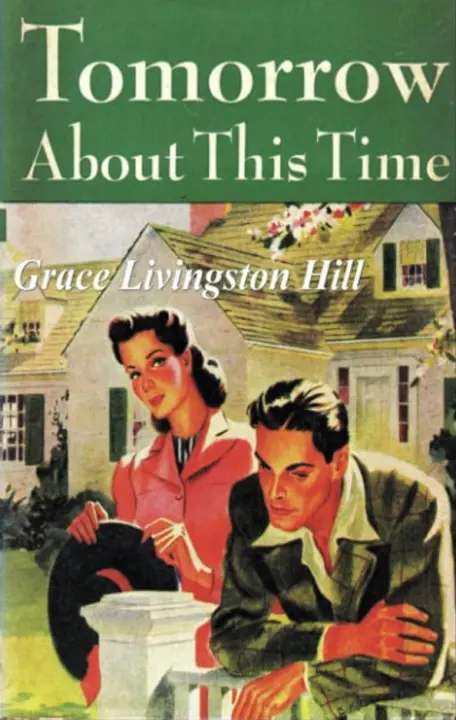
Tomorrow about this time
Grace Livingston Hill
THE CLASSIC COLLECTION · 1922
"The City of Fire" by Grace Livingston Hill is a novel likely written in the early 20th century. The story unfolds in a quaint, idyllic setting, focusing on the character of Billy Gaston, a fourteen-year-old boy residing in the picturesque community of Sabbath Valley. The narrative intricately weaves themes of adventure, intrigue, and the moral dilemmas that arise when Billy becomes embroiled in a plot involving kidnapping and deception. At the start of the book, we are introduced to Billy as he waits at the Pleasant View train station, contemplating the beauty of his surroundings and the upcoming baseball game he is eager to attend. However, his day takes an unexpected turn when he overhears a conversation between a freight agent and an unidentified man discussing a kidnapping. Intrigued and sensing an opportunity, Billy decides to engage with the freight agent, further entangling himself in a shady scheme that raises questions about loyalty and ethics. As he navigates this dangerous scenario, the contrast between the innocence of his youth in Sabbath Valley and the darker undercurrents of adult ambition and crime becomes apparent, setting the stage for a compelling adventure.
Introduction adapted from the source catalogue; source summaries may be automatically generated.
Free to read · English · 106,589 words · No account needed
MAKE TIME FOR A GOOD BOOK
On by default. Untick to stop anonymous reading totals. Each page counts after 10 seconds in view. How this works.
Anonymous counting is on unless you have switched it off.
The burly one gave Billy a brief and gruff negative to his query and went on painting barrel labels. He was thinking of other matters, but Billy still hung around. He had a hunch that he might be going to make merchandise in some way of the knowledge that he had gained, so he hung around, silently, observantly, leaning on old rusty-trusty.
The man looked up and frowned suspiciously:
“I told you NO!” he snapped threateningly, “What you standin' there
for?”
Billy regarded him amusedly as from a superior height.
“Don't happen to know of any odd jobs I could get,” he finally
condescended.
“Where would you expect a job around this dump?” sneered the man with an eloquent wave toward the majestic mountain, “Busy little hive right here now, ain't it?”
He subsided and Billy, slowly, thoughtfully, mounted his wheel and rode around the station, with the air of one who enjoys the scenery. The third time he rounded the curve by the freight agent the man looked up with a speculative squint and eyed the boy. The fourth time he called out, straightening up and laying down his brush.
“Say, Kid, do you know how to keep yer mouth shut?”
The boy regarded him with infinite contempt.
“Well, that depends!” he said at last. “If anybody'd make it worth my
while.”
The man looked at him narrowly, the tone was at once so casual and yet so full of possible meaning. The keenest searching revealed nothing in the immobile face of the boy. A cunning grew in the eyes of the man.
“How would a five look to you?”
“Not enough,” said the boy promptly, “I need twenty-five.”
“Well, ten then.”
“The boy rode off down the platform and circled the station again while the man stood puzzled, half troubled, and watched him:
“I'll make it fifteen. What you want, the earth with a gold fence around
it?”
“I said I needed twenty-five,” said Billy doggedly, lowering his eyes to cover the glitter of coming triumph.
The thick one stood squinting off at the distant mountain thoughtfully, then he turned and eyed Billy again.
“How'm I gonta know you're efficient?” he challenged.
“Guess you'c'n take me er leave me,” came back the boy quickly. “Course if you've got plenty help--”
The man gave him a quick bitter glance. The kid was sharp. He knew there was no one else. Besides, how much had he overheard? Had he been around when the station telephone rang? Kids like that were deep. You could always count on them to do a thing well if they undertook it.
Your reading position is saved on this browser. Take it to another device with a library code. Reading pages adapt to text, rather than matching a printed edition.
Grace Livingston Hill
Grace Livingston Hill
Grace Livingston Hill
Grace Livingston Hill
BEHIND THE BOOK
This eBook is for the use of anyone anywhere in the United States and most other parts of the world at no cost and with almost no restrictions whatsoever. You may copy it, give it away or re-use it under the terms of the Project Gutenberg License included with this eBook or online at www.gutenberg.org. If you are not located in the United States, you will have to check the laws of the country where you are located before using this eBook. Read the source licence.
The original source file, including credits and licence, is retained by this library. Request an original-format copy at no charge. Please include the book title and Project Gutenberg identifier #7008.
KEEP YOUR CURIOSITY GOING
Coulson Kernahan

Maurice Baring
Frances Wright
Cécile Tormay

Frederic Jesup Stimson

W. H. P. (William Henry Pope) Jarvis