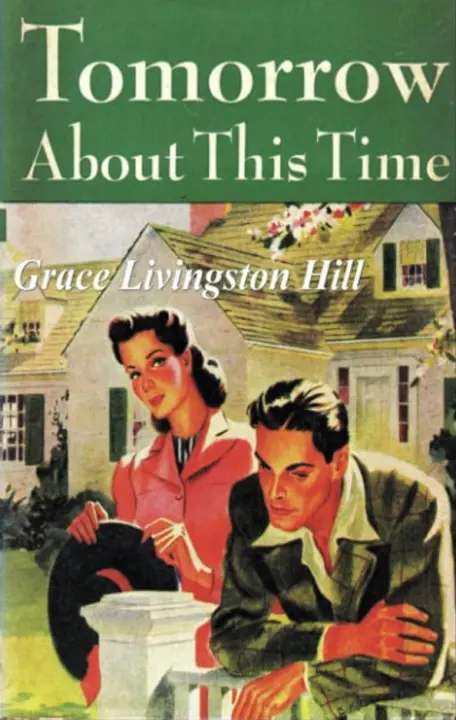
Tomorrow about this time
Grace Livingston Hill
THE CLASSIC COLLECTION · 1922
"The City of Fire" by Grace Livingston Hill is a novel likely written in the early 20th century. The story unfolds in a quaint, idyllic setting, focusing on the character of Billy Gaston, a fourteen-year-old boy residing in the picturesque community of Sabbath Valley. The narrative intricately weaves themes of adventure, intrigue, and the moral dilemmas that arise when Billy becomes embroiled in a plot involving kidnapping and deception. At the start of the book, we are introduced to Billy as he waits at the Pleasant View train station, contemplating the beauty of his surroundings and the upcoming baseball game he is eager to attend. However, his day takes an unexpected turn when he overhears a conversation between a freight agent and an unidentified man discussing a kidnapping. Intrigued and sensing an opportunity, Billy decides to engage with the freight agent, further entangling himself in a shady scheme that raises questions about loyalty and ethics. As he navigates this dangerous scenario, the contrast between the innocence of his youth in Sabbath Valley and the darker undercurrents of adult ambition and crime becomes apparent, setting the stage for a compelling adventure.
Introduction adapted from the source catalogue; source summaries may be automatically generated.
Free to read · English · 106,589 words · No account needed
MAKE TIME FOR A GOOD BOOK
On by default. Untick to stop anonymous reading totals. Each page counts after 10 seconds in view. How this works.
Anonymous counting is on unless you have switched it off.
The whistle of the Cannery at Sabbath Valley blew a relief blast five minutes ahead of midnight in deference to the church chimes, and the night shift which had been working overtime on account of a consignment of tomatoes that would not keep till Monday, poured joyously out into the road and scattered to their various homes.
The outmost of these homegoers, Tom McMertrie and Jim Rafferty, who lived at the other extreme of the village, came upon a crippled car, coughing and crawling toward them in front of the Graveyard. Its driver, much sobered by lack of stimulant, and frequent necessity for getting out and pushing his car over hard bits of road, called to them noisily.
The two workmen, pleasant of mood, ready for a joke, not altogether averse to helping if this proved to be “the right guy,” halted and stepped into the road just to look the poor noble car over. It was the lure of the fine machine.
“Met with an accident?” Jim remarked affably, as if it were something to
enjoy.
“Had toire thrubble?” added Tom, punching the collapsed tires.
The questions seemed to anger the driver, who demanded loftily:
“Where's your garage?”
“Garage? Oh, we haven't any garage,” said Jim pleasantly, with a mute twinkle in his Irish eye.
“No garage? Haven't any garage! What town is this,--if you call it a
town?”
“Why, mon, this is Sawbeth Volley! Shorely ye've heard of Sawbeth
Volley!”
“No, I never heard of it!” said the stranger contemptuously, “but from what I've seen of it so far I should say it ought to be called Hell's Pit! Well, what do you do when you want your car fixed?”
“Well, we don't hoppen to hove a cyar,” said Tom with a meditative air, stooping to examine the spokes of a wheel, “Boot, ef we hod mon, I'm thenkin' we'd fix it!”
Jim gave a flicker of a chuckle in his throat, but kept his outward gravity. The stranger eyed the two malevolently, helplessly, and began once more, holding his rage with a cold voice.
“Well, how much do you want to fix my car?” he asked, thrusting his hand into his pocket and bringing out an affluent wallet.
The men straightened up and eyed him coldly. Jim turned indifferently away and stepped back to the sidewalk. Tom lifted his chin and replied kindly:
“Why, Mon, it's the Sawbeth, didn't ye know? I'm s'proised at ye! It's the Sawbeth, an' this is Sawbeth Volley! We don't wurruk on the Sawbeth day in Sawbeth Volley. Whist! Hear thot, mon?”
Your reading position is saved on this browser. Take it to another device with a library code. Reading pages adapt to text, rather than matching a printed edition.
Grace Livingston Hill
Grace Livingston Hill
Grace Livingston Hill
Grace Livingston Hill
BEHIND THE BOOK
This eBook is for the use of anyone anywhere in the United States and most other parts of the world at no cost and with almost no restrictions whatsoever. You may copy it, give it away or re-use it under the terms of the Project Gutenberg License included with this eBook or online at www.gutenberg.org. If you are not located in the United States, you will have to check the laws of the country where you are located before using this eBook. Read the source licence.
The original source file, including credits and licence, is retained by this library. Request an original-format copy at no charge. Please include the book title and Project Gutenberg identifier #7008.
KEEP YOUR CURIOSITY GOING
Coulson Kernahan

Maurice Baring
Frances Wright
Cécile Tormay

Frederic Jesup Stimson

W. H. P. (William Henry Pope) Jarvis