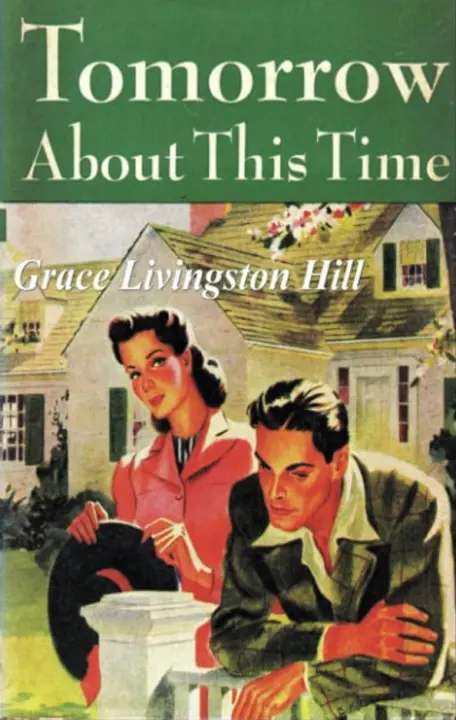
Tomorrow about this time
Grace Livingston Hill
THE CLASSIC COLLECTION · 1922
"The City of Fire" by Grace Livingston Hill is a novel likely written in the early 20th century. The story unfolds in a quaint, idyllic setting, focusing on the character of Billy Gaston, a fourteen-year-old boy residing in the picturesque community of Sabbath Valley. The narrative intricately weaves themes of adventure, intrigue, and the moral dilemmas that arise when Billy becomes embroiled in a plot involving kidnapping and deception. At the start of the book, we are introduced to Billy as he waits at the Pleasant View train station, contemplating the beauty of his surroundings and the upcoming baseball game he is eager to attend. However, his day takes an unexpected turn when he overhears a conversation between a freight agent and an unidentified man discussing a kidnapping. Intrigued and sensing an opportunity, Billy decides to engage with the freight agent, further entangling himself in a shady scheme that raises questions about loyalty and ethics. As he navigates this dangerous scenario, the contrast between the innocence of his youth in Sabbath Valley and the darker undercurrents of adult ambition and crime becomes apparent, setting the stage for a compelling adventure.
Introduction adapted from the source catalogue; source summaries may be automatically generated.
Free to read · English · 106,589 words · No account needed
MAKE TIME FOR A GOOD BOOK
On by default. Untick to stop anonymous reading totals. Each page counts after 10 seconds in view. How this works.
Anonymous counting is on unless you have switched it off.
When he reached a point on the Highway where Pleasant View station was easily discernible he dismounted, parked his wheel among the huckleberries, and slid into the green of the Valley. Stealing cautiously to the scene of the Saturday night hold-up he finally succeeded in locating the hidden telephone, and creeping into a well screened spot not far away arranged himself comfortably to wait till the trains came. He argued that Pat would likely come down to report or get orders about the same time as before, and so in the stillness of the morning he lay on the ground and waited. He could hear a song sparrow high up on the telegraph wire, sing out its wild sweet lonely strain: Sweet--sweetsweetsweet--sweetsweet--sweetsweet--! and a hum of bees in the wild grape that trailed over the sassafras trees. Beside him a little wood spider stole noiselessly on her busy way. But his heart was heavy with new burdens and he could not take his usual rhapsodic joy in the things of Nature. What was happening to Mark and what could he do about it? Perhaps Mark would have been better off if he had left him in the old house on Stark's mountain. The chief couldn't have found him then and the kidnappers would have kept him safe for a good many days till they got some money. But there wouldn't have been any money! For Mark wasn't the right man! And the kidnappers would have found it out pretty soon and what would they have done to Mark? Killed him perhaps so they wouldn't get into any more trouble! There was no telling! And time would have gone on and nobody would have known what had become of Mark. And the murder trial--if it was really a murder--would come off and they couldn't find Mark, and of course they would think Mark had killed the man and then run away. And Mark would never be able to come home again! No, he was glad Mark was out and safe and free from dope. At least Mark would know what to do to save himself. Or would he? Billy suddenly had his doubts. Would Mark take care of himself, just himself, or not? Mark was always looking after other people, but he had somehow always let people say and do what they would with him. Aw gee! Now Mark wouldn't let them locate a thing like a murder on him, would he? And there was Miss Lynn! And Mark's mother! Mark oughtta think of them. Well, maybe he wouldn't realize how much they did care. Billy had a sudden revelation that maybe that was half the matter, Mark didn't know how much any of them cared. Back in his mind there was an uncomfortable memory of Aunt Saxon's pink damp features and anxious eyes and a possible application of the same principle to his own life, as in the case of Judas. But he wasn't considering himself now. There might come a time when he would have to change his tactics with regard to Aunt Saxon somewhat. She certainly had been a good sport last night. But this wasn't the time to consider that. He had a great deal more important matters to think of now. He had to find out how he could make it perfectly plain to the world that Mark Carter had not shot a man after twelve o'clock Saturday night at the Blue Duck Tavern. And as yet he didn't see any way without incriminating himself as a kidnapper. This cut deep because in the strict sense of the word he was not a kidnapper, because he hadn't meant to be a kidnapper. He had only meant to play a joke on the kidnappers, and at worst his only really intended fault had been the putting up of that detour on the Highway. But he had an uncomfortable conviction that he wouldn't be able to make the Chief and the Constable, and some of those people over at Economy Court House see it that way. As matters stood he was safe if he kept his mouth shut. Nobody knew but Mark, and he didn't know the details. Besides, Mark would never tell. Mark would even go to trial for murder before he would let himself out by telling on Billy, Billy knew that as well as he knew that the old mountain on whose feet he lay stretched now would stand up there for ages and always keep his secret for him. Mark was that way. That was why it made it worse for Billy. Judas again! Billy was surprised to find how much Judas-blood there seemed to be in him. He lay there and despised himself without being able to help himself out or think of anything he could do. And then quite suddenly as he was going over the whole circumstance from the time he first listened to Pat's message into the moss of the mountain, until now, the name Shafton came to him. Laurence Shafton. Shafton, son of William J., of Gates and Shafton. Those were the words the telephone had squeaked out quite plainly. And Shafton. Mr. Shafton. That was the name Mark had called the guy with the car at the parsonage. Mr. Shafton. The same guy, of course. Bah! What a mess he had made of it all. Got Mark kidnapped, landed that sissy-guy on the Severns for no knowing how long, and perhaps helped to tangle Mark up in a murder case. Aw Gee! There's the train! What could he do? That rich guy! Well, there wasn't anything to that. He would get out as soon as Mark got his car fixed up and never know he had been kidnapped. And what was he, Billy, waiting here for anyway? Just a chance! Just to see whether Pat and Sam had found out yet that their quarry had vanished. Just to wonder what had become of Link and Shorty.
Your reading position is saved on this browser. Take it to another device with a library code. Reading pages adapt to text, rather than matching a printed edition.
Grace Livingston Hill
Grace Livingston Hill
Grace Livingston Hill
Grace Livingston Hill
BEHIND THE BOOK
This eBook is for the use of anyone anywhere in the United States and most other parts of the world at no cost and with almost no restrictions whatsoever. You may copy it, give it away or re-use it under the terms of the Project Gutenberg License included with this eBook or online at www.gutenberg.org. If you are not located in the United States, you will have to check the laws of the country where you are located before using this eBook. Read the source licence.
The original source file, including credits and licence, is retained by this library. Request an original-format copy at no charge. Please include the book title and Project Gutenberg identifier #7008.
KEEP YOUR CURIOSITY GOING
Coulson Kernahan

Maurice Baring
Frances Wright
Cécile Tormay

Frederic Jesup Stimson

W. H. P. (William Henry Pope) Jarvis