THE CLASSIC COLLECTION✦The Happy IslesCLASSIC FREE BOOKS
The Happy Isles
Basil King
THE CLASSIC COLLECTION · 1919
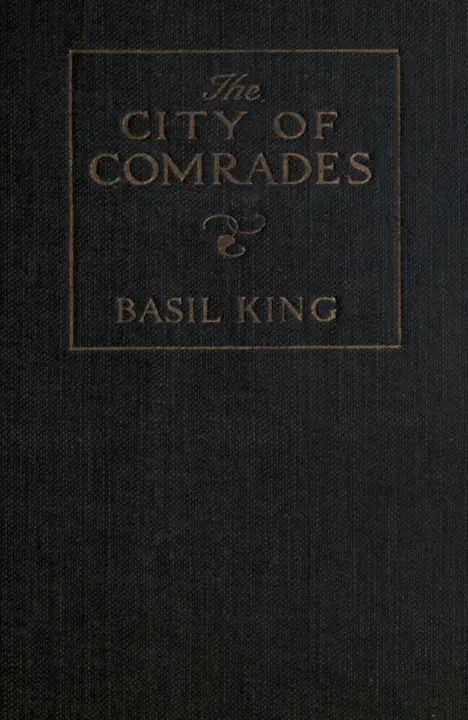
"The City of Comrades" by Basil King is a novel written in the early 20th century. The book delves into the struggles of individuals living on the fringes of society, focusing on complex themes of human connection and redemption. At its center is a discreet but deeply conflicted protagonist, who is drawn into a life of crime while battling his own demons and the expectations of society. The opening of the narrative introduces us to a grim and bustling New York City in June 1913, setting the stage for themes of desperation and the quest for belonging. We meet the protagonist, a nameless man, in the company of Lovey, a disheveled figure suggesting a petty crime involving two wealthy old ladies. As the protagonist wrestles with moral dilemmas, he reflects on his past, revealing a painful history and aspirations cut short by failures and societal rejection. The tone is tense as he contemplates his next move in a city filled with opportunity yet fraught with danger, while Lovey's eagerness contrasts with the protagonist's apprehension. The stage is set for a gripping exploration of the human condition and the profound bonds that form in moments of crisis.
Introduction adapted from the source catalogue; source summaries may be automatically generated.
Free to read · English · 118,845 words · No account needed
MAKE TIME FOR A GOOD BOOK
On by default. Untick to stop anonymous reading totals. Each page counts after 10 seconds in view. How this works.
Anonymous counting is on unless you have switched it off.
No one could have been kinder to me than he was—and I liked him. I reminded myself that it was none of my business if his tastes were fastidious, and that to spend his money this way was better than in lounging about bar-rooms, as I had done; and yet I could understand that a girl like Regina Barry should be impatient of these traits in a husband.
I sat, however, with my back to it all, astride of a small chair, my pipe in my mouth, looking down on the lights and traffic.
Breaking a long silence, I said, as casually as I could do it: “I met Sterling Barry’s daughter the other day—Miss Regina Barry, her name is, isn’t it?”
Vague, restless movements preceded the laconic response, “Where?”
“She came to the memorial with Mrs. Grace.”
Hearing him strike a match, I knew he was making an effort at sang-froid by lighting a cigarette.
“Did you—did you—think her—pretty?”
“Pretty wouldn’t be the word.”
“Beautiful?”
“Nor beautiful.”
“What then?”
“No word that I know would be adequate. You might say fascinating if it hadn’t been vulgarized; and chic would be worse.”
“She’s tremendously animated—and vivid.”
“She has the most living eyes and mouth I’ve ever seen in a human being. I’ve never seen a face so aglow with mind, emotion, and color. She’s all flame, but a flame like that of the burning bush, afire from a force within.”
He spoke bitterly. “And people talk about that being conquered!”
To lead him further I said, “Has any one talked of it?”
“Didn’t you know?”
“How should I know? You—you’ve never told me.”
“Well, I’m—I’m telling you now.”
My sympathy was quite genuine.
“Thanks, old boy. I can see—I can see how hard it must have gone with
you.”
“How hard it’s going, Frank. There’s a difference in tense. If you knew
her better—”
“I’m not sure that I care to know her better; and that, old man, isn’t said out of rudeness. I don’t belong to her world any more; and I’d rather not try to get back into it.”
“Oh, get out! As a matter of fact I’m going to take you to see her.”
“You needn’t do that, because she asked me to come.”
“Right off the bat like that? The first time she’d ever seen you?”
“It wasn’t exactly that. She knew my brother Jack; and my cousin, Annette van Elstine, is a friend of hers.”
Your reading position is saved on this browser. Take it to another device with a library code. Reading pages adapt to text, rather than matching a printed edition.
BEHIND THE BOOK
This eBook is for the use of anyone anywhere in the United States and most other parts of the world at no cost and with almost no restrictions whatsoever. You may copy it, give it away or re-use it under the terms of the Project Gutenberg License included with this eBook or online at www.gutenberg.org. If you are not located in the United States, you will have to check the laws of the country where you are located before using this eBook. Read the source licence.
The original source file, including credits and licence, is retained by this library. Request an original-format copy at no charge. Please include the book title and Project Gutenberg identifier #64255.
KEEP YOUR CURIOSITY GOING
Coulson Kernahan

Maurice Baring
Frances Wright
Cécile Tormay

Frederic Jesup Stimson

W. H. P. (William Henry Pope) Jarvis