THE CLASSIC COLLECTION✦The Happy IslesCLASSIC FREE BOOKS
The Happy Isles
Basil King
THE CLASSIC COLLECTION · 1919
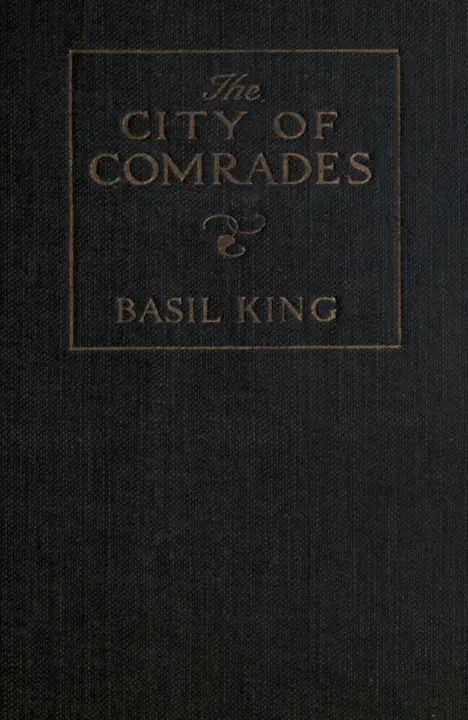
"The City of Comrades" by Basil King is a novel written in the early 20th century. The book delves into the struggles of individuals living on the fringes of society, focusing on complex themes of human connection and redemption. At its center is a discreet but deeply conflicted protagonist, who is drawn into a life of crime while battling his own demons and the expectations of society. The opening of the narrative introduces us to a grim and bustling New York City in June 1913, setting the stage for themes of desperation and the quest for belonging. We meet the protagonist, a nameless man, in the company of Lovey, a disheveled figure suggesting a petty crime involving two wealthy old ladies. As the protagonist wrestles with moral dilemmas, he reflects on his past, revealing a painful history and aspirations cut short by failures and societal rejection. The tone is tense as he contemplates his next move in a city filled with opportunity yet fraught with danger, while Lovey's eagerness contrasts with the protagonist's apprehension. The stage is set for a gripping exploration of the human condition and the profound bonds that form in moments of crisis.
Introduction adapted from the source catalogue; source summaries may be automatically generated.
Free to read · English · 118,845 words · No account needed
MAKE TIME FOR A GOOD BOOK
On by default. Untick to stop anonymous reading totals. Each page counts after 10 seconds in view. How this works.
Anonymous counting is on unless you have switched it off.
“Haven’t we met before?”
Regina Barry said this as she came into the room with her rapid, easy movement and took two or three paces toward me, stopping as abruptly as she entered.
I hung my head, crimsoning slowly.
“Yes.”
“I thought so, though I didn’t recognize you at first. I knew I had some association with you, but it was so vague—”
“Of course.”
“Then I had no idea you were an architect.”
“How could you?”
“You see, meeting you for so short a time—”
“And practically in the dark—”
“I don’t remember that. But I had no chance to ask anything about you. I only hoped you’d come back.”
“Oh, I couldn’t have done that.”
“Why not?”
“I should think you’d understand.”
“I don’t—considering that I asked you particularly.”
“I know you asked me particularly, but anything in life—or death—would have been easier than to obey you.”
“What did I do to frighten you so?”
“Nothing but show me too much mercy.”
“Oh, I didn’t think anything of that.”
“Of what? Of the crime—or of the forgiveness?”
“Of the crime, of course.”
I stepped back from her in amazement.
“You didn’t think anything of—”
“Why, no! I’ve often done the same myself.”
“You? You’ve often done—”
“Of course! Everybody has—at one time or another in their lives. Naturally it doesn’t happen every day—and one wouldn’t want it to. One wouldn’t have anything left in the house if it did; but once in a way—it’s nothing. What astonishes me is that you should have thought of it.”
“But—but you’ve thought of it.”
“Oh, well—that’s different. But please don’t suppose that I’ve thought of it seriously. It simply happened that that evening—” The only sign of embarrassment she gave was in grasping the greenish-goldish veil with her left hand and pulling it round over her bosom. The great eyes, of which the light made one doubtful as to the color, glowed feverishly, and the long scarlet lips threw at me one of their daring, challenging smiles. “Do you want me to be absolutely frank?”
“We began with frankness, didn’t we? Why shouldn’t we keep it up?”
“Well, it happened that that evening I’d broken off my engagement.”
Not to betray all I had learned by my eavesdropping behind the rose-colored hangings, I merely said, “Indeed?”
Your reading position is saved on this browser. Take it to another device with a library code. Reading pages adapt to text, rather than matching a printed edition.
BEHIND THE BOOK
This eBook is for the use of anyone anywhere in the United States and most other parts of the world at no cost and with almost no restrictions whatsoever. You may copy it, give it away or re-use it under the terms of the Project Gutenberg License included with this eBook or online at www.gutenberg.org. If you are not located in the United States, you will have to check the laws of the country where you are located before using this eBook. Read the source licence.
The original source file, including credits and licence, is retained by this library. Request an original-format copy at no charge. Please include the book title and Project Gutenberg identifier #64255.
KEEP YOUR CURIOSITY GOING
Coulson Kernahan

Maurice Baring
Frances Wright
Cécile Tormay

Frederic Jesup Stimson

W. H. P. (William Henry Pope) Jarvis