THE CLASSIC COLLECTION✦The Happy IslesCLASSIC FREE BOOKS
The Happy Isles
Basil King
THE CLASSIC COLLECTION · 1919
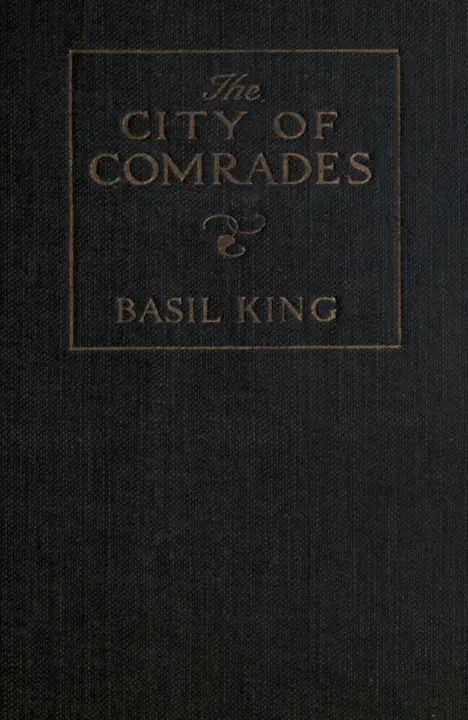
"The City of Comrades" by Basil King is a novel written in the early 20th century. The book delves into the struggles of individuals living on the fringes of society, focusing on complex themes of human connection and redemption. At its center is a discreet but deeply conflicted protagonist, who is drawn into a life of crime while battling his own demons and the expectations of society. The opening of the narrative introduces us to a grim and bustling New York City in June 1913, setting the stage for themes of desperation and the quest for belonging. We meet the protagonist, a nameless man, in the company of Lovey, a disheveled figure suggesting a petty crime involving two wealthy old ladies. As the protagonist wrestles with moral dilemmas, he reflects on his past, revealing a painful history and aspirations cut short by failures and societal rejection. The tone is tense as he contemplates his next move in a city filled with opportunity yet fraught with danger, while Lovey's eagerness contrasts with the protagonist's apprehension. The stage is set for a gripping exploration of the human condition and the profound bonds that form in moments of crisis.
Introduction adapted from the source catalogue; source summaries may be automatically generated.
Free to read · English · 118,845 words · No account needed
MAKE TIME FOR A GOOD BOOK
On by default. Untick to stop anonymous reading totals. Each page counts after 10 seconds in view. How this works.
Anonymous counting is on unless you have switched it off.
But I took comfort in the thought of Pyn. Pyn showed nothing. He was like one of the three holy men who went through Nebuchadnezzar’s furnace—the smell of fire had not passed on him. A heartier, healthier, merrier fellow it would have been difficult to find.
He entered now with the air of authority which belongs to the member of a
club.
“Fellows had their breakfast, Spender?”
Spender was all welcome, of the wistful, yearning kind.
“The men at work is gone; but the guys under restraint is still at table.”
“Mr. Christian not here yet?”
“Never gets here before nine; and it’s not half past seven yet.”
Pyn turned to me. “Say, do you want to go in and feed, or will you wash up first, or go to bed, or what?”
With this large liberty of choice I asked if we could do whatever we liked. It was Spender who explained.
“That’s the rule for new arrivals, unless they’ve got to be put under restraint at once.”
“I don’t want to be put under no restraint,” Lovey declared, indignantly.
“That’ll be all right,” Spender replied, kindly, “unless there’s vermin—”
Lovey jumped.
“See here, now! Don’t you begin no such immodest talk to me.”
“There, there, Lovikins,” Pyn broke in. “Spender don’t mean no harm. All sorts have to come to a place like this. But when we see a gentleman we treat him like a gentleman. All Spender wants to know is this, Is it eats for you first, or a bath?”
“And I don’t want no bath,” Lovey declared, proudly.
“Then it’ll be eats. Quick march! I’ve got to beat it back to my job.”
Pyn’s introduction of us to those already in the dining-room was simple.
“This is Lovey. This is Slim. You guys’ll make ’em feel at home.”
Making us feel at home consisted in moving along the table so as to give us room. In words there was no response to Pyn, who withdrew at once, nor was there more than a cursory inspection of us with the eyes. Whatever was kindly was in the atmosphere, and that was perceptible.
As we sat before two empty places, one of our new companions rose, went to the dresser behind us, and brought us each a plate, a spoon, a knife, and a cup and saucer. A big man went to the kitchen door and in a voice like thunder called out, “Mouse!”
Your reading position is saved on this browser. Take it to another device with a library code. Reading pages adapt to text, rather than matching a printed edition.
BEHIND THE BOOK
This eBook is for the use of anyone anywhere in the United States and most other parts of the world at no cost and with almost no restrictions whatsoever. You may copy it, give it away or re-use it under the terms of the Project Gutenberg License included with this eBook or online at www.gutenberg.org. If you are not located in the United States, you will have to check the laws of the country where you are located before using this eBook. Read the source licence.
The original source file, including credits and licence, is retained by this library. Request an original-format copy at no charge. Please include the book title and Project Gutenberg identifier #64255.
KEEP YOUR CURIOSITY GOING
Coulson Kernahan

Maurice Baring
Frances Wright
Cécile Tormay

Frederic Jesup Stimson

W. H. P. (William Henry Pope) Jarvis