THE CLASSIC COLLECTION✦The Happy IslesCLASSIC FREE BOOKS
The Happy Isles
Basil King
THE CLASSIC COLLECTION · 1919
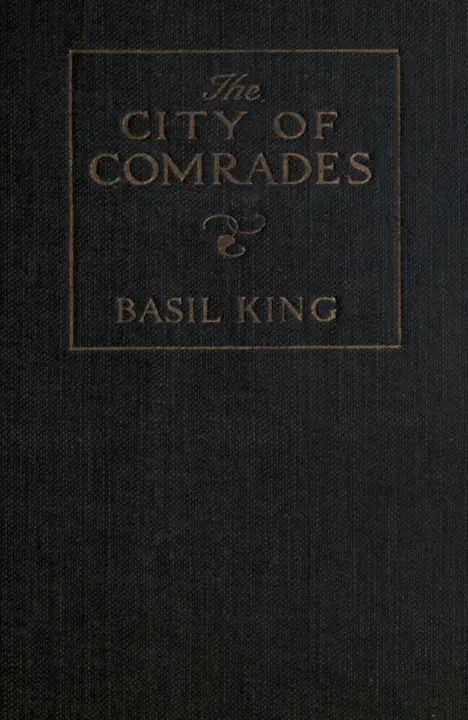
"The City of Comrades" by Basil King is a novel written in the early 20th century. The book delves into the struggles of individuals living on the fringes of society, focusing on complex themes of human connection and redemption. At its center is a discreet but deeply conflicted protagonist, who is drawn into a life of crime while battling his own demons and the expectations of society. The opening of the narrative introduces us to a grim and bustling New York City in June 1913, setting the stage for themes of desperation and the quest for belonging. We meet the protagonist, a nameless man, in the company of Lovey, a disheveled figure suggesting a petty crime involving two wealthy old ladies. As the protagonist wrestles with moral dilemmas, he reflects on his past, revealing a painful history and aspirations cut short by failures and societal rejection. The tone is tense as he contemplates his next move in a city filled with opportunity yet fraught with danger, while Lovey's eagerness contrasts with the protagonist's apprehension. The stage is set for a gripping exploration of the human condition and the profound bonds that form in moments of crisis.
Introduction adapted from the source catalogue; source summaries may be automatically generated.
Free to read · English · 118,845 words · No account needed
MAKE TIME FOR A GOOD BOOK
On by default. Untick to stop anonymous reading totals. Each page counts after 10 seconds in view. How this works.
Anonymous counting is on unless you have switched it off.
I sat and said nothing because I knew it was what they liked. They liked the companionship, as babies and dogs like companionship, though their aching minds could not have responded to talk. There was no embarrassment in this silence, no expectation. It was a stupefied pleasure to them to stare at the uniform, to speculate inchoately as to the patch on my eye; and that little was enough.
Nobody read; nobody smoked. I neither smoked nor read; I only sat as in a Quaker meeting, waiting for the first movement of the spirit.
It came when a husky voice, that seemed to travel from across a gulf, said, without any particular reason, “I’m Spud.”
I turned to my right, to see a good-looking, brown-eyed fellow, of perhaps twenty-eight, trying to reach me, as it were, with his pathetic, despairing gaze.
I knew what was behind this self-introduction. The lost identity was trying to find itself; the man who was worthy of something was doing his utmost to get out of the abyss by reaching up his hands to the man who had got out.
“All right, Spud,” I said, heartily. “Put it there! We’re going to be
friends.”
Silence for another five minutes was broken when a high voice recited in a sort of litany, “I’m Jimmy McKeever, traveler for Grubbe & Oates, gents’ furnishers.”
Sharp-faced, wiry, catlike, agile, tough as wire, I could see this fellow creeping out into the darkness of No Man’s Land, and creeping back with information of the enemy.
I broke in on the litany to say: “Good for you, Jimmy, old boy! Glad to know you. Let’s shake hands.”
He sprang from his seat on the outskirts of the group, but before he could reach me a great, brawny paw was stretched forward by a blue-eyed young Hercules sitting nearer me, which grasped my fingers as if in a vise. There was then a scramble of handshaking, each of the bunch asserting his claim for recognition, like very small children. The older man alone held aloof, sitting by himself, scowling, hard-faced, cross-legged, kicking out a big foot with a rapid, nervous rhythm.
It was he who, when the handshaking was over, snarled out the question, “What’s the matter with your eye?”
I told them the story of how I lost it.
I told it as simply as I could, while working in a fair share of the strong color which I hoped would arrest their attention.
Your reading position is saved on this browser. Take it to another device with a library code. Reading pages adapt to text, rather than matching a printed edition.
BEHIND THE BOOK
This eBook is for the use of anyone anywhere in the United States and most other parts of the world at no cost and with almost no restrictions whatsoever. You may copy it, give it away or re-use it under the terms of the Project Gutenberg License included with this eBook or online at www.gutenberg.org. If you are not located in the United States, you will have to check the laws of the country where you are located before using this eBook. Read the source licence.
The original source file, including credits and licence, is retained by this library. Request an original-format copy at no charge. Please include the book title and Project Gutenberg identifier #64255.
KEEP YOUR CURIOSITY GOING
Coulson Kernahan

Maurice Baring
Frances Wright
Cécile Tormay

Frederic Jesup Stimson

W. H. P. (William Henry Pope) Jarvis