THE CLASSIC COLLECTION✦The Happy IslesCLASSIC FREE BOOKS
The Happy Isles
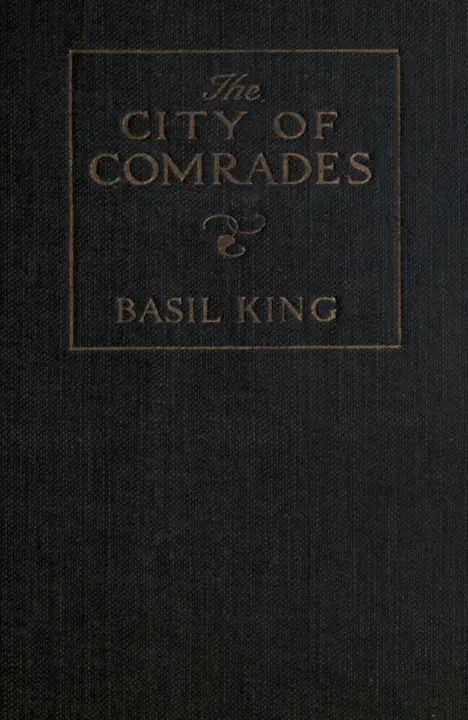
Basil King
THE CLASSIC COLLECTION · 1919
"The City of Comrades" by Basil King is a novel written in the early 20th century. The book delves into the struggles of individuals living on the fringes of society, focusing on complex themes of human connection and redemption. At its center is a discreet but deeply conflicted protagonist, who is drawn into a life of crime while battling his own demons and the expectations of society. The opening of the narrative introduces us to a grim and bustling New York City in June 1913, setting the stage for themes of desperation and the quest for belonging. We meet the protagonist, a nameless man, in the company of Lovey, a disheveled figure suggesting a petty crime involving two wealthy old ladies. As the protagonist wrestles with moral dilemmas, he reflects on his past, revealing a painful history and aspirations cut short by failures and societal rejection. The tone is tense as he contemplates his next move in a city filled with opportunity yet fraught with danger, while Lovey's eagerness contrasts with the protagonist's apprehension. The stage is set for a gripping exploration of the human condition and the profound bonds that form in moments of crisis.
Introduction adapted from the source catalogue; source summaries may be automatically generated.
Free to read · English · 118,845 words · No account needed
MAKE TIME FOR A GOOD BOOK
On by default. Untick to stop anonymous reading totals. Each page counts after 10 seconds in view. How this works.
Anonymous counting is on unless you have switched it off.
Now and then, however, she came out of it with some brief remark which gave me a lead and perhaps made me hope. One such occasion was at the theater. Cantyre had not put me next to her, but there was an entr’acte when I found his place empty and slipped into it.
“And how are events taking their course?” I asked, with a semblance of
speaking cheerily.
“I’m waiting to see.”
“Still?”
“Still.”
“And how long is that to go on?”
“Till events have shaped their course in a way that will tell me what to
do.”
“How shall you know that?”
“How does the twig know when the current takes it from the spot where it has been caught and carries it down-stream?”
“Oh, but you’ve got intelligence.”
“Any intelligence I’ve got implores me to keep on waiting.”
“So that you’re not going to be married right away?”
“I shall not be married till I see it’s the obvious thing to do.”
“Not even to me?”
“That’s different. I’ve already told you—”
“That if I give the word— But don’t you see I can’t give it?”
“Exactly. You’re waiting for the sign as much as I am.”
“What sign?”
“We shall recognize it when the time comes.”
“Where will it come from?”
“Right up out of life; I don’t know where, nor how.”
“Who’ll give it to us?”
She had only time, as Cantyre returned to his seat, to send me a long, slantwise look, with the underscored words, “You know!”
Another time was in the regrouping of guests, after Annette’s luncheon. Finding myself beside her at a window, I asked the plain question, “Are you engaged to Cantyre?”
“I’m just where I was when I told you about it on board ship. He hasn’t asked me to be more definite.”
“Is he just where he was?”
“I think he is, in that—in that he expects me to marry him.”
“And you leave him under that impression?”
“I don’t know what else to do—till I get the sign.”
“You’re still looking for that?”
“Yes. Aren’t you?”
“Not that I’m aware of.”
“Oh, but you are, whether you’re aware of it or not.”
“And suppose he urges you before the sign comes?”
“I shall still wait.”
“And suppose I urged you?”
“I’d take that as the sign.”
Your reading position is saved on this browser. Take it to another device with a library code. Reading pages adapt to text, rather than matching a printed edition.
BEHIND THE BOOK
This eBook is for the use of anyone anywhere in the United States and most other parts of the world at no cost and with almost no restrictions whatsoever. You may copy it, give it away or re-use it under the terms of the Project Gutenberg License included with this eBook or online at www.gutenberg.org. If you are not located in the United States, you will have to check the laws of the country where you are located before using this eBook. Read the source licence.
The original source file, including credits and licence, is retained by this library. Request an original-format copy at no charge. Please include the book title and Project Gutenberg identifier #64255.
KEEP YOUR CURIOSITY GOING
Coulson Kernahan

Maurice Baring
Frances Wright
Cécile Tormay

Frederic Jesup Stimson

W. H. P. (William Henry Pope) Jarvis