THE CLASSIC COLLECTION✦A dead man’s diaryCLASSIC FREE BOOKS
A dead man’s diary
Coulson Kernahan
THE CLASSIC COLLECTION · 1909
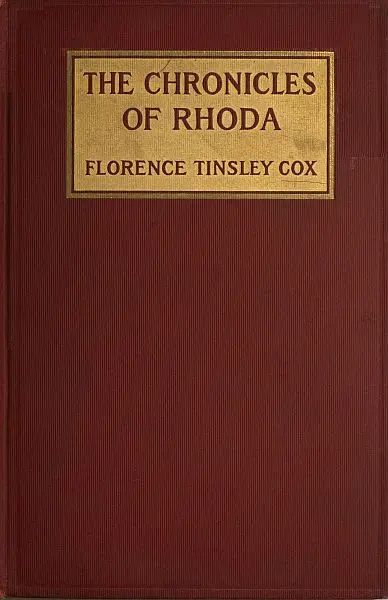
"The Chronicles of Rhoda" by Florence Tinsley Cox is a novel written in the early 20th century. The narrative centers around a young girl named Rhoda Harcourt, exploring her imaginative thoughts, her relationships with her family, and her experiences as she navigates childhood. The book delves into themes of innocence, love, and the complexities of growing up, inviting readers into the whimsical and sometimes tumultuous world of Rhoda. The opening of the novel introduces Rhoda's family life and the special bond she shares with her grandmother. As Rhoda interacts with her family, she showcases her vivid imagination, weaving stories and adventures that reflect her childlike perspective. We see Rhoda grapple with feelings of jealousy upon the arrival of new siblings, the challenge of defining her identity, and her unique friendship with her father, which sets the stage for her emotional journey throughout the book. As her family dynamics shift with the introduction of twins, Rhoda's imaginative lens offers both humor and poignancy as she learns about sibling rivalry, love, and the complexities of family life.
Introduction adapted from the source catalogue; source summaries may be automatically generated.
Free to read · English · 38,282 words · No account needed
MAKE TIME FOR A GOOD BOOK
On by default. Untick to stop anonymous reading totals. Each page counts after 10 seconds in view. How this works.
Anonymous counting is on unless you have switched it off.
Dick and I knew lots and lots of hymns. We always learned them on Sundays to please our grandmother. We stood closer together, and sang with full hearts, our voices rising up, clearly, shrilly, with childish emphasis:
"There's a Home for little children,
Above the bright blue sky,
Where Jesus reigns in glory,
A Home of peace and joy;
No home on earth is like it,
Nor can with it compare,
For everyone is happy,
Nor can be happier there."
There was a sound of weeping in the room, but we sang on, earnestly, line after line, just as we had played.
Suddenly a hand was laid on each of our heads, and we looked up to see an old priest standing by us. He motioned for us to be silent, and went on to the corner where the child lay on the bed with the woman on her knees beside her, her face buried in the tiny dress.
"My daughter?" he said, inquiringly.
The pretty gay head came up with a start. The red cheeks were disfigured
with weeping.
"She's gone, father!" the woman cried.
She dragged herself around, still on her knees, and laid her head
against his hand.
"I've tried so hard to be good, father. Ever since you talked to me I've tried and I've tried. You know I have. But it's no use. No use. Everything goes wrong with me. And now my Amy's gone!"
She burst into tears again, her words becoming incoherent from grief, and sobbed wildly, her head falling back against the bed.
"Where did these children come from?" the priest demanded, sternly.
She explained through her tears.
"I brought them here for Amy to play with. I thought-- You know how they all look down on her here, father. She never had a playmate. I thought if she were happier, if there were little friends of her own age about her, that I might coax her back again, get her to stay with me for awhile. I saw the two children standing at their gate. I only borrowed them. Sure, I didn't mean them any harm."
Her voice broke off again into sobs.
It was Dick who created a diversion at this moment. He had been hunting through his pockets, and now he brought out all his precious things,--the knob off the machine drawer, the stopper of the cologne bottle, the ten missionary cents that were to educate the native child in India, even the Waterbury watch,--and laid them in a little pile on the bed. He pulled the old priest's hand to attract his attention.
"They're for her," he explained, with a nod at the bed.
Your reading position is saved on this browser. Take it to another device with a library code. Reading pages adapt to text, rather than matching a printed edition.
BEHIND THE BOOK
This eBook is for the use of anyone anywhere in the United States and most other parts of the world at no cost and with almost no restrictions whatsoever. You may copy it, give it away or re-use it under the terms of the Project Gutenberg License included with this eBook or online at www.gutenberg.org. If you are not located in the United States, you will have to check the laws of the country where you are located before using this eBook. Read the source licence.
The original source file, including credits and licence, is retained by this library. Request an original-format copy at no charge. Please include the book title and Project Gutenberg identifier #40526.
KEEP YOUR CURIOSITY GOING
Coulson Kernahan

Maurice Baring
Frances Wright
Cécile Tormay

Frederic Jesup Stimson

W. H. P. (William Henry Pope) Jarvis