THE CLASSIC COLLECTION✦A dead man’s diaryCLASSIC FREE BOOKS
A dead man’s diary
Coulson Kernahan
THE CLASSIC COLLECTION · 1909
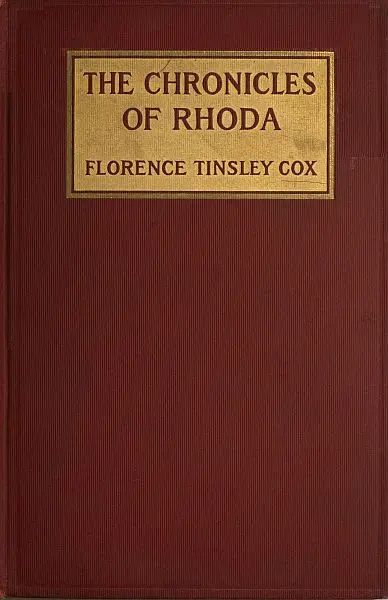
"The Chronicles of Rhoda" by Florence Tinsley Cox is a novel written in the early 20th century. The narrative centers around a young girl named Rhoda Harcourt, exploring her imaginative thoughts, her relationships with her family, and her experiences as she navigates childhood. The book delves into themes of innocence, love, and the complexities of growing up, inviting readers into the whimsical and sometimes tumultuous world of Rhoda. The opening of the novel introduces Rhoda's family life and the special bond she shares with her grandmother. As Rhoda interacts with her family, she showcases her vivid imagination, weaving stories and adventures that reflect her childlike perspective. We see Rhoda grapple with feelings of jealousy upon the arrival of new siblings, the challenge of defining her identity, and her unique friendship with her father, which sets the stage for her emotional journey throughout the book. As her family dynamics shift with the introduction of twins, Rhoda's imaginative lens offers both humor and poignancy as she learns about sibling rivalry, love, and the complexities of family life.
Introduction adapted from the source catalogue; source summaries may be automatically generated.
Free to read · English · 38,282 words · No account needed
MAKE TIME FOR A GOOD BOOK
On by default. Untick to stop anonymous reading totals. Each page counts after 10 seconds in view. How this works.
Anonymous counting is on unless you have switched it off.
It was very different on the other side of the wall from our side. There were no flowers there, and no vines. There was a street with small, mean houses, and great piles of clam shells, and a goat or two running about at a distance, and some very dirty ducks going home in single file. Away down the square there was a great red building, with smoke pouring out of its many chimneys, and here and there walking about the street, and standing at the doors, were the black people--not black in any true sense of the word, but grimed with the smut of those who labor in iron works.
It was a dreadful place. We stood outside the gate, flattened against the fence, looking into the street, and afraid to venture any farther.
Almost, however, in the first moment we found a friend. She was quite a small woman, with an anxious expression, and she gazed at us in a hungry way. She had an old plaid shawl drawn loosely over her head, and a little bundle of shoe-strings dangled from her hand. She had the prettiest, brightest red cheeks that I had ever seen, and her hair was a wonderful yellow color, like a doll's. But somehow there was something about her that I did not quite like.
She had been walking along the street, but when she saw us she stopped
suddenly.
"How do you do, ma'am?" she said. "And how do you do, master?"
We clung together a little tighter, and answered her politely.
"Pretty well, I thank you," we said in a chorus, just as our mother had taught us to do to strangers.
"Wouldn't you like to take a little walk with me?" she asked, pleasantly. "Just a block or two? To see my house? And my little girl?"
We were not dressed to go visiting. I had on a brown gingham apron to play in, and Dick had on one, too, over his knickerbockers. I began to tell her about it, but she cut me short.
"As if that mattered!" she cried. "My God! And my baby! Come, dears. Come! My little girl is sick. It would be a Christian charity to come to see her."
She looked at us almost beseechingly.
"Oh, what can I say to get them to come!" she exclaimed, in a piteous
fashion.
Dick unclasped my hand and went up to her sturdily.
"I'm not afraid," he said. "I'll go with you. Come, sister."
Of course if Dick went I had to go, too, for he was the smaller. I started with a reluctant step.
"That's the little lady!" the woman cried, exultingly.
Your reading position is saved on this browser. Take it to another device with a library code. Reading pages adapt to text, rather than matching a printed edition.
BEHIND THE BOOK
This eBook is for the use of anyone anywhere in the United States and most other parts of the world at no cost and with almost no restrictions whatsoever. You may copy it, give it away or re-use it under the terms of the Project Gutenberg License included with this eBook or online at www.gutenberg.org. If you are not located in the United States, you will have to check the laws of the country where you are located before using this eBook. Read the source licence.
The original source file, including credits and licence, is retained by this library. Request an original-format copy at no charge. Please include the book title and Project Gutenberg identifier #40526.
KEEP YOUR CURIOSITY GOING
Coulson Kernahan

Maurice Baring
Frances Wright
Cécile Tormay

Frederic Jesup Stimson

W. H. P. (William Henry Pope) Jarvis