THE CLASSIC COLLECTION✦A dead man’s diaryCLASSIC FREE BOOKS
A dead man’s diary
Coulson Kernahan
THE CLASSIC COLLECTION · 1909
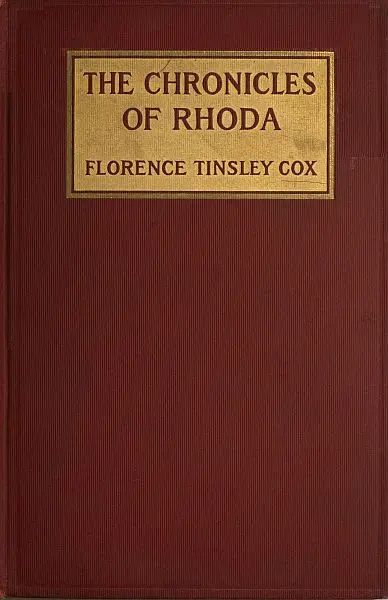
"The Chronicles of Rhoda" by Florence Tinsley Cox is a novel written in the early 20th century. The narrative centers around a young girl named Rhoda Harcourt, exploring her imaginative thoughts, her relationships with her family, and her experiences as she navigates childhood. The book delves into themes of innocence, love, and the complexities of growing up, inviting readers into the whimsical and sometimes tumultuous world of Rhoda. The opening of the novel introduces Rhoda's family life and the special bond she shares with her grandmother. As Rhoda interacts with her family, she showcases her vivid imagination, weaving stories and adventures that reflect her childlike perspective. We see Rhoda grapple with feelings of jealousy upon the arrival of new siblings, the challenge of defining her identity, and her unique friendship with her father, which sets the stage for her emotional journey throughout the book. As her family dynamics shift with the introduction of twins, Rhoda's imaginative lens offers both humor and poignancy as she learns about sibling rivalry, love, and the complexities of family life.
Introduction adapted from the source catalogue; source summaries may be automatically generated.
Free to read · English · 38,282 words · No account needed
MAKE TIME FOR A GOOD BOOK
On by default. Untick to stop anonymous reading totals. Each page counts after 10 seconds in view. How this works.
Anonymous counting is on unless you have switched it off.
He picked up one of his little shoes by the side of the bed, and threw it at Trixie. There was an immediate wail from the next crib. Dick was always a good shot.
"Oh, children, children!" my mother cried, in despair. "Dick, go to sleep this moment. Trixie, Trixie, dear, you are not really hurt."
"But her feelings are, mother," I protested.
I knew that the littlest things hurt just as much as the big.
My mother settled down, disconsolately, in her rocking chair, with a small, weeping burden in her arms, and rocked and sang.
"This is a dreadful family," she said, in between verses. "There is
always a fuss."
As for Dick he made one more triumphant discovery before he finally
subsided for the night.
"Girls are soft things," he declared, jealously, from his crib. "They
are! They are!"
"Dick!" my father called from downstairs, "you stop that!"
Which settled the subject for the time being.
There was just one person in the family who was not upset, and that was my grandmother Harcourt. She read her Bible as usual, and watched us with grave eyes. She watched grandmother Lawrence buying pretty dresses by the dozen for Auntie May, and scolding violently, because they were not worn, and she watched granddad going about, with a perplexed face and a heavy heart, and even my own father laboriously concocting funny stories at which nobody laughed. When grandmother spoke her remarks were oracular.
"Those whom God hath joined together let no man put asunder," she said,
with dignity.
And one day when things were at their very worst, and Auntie May had come to our house, "to cry in peace," as she said, grandmother Harcourt laid a small white note in her hand.
"Go out in the garden, dear," she said, impressively. "Behind the lilac
bush. Quick!"
Away flew Auntie May, and I after her.
Now behind the lilac bush was my own particular domain. It was where I made my little mudpies in beautiful clam shells, and once I had had a caterpillar colony there, all pretty brown and yellow ones, and some few with neat tufted backs and red whiskers. And Jeremiah John, the wandering turtle, lived there. But no grown-up person ever ventured behind the lilac bush, so it was a surprise to find Burton Raymond, with cobwebs on his coat and a pale face, waiting for us.
"You!" Auntie May cried.
She said it almost in a shriek. She put her arms about him and clung to
him.
"You!" she said again, with infinite content.
Your reading position is saved on this browser. Take it to another device with a library code. Reading pages adapt to text, rather than matching a printed edition.
BEHIND THE BOOK
This eBook is for the use of anyone anywhere in the United States and most other parts of the world at no cost and with almost no restrictions whatsoever. You may copy it, give it away or re-use it under the terms of the Project Gutenberg License included with this eBook or online at www.gutenberg.org. If you are not located in the United States, you will have to check the laws of the country where you are located before using this eBook. Read the source licence.
The original source file, including credits and licence, is retained by this library. Request an original-format copy at no charge. Please include the book title and Project Gutenberg identifier #40526.
KEEP YOUR CURIOSITY GOING
Coulson Kernahan

Maurice Baring
Frances Wright
Cécile Tormay

Frederic Jesup Stimson

W. H. P. (William Henry Pope) Jarvis