THE CLASSIC COLLECTION✦A dead man’s diaryCLASSIC FREE BOOKS
A dead man’s diary
Coulson Kernahan
THE CLASSIC COLLECTION · 1909
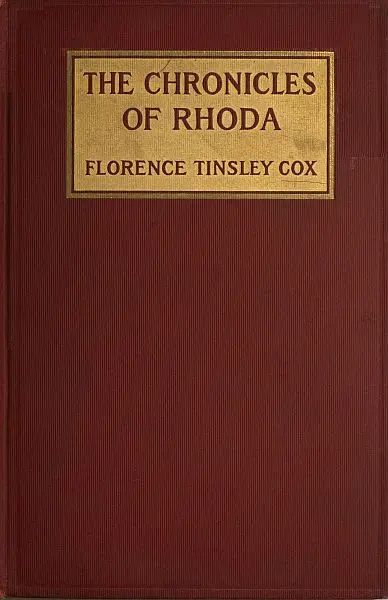
"The Chronicles of Rhoda" by Florence Tinsley Cox is a novel written in the early 20th century. The narrative centers around a young girl named Rhoda Harcourt, exploring her imaginative thoughts, her relationships with her family, and her experiences as she navigates childhood. The book delves into themes of innocence, love, and the complexities of growing up, inviting readers into the whimsical and sometimes tumultuous world of Rhoda. The opening of the novel introduces Rhoda's family life and the special bond she shares with her grandmother. As Rhoda interacts with her family, she showcases her vivid imagination, weaving stories and adventures that reflect her childlike perspective. We see Rhoda grapple with feelings of jealousy upon the arrival of new siblings, the challenge of defining her identity, and her unique friendship with her father, which sets the stage for her emotional journey throughout the book. As her family dynamics shift with the introduction of twins, Rhoda's imaginative lens offers both humor and poignancy as she learns about sibling rivalry, love, and the complexities of family life.
Introduction adapted from the source catalogue; source summaries may be automatically generated.
Free to read · English · 38,282 words · No account needed
MAKE TIME FOR A GOOD BOOK
On by default. Untick to stop anonymous reading totals. Each page counts after 10 seconds in view. How this works.
Anonymous counting is on unless you have switched it off.
It was not hard to dance. Somehow it was more fun than it had been at home with Auntie May. I always remembered to give my right hand first in the ladies' chain, and when I met my partner I courtesied to him every time. I did not forget a single thing! The music was very lively, and everybody was smiling, even the grown-up people at the other end of the room who danced and romped among themselves. I thought that I should like to go on forever, back and forth, and in and out in the ladies' chain. I wished that the music would never stop, but it did, at last, with a sudden chord, and we were all ready for something else.
It was a game this time, a strange, new game called "Post-office." It began by a little girl leaving the room, mysteriously, and calling a little boy out into the hall to receive a letter.
"There's a letter in the post-office for Davie Williams," she cried, in a shrill, high voice that sounded frightened.
All the other little girls laughed. Davie Williams grew very red in the face, but he went out for his letter, and closed the door carefully behind him.
I wondered why he stayed so long, and what they could possibly be doing behind the door. It was very exciting. Suppose, just suppose, that there should be a letter for me! More little girls went out, and more little boys. The girls tossed their heads, and the boys went quickly, as though to get it over. One boy called out another boy instead of a little girl, and was laughed at. I did not think that I should like to be laughed at. Then Theodore Otway went out and I heard my name.
He was waiting for me with his hands in his pockets.
"Hello," he said, in a diffident way.
"Hello," I answered, shyly fingering my hair.
I looked about for the wonderful something which I had come to see. There was nothing, only the hall and Theodore Otway still with his hands in his pockets. Strange to say he seemed embarrassed. He fidgeted. He talked in jerks.
"I saw you in church," he said, suddenly.
I nodded at him.
"I saw you, too," I confessed, with a shamefaced smile.
He came a step nearer, and hesitated.
"Say," he said, "I don't live in this house when I'm home."
"No?" I answered, inquiringly.
"No," he replied, seriously.
We were both silent. There did not seem to be anything more to talk about. Still it was rather nice out in the hall.
Somebody rattled the knob. Evidently our turn was over.
Your reading position is saved on this browser. Take it to another device with a library code. Reading pages adapt to text, rather than matching a printed edition.
BEHIND THE BOOK
This eBook is for the use of anyone anywhere in the United States and most other parts of the world at no cost and with almost no restrictions whatsoever. You may copy it, give it away or re-use it under the terms of the Project Gutenberg License included with this eBook or online at www.gutenberg.org. If you are not located in the United States, you will have to check the laws of the country where you are located before using this eBook. Read the source licence.
The original source file, including credits and licence, is retained by this library. Request an original-format copy at no charge. Please include the book title and Project Gutenberg identifier #40526.
KEEP YOUR CURIOSITY GOING
Coulson Kernahan

Maurice Baring
Frances Wright
Cécile Tormay

Frederic Jesup Stimson

W. H. P. (William Henry Pope) Jarvis